Inkaso in Banking: How It Works and Its Benefits
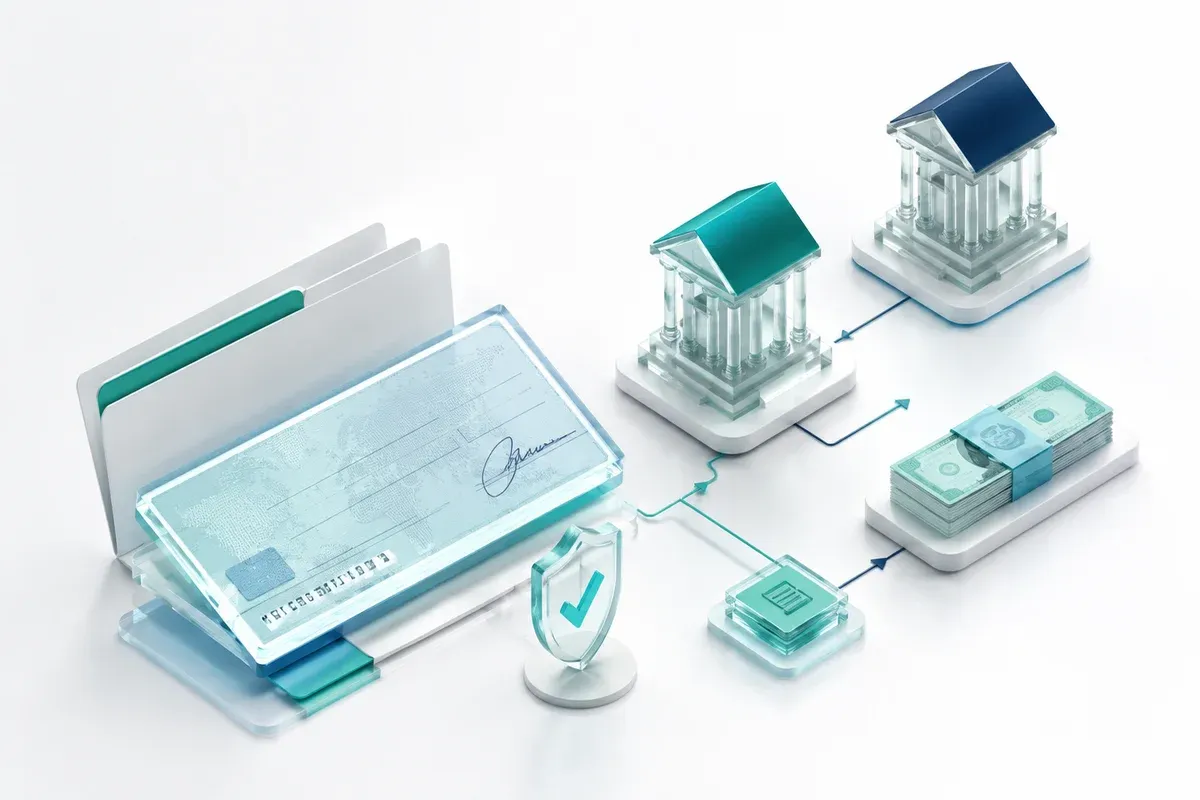
Inkaso is a banking collection service where a bank acts on behalf of a customer to collect payment from cheques, bilyet giro, bills of exchange, or trade documents. The collecting bank forwards the instrument to the paying bank, and successful payment is credited to the customer's account.
This service is still widely used in Indonesia for business transactions and cross-border trade. However, faster payment rails and crypto payment options are changing how businesses think about settlement speed and cost. This article explains
Key Points
-
Service definition: Inkaso is a bank collection service used to collect payment from cheques, bilyet giro, bills of exchange, or trade documents.
-
Layered process: Inkaso involves a remitting bank, a paying bank, and the customer, with settlement usually taking 1-3 business days.
-
Main strength: Inkaso provides a clear audit trail and formal documentation for medium-value business deals.
-
Core risks: Unpaid cheques, stamp duty fees, and document rejection are the main risks to monitor.
-
Modern alternative: BI-FAST transfers and crypto payments are faster and often cheaper than inkaso.
What Is Inkaso in Banking?
Inkaso falls under bank collection services. A customer submits a cheque, bilyet giro, bill of exchange, or trade document to a bank, and the bank forwards it to the party that must pay. According to the Uniform Rules for Collections (URC 522) issued by the International Chamber of Commerce (ICC) since 1995, this mechanism is called a bank collection and works for both domestic and cross-border transactions.
The instruments that can be collected through inkaso include:
• Cheques and bilyet giro: Payment instruments issued by account holders and cleared through the paying bank.
• Bills of exchange: Written orders requiring the drawee to pay a specified amount.
• Trade documents: Delivery notes, invoices, and customs documents attached to export transactions.
• Other financial instruments: Instruments that can be settled through the clearing system.
How Inkaso Works from Submission to Settlement
The process resembles a layered clearing flow. Bank Indonesia only runs clearing mechanisms on business days, so domestic settlement usually takes 1-3 business days.
1. Submit the instrument to your bank: Hand the cheque, bilyet giro, or bill of exchange to the remitting bank.
2. The bank forwards the claim: The remitting bank sends the instrument to the paying bank through clearing.
3. The paying bank verifies: The destination bank checks funds and document validity.
4. Funds are returned: The paying bank sends the money to the remitting bank for crediting.
5. Confirmation or return: You receive a success notice, or the instrument is returned if funds are unavailable.
Note that this is not the same as a direct bank deposit. Modern services like bank deposit offer simpler funding flows but still require KYC and verification.
Main Functions of Inkaso for Businesses
Businesses choose inkaso for document certainty and formal transaction records, not for speed.
• Payment verification: The bank confirms that the claim arrives through an official channel, reducing the risk of fake payments.
• Transaction documentation: Every instrument is recorded and can be used as evidence in a dispute.
• Intercity collections: Companies can collect payments from other cities without opening a local branch.
• International trade support: Documentary inkaso lets buyers receive customs documents after payment is made.
Benefits of Inkaso for Bank Customers
Inkaso is most useful when you need document certainty rather than instant settlement.
• Lower cost: Bank commissions are usually cheaper than opening a letter of credit.
• Transaction safety: The bank does not release payment before the instrument and documents are verified.
• Complete audit trail: Documents are stored in the banking system and easy to trace.
• Flexible amounts: This service suits medium-value invoices that do not demand real-time settlement.
For comparison, each crypto type has different speed and risk profiles. You need to match the instrument with your transaction or investment needs.
Risks and Limitations of Inkaso
Despite its formal looks, inkaso still carries risks that can hurt you if left unmonitored.
• Insufficient funds risk: A buyer can issue a cheque without enough balance, causing the payment to fail.
Example: a new buyer provides a cheque, but the account has no funds during clearing.
Mitigation: check the buyer's reputation and request account confirmation.
• Delay risk: Inkaso depends on clearing hours and business days.
Example: an instrument submitted on Friday afternoon is not credited until Monday or Tuesday.
Mitigation: use BI-FAST for time-sensitive payments.
• Extra costs: Bank commissions, stamp duty, and instrument fees can add up.
Example: cheques and bilyet giro require a Rp10,000 stamp duty under Indonesian Stamp Duty Act No. 10 of 2020.
Mitigation: ask for a detailed fee breakdown before starting.
• Document rejection risk: In documentary inkaso, mismatched documents can make the buyer refuse payment.
Example: invoice and packing list are inconsistent.
Mitigation: review all documents carefully before sending them to the bank.
The mindset for managing these risks is similar to trading discipline. You can learn from crypto trading tips to build better risk management habits.
Inkaso vs Bank Transfer vs Crypto Payment
The best comparison comes from settlement time, cost, and reach. For transactions that need fast execution, you can use Spot Trade, while formal business transactions still rely on inkaso.
| Aspect | Inkaso | BI-FAST Transfer | Crypto Payment |
|---|---|---|---|
| Settlement Time | 1–3 business days | Real-time 24/7 | Seconds to minutes |
| Cost | Commission, stamp duty, instrument fee | Around Rp2,500 cap per transaction | Network fee depends on blockchain |
| Reach | Domestic and international | Domestic | Cross-border without intermediary bank |
| Default Risk | Unpaid cheque or rejected document | Low | Asset volatility and regulation |
| Best For | Businesses with complete documentation | Daily transfers | Cross-border payments and digital users |
According to Bank Indonesia, BI-FAST launched in December 2021 and operates 24/7 with a regulated fee cap of around Rp2,500 per transaction. Crypto payments settle on blockchain networks within minutes. According to CoinGecko data from early 2026, the stablecoin market was estimated above $200 billion, showing stronger demand for fast digital settlement.
Simple Case Examples
Here are two practical contexts where inkaso is used.
1. Domestic collection: CV Mekar sells goods to PT Sumber Jaya and receives a bilyet giro. The bank forwards the instrument, and CV Mekar receives the money after clearing, usually within 1-2 business days.
2. Export documentary collection: PT Kopi Nusantara ships coffee to Singapore. The bank sends customs documents to the buyer's bank, the buyer pays before documents are released, and the exporter has more protection.
Checklist for Choosing a Collection or Payment Service
Use this checklist before deciding between inkaso and another payment method.
1. Check bank regulation: Make sure the service uses Bank Indonesia's official clearing or transfer systems.
2. Calculate total costs: Compare inkaso commission, stamp duty, and digital transfer fees.
3. Match settlement time: Use inkaso only when payment is not time-sensitive.
4. Evaluate the counterparty: Check the buyer's reputation before accepting a cheque or bilyet giro.
5. Consider digital options: Use crypto payment or real-time transfer for cross-border settlements.
6. Keep full records: Store instrument receipts, bank confirmations, and invoice records.
To understand deposit and transaction flows, you can follow the Mobee tutorial.
Conclusion
Inkaso remains a reliable collection service for document-based transactions and formal trade. However, its speed and cost are less efficient than real-time transfers and crypto payments. The right choice depends on time, cost, and risk profile. For modern business needs, combine traditional bank services with digital instruments so you stay flexible.
FAQ
Inkaso is a bank collection service where the bank collects payment on behalf of a customer using cheques, bilyet giro, bills of exchange, or trade documents. The bank forwards the instrument to the paying bank, then credits the collected amount to the customer's account. If funds are unavailable, the bank returns the instrument.
Domestic inkaso usually takes 1–3 business days because clearing only runs on business days. International collection can take longer because correspondent banks are involved. If timing matters, BI-FAST transfers or crypto payments settle faster.
Inkaso is a document-based collection process that relies on clearing and verification, while a bank transfer moves funds directly between accounts. BI-FAST transfers run 24/7 with a regulated fee cap, while inkaso often involves commission fees, stamp duty, and longer clearing time.
Inkaso is safe because it runs through regulated banking channels, but it still carries risks such as unpaid cheques, rejected documents, and delayed clearing. Reduce risk by checking the buyer's reputation, confirming available funds, and keeping all transfer documents.
Yes, inkaso remains useful for formal trade transactions that need documented proof and legal certainty. For cross-border payments that need speed, crypto payments can settle in minutes with network fees. Choose based on cost, time, and your risk tolerance.
Start with Mobee
Mobee is a digital asset platform licensed and supervised by OJK, helping users explore crypto and investment products with clearer access and practical learning. Start your investment journey through Mobee and choose products that match your goals and risk profile.
 Direct market access from the app
 Start exploring digital assets with Mobee
Track the market, learn about digital assets, and start trading more conveniently with the Mobee App.
Mobee is licensed and supervised by the OJK. Not a solicitation to buy or sell any asset.