Launchpads and LPs: The Engines Behind the Meme Coin Season
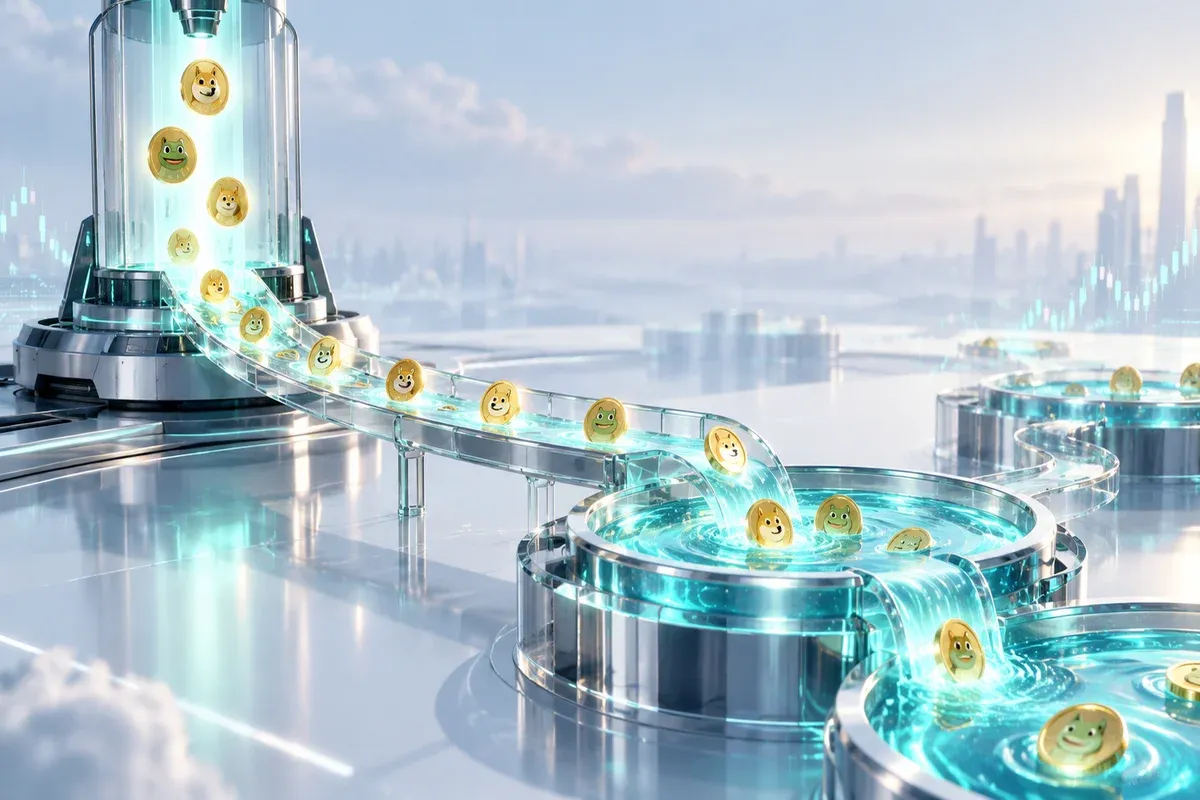
This is all made possible by two things working in tandem: launchpad, where tokens are created and begin trading, and liquidity provider (LP), the party that provides the funds to ensure trading can actually take place. This article breaks down how both work, along with the platforms currently gaining traction.
Key Takeaways
- Launchpads eliminate the need for coding. Anyone can create a meme token in minutes just by entering a name, symbol, image, and narrative.
- LPs are the parties that provide the liquidity necessary for trading to occur, and in return, they receive a percentage of every transaction that takes place within that pool.
- Each launchpad has its own designated LP venue once a token "graduates" from its initial phase, and the destination can vary depending on the blockchain network being used.
- The Robinhood Chain has emerged as a surprising new player through Pons, a token launchpad whose native token has surged thousands of percent since July 2026. Virtual, as an AI token launchpad, is also expanding its reach by integrating the Robinhood chain into its platform.
- LP is not risk-free. Beyond the price risk of the token itself, there is the risk of impermanent loss and thin liquidity, which can make exiting difficult for less popular tokens.
What Is a Token Launchpad
A launchpad is a platform that provides ready-to-use tools for creating and launching tokens, typically via a bonding curve mechanism—an automated pricing scheme where the token price increases as more people buy during the initial phase.
The process usually looks like this:
- The token creator fills in the basic details, such as the name, symbol, image, and description, without needing to write a single line of code.
- Tokens enter the bonding curve, where the price moves automatically based on the volume of purchases, rather than being set manually.
- Once a token reaches a specific target (known as "graduation"), its liquidity is automatically moved to a decentralized exchange (DEX), where the token can be traded more freely like typical crypto assets.
This third stage is what connects the launchpad to the world of LPs, because once a token graduates, it needs a liquidity pool to host it on the target DEX.
What Is a Liquidity Provider (LP) and Why Is It Important?
Imagine a token has just graduated from a launchpad. For people to buy and sell it, someone must deposit a pair of assets (for example, the token and SOL, or the token and ETH) into a liquidity pool. The party that deposits these assets is called a liquidity provider.
Every time a transaction uses that pool, the LP receives a small cut of the transaction fee, proportional to the share of capital they deposited into the pool. The more active the trading in that pool, the greater the potential earnings for the LP, but also the greater the risk they face if the prices of the two assets in the pool move in significantly different directions, a condition known as impermanent loss.
Without LPs, a launchpad is just a token-making machine with nowhere to trade them. The two are mutually dependent.
Popular Launchpads Right Now
| Launchpad | Network | Where Liquidity Flows After Graduation | Key Feature |
|---|---|---|---|
| Pump.fun | Solana | PumpSwap, its own DEX since March 2025, previously Raydium | A pioneer of the no-code bonding curve format and still a benchmark for meme coin launchpads |
| Four.meme | BNB Chain | PancakeSwap | Focused on the BNB ecosystem and uses an LP burn mechanism to reduce technical rug-pull risk |
| Virtuals Protocol | Base, Robinhood | Uniswap | Originally focused on AI agent tokens and later saw an influx of meme tokens carrying AI narratives |
| Pons | Robinhood Chain | Robinhood Chain's native pool | - |
The PONS token itself uses a buyback-and-burn scheme funded by approximately 80% of the platform's revenue, and it has surged more than 18,000% since its low in July 2026.
A note on Pump.fun: before March 2025, tokens that graduated from its bonding curve flowed to Raydium, which is why Raydium became synonymous with the term "where pump.fun tokens land." After Pump.fun launched PumpSwap, its own native DEX, the majority of new graduations now land there instead of Raydium.
LP Venues Hosting These Tokens
| LP Venue | Network | Current Context |
|---|---|---|
| Meteora | Solana | Received an AA rating from the Universal Token Rating system by DefiLlama and Forgd, second only to Uniswap's AAA rating |
| Uniswap | Multi-chain (Ethereum, Base, and others) | Remains the highest-rated DEX with an AAA rating and the largest overall trading volume |
| Raydium | Solana | Its RAY token rose 59.3% over seven days and 103.5% over one month, supported by renewed meme coin trading activity on Solana |
Related Token Price Snapshot
| Token | Price | 24H | 7D | 30D | 6M |
|---|---|---|---|---|---|
| PUMP (Pump.fun) | Rp71.40 | -9.10% | -4.9% | +44.1% | +101.4% |
| VIRTUAL (Virtuals Protocol) | Rp11,471 | -7.11% | -4.6% | +18.2% | -5.7% |
| RAY (Raydium) | Rp23,982 | +13.93% | +59.3% | +103.5% | +128.6% |
| UNI (Uniswap) | Rp106,431 | -11.46% | +4.8% | +52.9% | +56.0% |
| MET (Meteora) | Rp3,590 | +5.78% | +2.7% | +29.1% | +26.5% |
| PONS (Pons) | Rp11,334 | -16.30% | +33.3% | +1,803.1% | N/A |
The extreme surge in PONS reflects how young the token is (it only hit its low point on July 17, 2026), so its percentage figures are far more volatile than those of more established tokens like UNI or RAY. The 6-month column for PONS is marked N/A because the token did not exist in March 2026, so there is no valid comparative price point.
Risks to Understand
1. Launchpads do not guarantee token quality
Because anyone can create a token in minutes, the majority of tokens born from launchpads do not last long, and most see their value drop drastically once the initial hype fades.
2. Post-graduation liquidity is not automatically deep
Tokens that successfully "graduate" from a bonding curve and move to a DEX do not automatically have deep liquidity. If trading volume is low, exiting at a fair price can be difficult, especially for large positions.
3. Being an LP is not just about waiting for fees to roll in
There is a risk of impermanent loss when the price of one asset in the pool moves significantly from the price at the time of deposit, which can result in the total value withdrawn being less than simply holding the assets without becoming an LP.
4. Burn mechanisms do not guarantee price increases
Schemes like buyback-and-burn on Pons do reduce the circulating supply, but the price is still determined by market demand, not just a shrinking supply.
FAQ
What is the difference between a launchpad and an LP?
A launchpad is where tokens are created and initially traded through mechanisms such as bonding curves. An LP, or liquidity provider, supplies assets to a liquidity pool so trading can continue after a token graduates and moves to a DEX. They play different roles but are connected within the life cycle of a meme token.
Why does Pump.fun no longer use Raydium?
In March 2025, Pump.fun launched its own DEX called PumpSwap. Since then, most tokens that graduate from its bonding curve have moved directly to PumpSwap instead of Raydium, which was previously the main destination.
Is being a liquidity provider always profitable?
Not always. Liquidity providers earn a share of trading fees, but they also face risks such as impermanent loss when asset prices move unevenly and low liquidity if the token they support attracts limited market demand.
What is Robinhood Chain and why has it become popular?
Robinhood Chain is Robinhood's blockchain network, which launched its mainnet in 2026. It introduced features such as tokenized stocks and its own token launchpad through Pons. Its arrival has increased competition for meme coin trading activity, which is no longer concentrated only on Solana.
Are all tokens that graduate from a launchpad safe to buy?
No. Graduating from a bonding curve only means a token has reached its initial liquidity target. It does not guarantee that the project has strong fundamentals or a credible team. Independent research is still necessary before buying any newly launched token.
Monitor and Get Started on Mobee
Some of the tokens discussed in this article are already available on Mobee and can be purchased directly with Rupiah:
Before jumping on the meme coin bandwagon, it is a good idea to first build an allocation framework through a beginner crypto portfolio, and understand crypto trading tips, and store assets securely with our guide on the best crypto wallets. How to read market signals more generally is also discussed in how to analyze crypto.
You can deposit Rupiah via QRIS, bank transfer, or virtual account, with full instructions available in our Mobee Tutorial.
Disclaimer. This article is for educational purposes only and does not constitute a recommendation to buy or sell any specific assets. Meme tokens and launchpad tokens carry extremely high risks, including the risk of losing your entire investment. All price data is point-in-time as of the article's publication and is subject to rapid change. Always conduct your own research and align your decisions with your personal risk profile.
 Direct market access from the app
 Start exploring digital assets with Mobee
Track the market, learn about digital assets, and start trading more conveniently with the Mobee App.
Mobee is licensed and supervised by the OJK. Not a solicitation to buy or sell any asset.