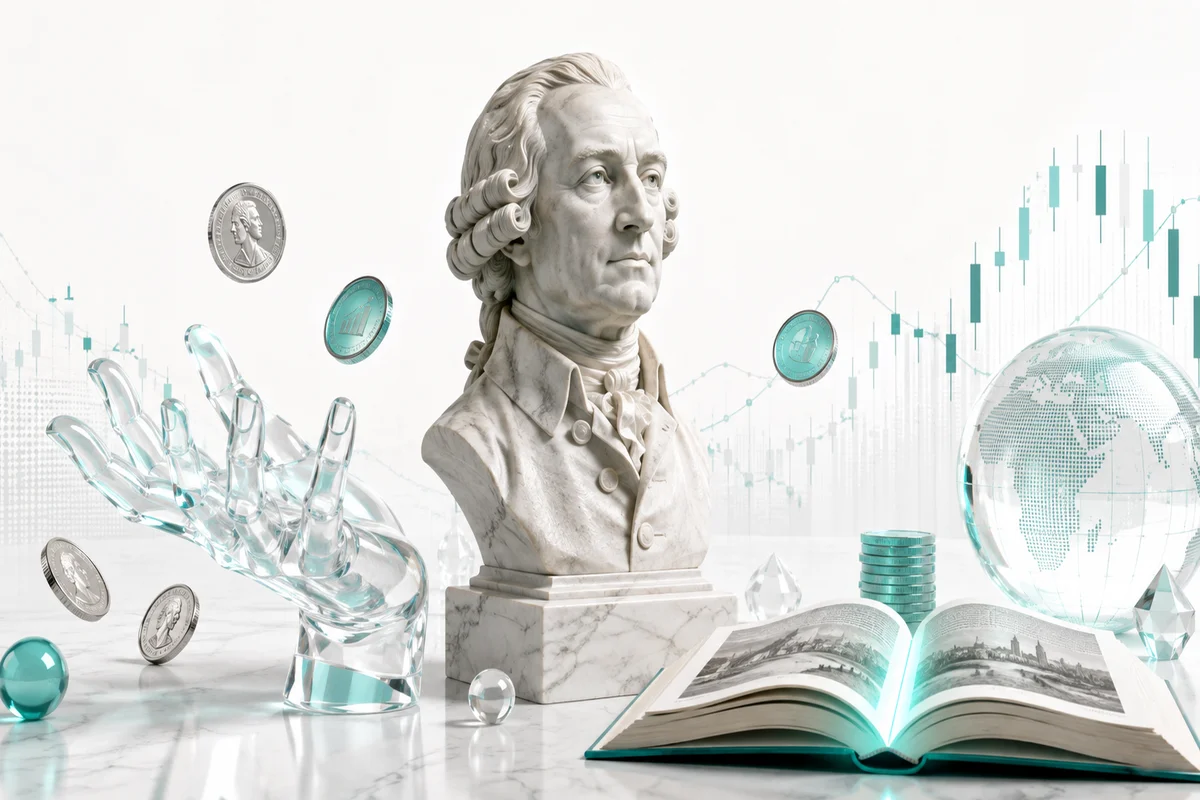
The father of world economics is Adam Smith, the Scottish philosopher widely credited as the pioneer of modern economic science. The label stuck because his book An Inquiry into the Nature and Causes of the Wealth of Nations, published in 1776, laid the foundation for free-market capitalism.
Smith introduced the division of labor, price mechanisms, and the metaphor of the invisible hand, concepts still used to analyze economies today. Understanding his ideas matters because they remain the framework for reading markets, from stocks to crypto assets.
Key Points
- Common definition: Adam Smith is called the father of world economics after publishing The Wealth of Nations in 1776.
- Core ideas: Division of labor and the invisible hand form the basis of modern market economics.
- Alternative figures: John Maynard Keynes and Milton Friedman are also mentioned, but Smith is seen as the pioneer.
- Relevance in 2026: Supply and demand principles still guide analysis of stocks and crypto assets.
- Practical lesson: Economic history helps beginner investors understand market cycles before they start.
If you want to see this principle in modern markets, you can observe the movement of US stocks as a practical example of supply and demand.
Why Did Adam Smith Earn This Title?
The title father of world economics emerged because The Wealth of Nations, published on March 9, 1776, discussed production, distribution, and growth in one broad framework. Smith also served as a professor at the University of Glasgow from 1751, where he developed many ideas about morality and economics.
• Division of labor: Specialization makes workers more productive and raises national output.
• Invisible hand: Individuals pursuing their own interest can unintentionally promote public welfare.
• Free markets: Prices work more efficiently when the government avoids heavy intervention.
• Market value: Natural price and market price became the basis for discussing economic fluctuations.
This foundation is useful when you begin learning beginner stock investing, because many stock movements reflect supply and demand.
Three Core Ideas from Adam Smith
To understand why Adam Smith is called the father of world economics, look at the three ideas most often cited.
• Invisible hand: Rational individuals indirectly help economic balance.
• Division of labor: Splitting work into smaller tasks increases speed and efficiency.
• Capital accumulation: Savings and investment fuel long-term economic growth.
Supply and demand concepts are also used in digital markets. If you want to go deeper, you can explore the crypto types available in the market today.
Other Figures Also Called Fathers of Economics
Besides Adam Smith, several thinkers sometimes receive the title in more specific contexts.
• John Maynard Keynes: Often called the father of modern macroeconomics, mainly after publishing The General Theory of Employment, Interest and Money in 1936.
• Milton Friedman: A leading monetarist who won the Nobel Prize in Economics in 1976 for his focus on money supply and inflation.
• Alfred Marshall: Known for formalizing supply and demand curves that became the basis of microeconomics.
• Karl Marx: Offered a critical view of capitalism and created a different school of political economy.
The title father of world economics still belongs most often to Adam Smith because he laid the broad foundation earlier than the others.
How Classical Economics Influences the Modern World
Smith's ideas are not just history. They still appear in modern economic analysis, including monetary policy and international trade.
• Supply and demand: The foundation for reading stock, commodity, and crypto prices.
• Role of government: The debate over state intervention still echoes the Smith vs Keynes discussion.
• Production efficiency: Division of labor appears in global supply chains and technology industries.
• Market innovation: Competitive markets are considered a driver of innovation and efficiency, as seen in crypto.
For investing, this framework helps you read price momentum. To understand more, you can check crypto trading tips, which often rely on supply and demand analysis.
Lessons for Beginner Investors
Economic history gives practical lessons for starting your investment journey.
1. Understand the market mechanism: Prices move because supply and demand change, not because of sentiment alone.
2. Separate short-term and long-term analysis: Adam Smith focused on long-term growth, not daily returns.
3. Do not ignore risk: Free markets can fail without adequate regulation.
4. Use money that does not disrupt basic needs: Capital accumulation teaches you to save first.
5. Keep learning from new sources: Modern markets change, so your strategy must adapt.
These rules also apply to digital assets. If you want to see how economic theory is applied in modern financial products, the Mobee tutorial can help you understand the investment flow from the start.
Summary Table of Figures and Contributions
Here is a simple comparison of economists most often mentioned.
This table shows that each figure answered different economic problems of their time.
Criticism of This Title
The title father of world economics is not free from criticism. Some economic historians argue that Adam Smith was not the only creator of economic science.
• Ignoring the state's role: Free markets are not always efficient without regulation, as financial crises show.
• Assuming rational humans: Smith could be too optimistic because not all market players make logical decisions.
• Historical context: Some ideas reflect 18th-century England, not today's digital economy.
• Limited data: Economic statistics were not well developed during his lifetime.
Modern investors also need to understand applicable rules, including taxes. In Indonesia, you should learn about crypto tax before calculating your investment returns.
Conclusion
Adam Smith is the figure most often called the father of world economics because his work in 1776 became the foundation of modern economic science. However, economic history does not stop at one person. The ideas of Keynes, Friedman, and others complete the way we understand markets. For investors, the biggest lesson from Smith is the importance of understanding market mechanics, managing risk, and continuing to learn. The principles he wrote nearly 250 years ago still feel relevant when you read stock and crypto prices in 2026.
FAQ
Start with Mobee
Mobee is a digital asset platform licensed and supervised by OJK, helping users explore crypto and investment products with clearer access and practical learning. Start your investment journey through Mobee and choose products that match your goals and risk profile.