Grab Stock 2026 Outlook: Prospects, Valuation, and Risks
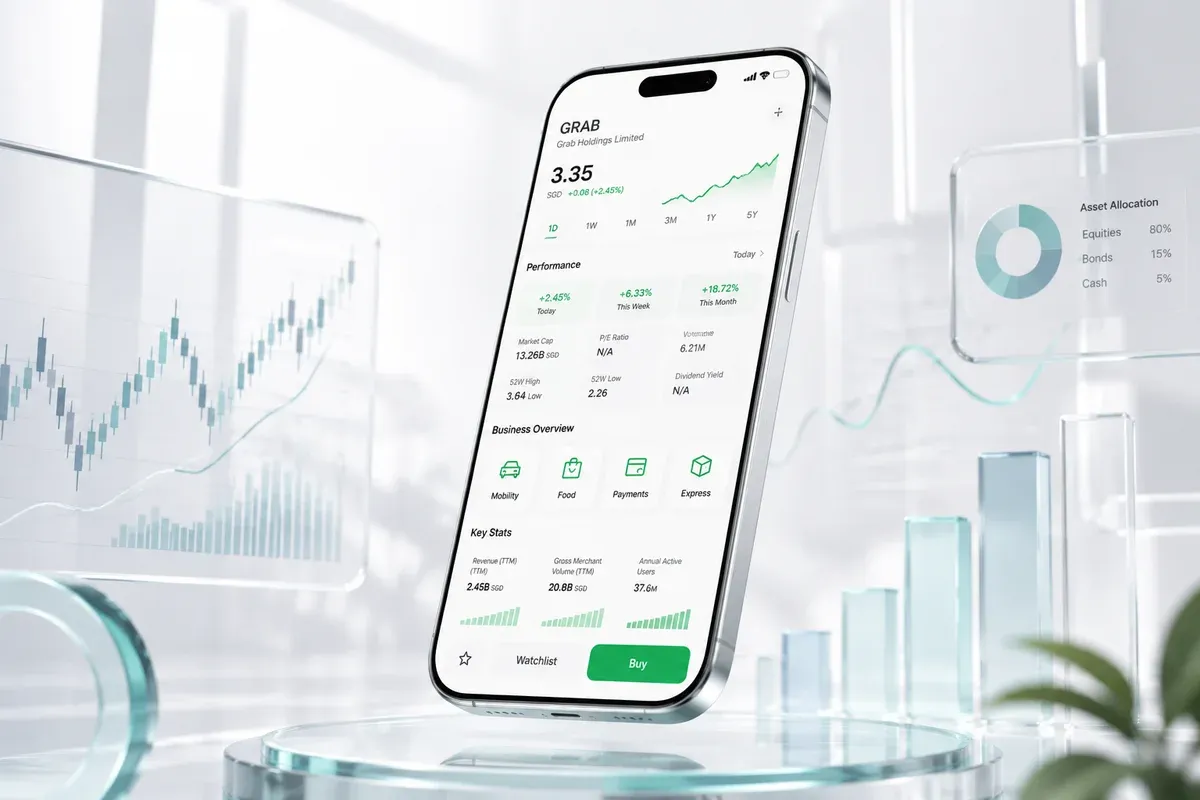
Grab stock refers to the shares of Grab Holdings Ltd, a Singapore-based superapp company listed on Nasdaq under the ticker GRAB. The stock has had a long journey since its December 2021 IPO, falling far below its listing price and then stabilizing as the company improved profitability.
For international investors, Grab offers direct exposure to Southeast Asia's digital economy, including Indonesia, Singapore, Malaysia, and Vietnam. However, buying GRAB requires a clear understanding of the business model, risks, and growth scenarios associated with a high-growth tech stock. This article explains the profile, business model, recent performance, catalysts, risks, and how to buy US stocks like Grab from abroad.
Key Points
-
Ticker and listing: Grab stock is listed on Nasdaq under ticker GRAB since December 2021.
-
Business model: Grab generates revenue from mobility, food delivery, fintech, and digital advertising.
-
Revenue performance: According to FY2024 results, Grab revenue grew around 18% YoY to US$2.8 billion.
-
Main risks: GRAB stock remains highly sensitive to US interest rates and regional competition.
-
How to buy: Indonesian investors can buy Grab stock through OJK-regulated platforms offering US stocks.
What is Grab stock?
Grab stock represents ownership in Grab Holdings Ltd, the parent company behind the Grab app for ride-hailing, food delivery, and digital payments. Grab began trading on Nasdaq in December 2021 through a SPAC merger, with an IPO price of US$13 per share. Since then, GRAB has become one of the most watched Southeast Asian tech stocks among global investors.
• Listing: Nasdaq since December 2021 under the ticker GRAB.
• IPO price: US$13 per share based on Nasdaq listing records.
• Operating region: 8 countries in Southeast Asia.
• Main services: ride-hailing, delivery, logistics, fintech, and advertising.
• Target market: mobile-first consumers and local small businesses.
If you are new to global equities, start with stock education to understand the risks before buying international stocks.
How does Grab make money?
Grab operates as a two-sided platform connecting consumers, drivers, and merchant partners. Its main revenue streams are split into several segments.
• On-Demand Services: revenue from ride-hailing and food delivery commissions.
• Financial Services: revenue from GrabPay, digital lending, and financial transactions.
• Enterprise and New Initiatives: revenue from advertising and data services.
• Regional expansion: growth into hotels, logistics, and shopping services.
According to Grab's Q3 2024 earnings report released in November 2024, revenue rose 17% YoY to US$691 million. This shows on-demand demand remains strong while fintech gradually contributes more to total revenue.
Grab stock performance from IPO to 2026
Grab's stock price is closely tied to fundamental growth and global interest rates. In 2023, the stock traded below US$4 as growth stocks faced pressure from higher rates.
• 2021: Grab IPO on Nasdaq at US$13 per share.
• 2022: big correction as the Federal Reserve raised rates.
• 2023: cost efficiency started to show in profitability metrics.
• 2024: annual revenue rose around 18% to US$2.8 billion.
• 2025-2026: AI and fintech sentiment are expected to drive valuation.
Based on Grab's Q1 2024 report released in May 2024, the company had around 42 million monthly transacting users. A large user base matters because it can lower incentive costs and increase advertising revenue.
Growth catalysts for Grab in 2026
Catalysts are events or trends that can push a stock price higher. For GRAB, several catalysts are worth watching through 2026.
• Southeast Asia digital economy: the Google, Temasek, and Bain e-Conomy SEA 2024 report estimates regional digital economy GMV reached US$263 billion.
• Fintech and lending: these segments carry higher margins than ride-hailing.
• AI adoption: AI can reduce costs through demand prediction and chatbots.
• Digital advertising: Grab can use transaction data to offer low-cost ads to small businesses.
• Lower interest rate expectation: a looser policy environment tends to support growth stocks.
To compare GRAB with other high-profile technology companies, reading about SpaceX stock can give you more context on how private tech valuations behave.
Main risks of investing in GRAB
Every tech stock carries risks, and GRAB is no different.
• Interest rate sensitivity: persistently high rates in 2026 could pressure growth stock valuations.
• Competition: GoTo, ShopeeFood, and other regional players compete for the same users.
• Regulation: transport and fintech rules in each country can raise compliance costs.
• Market sentiment: sell-offs in ADR shares can affect GRAB directly.
• Profitability risk: revenue growth does not automatically translate into stable net profit.
For example, if GoTo starts another incentive war in Indonesia, Grab may need to lower take rates to defend market share. The result is weaker short-term margins even if transaction volume remains high.
GRAB price scenarios in 2026
No one can predict price direction with certainty, but scenarios help structure expectations.
| Scenario | Driving Condition | Potential Impact on GRAB |
|---|---|---|
| Bullish | Fed cuts rates, digital economy accelerates | Stock price may rise with higher trading volume |
| Neutral | Consistent earnings, moderate growth, stable rates | Price trades sideways within a range |
| Bearish | Global recession, incentive war, stricter regulation | Price faces downside, investors should revise targets |
This is not a prediction, just a thinking framework. Combine fundamental analysis with the latest macro news. You can also review a list of largest assets to better understand where Grab sits among global companies.
How to buy Grab stock from Indonesia
You cannot buy Grab stock directly on the Indonesia Stock Exchange. You need a platform that offers US stocks or tokenized stock products.
1. Choose a platform: use a licensed investment platform that provides access to US stocks.
2. Complete KYC: prepare your ID and supporting documents using the KYC guide.
3. Deposit funds: use bank transfer or QRIS according to the bank deposit guide.
4. Search for ticker GRAB: check liquidity and bid-ask spread before placing an order.
5. Set position size: avoid putting all your capital into one stock.
6. Monitor regularly: review quarterly earnings, competitive news, and interest rate direction.
Grab stock profile summary
| Aspect | Detail |
|---|---|
| Company | Grab Holdings Ltd |
| Ticker | GRAB |
| Exchange | Nasdaq |
| IPO | December 2021 |
| IPO Price | US$13 per share |
| Sector | Tech, mobility, fintech |
| Main Region | Southeast Asia |
| Revenue Model | Transaction fees, fintech, ads |
What to monitor after buying GRAB
• Quarterly earnings: review revenue, take rate, and incentive spending.
• User growth: watch monthly transacting users.
• Cash flow: check whether operating cash flow is positive.
• Macro conditions: follow Federal Reserve policy and inflation data.
• Southeast Asia regulation: track fintech licensing updates in each market.
Conclusion
Grab stock offers exposure to Southeast Asia's fast-growing digital economy, but it also carries the risks of a high-growth tech stock. Investors need to monitor quarterly results, profitability metrics, and global interest rates. With disciplined position sizing and solid risk awareness, GRAB can be a small part of a diversified portfolio.
FAQ
Can I buy Grab stock from Indonesia?
Yes. GRAB can be bought through platforms that offer US stocks and are regulated by OJK. Some platforms provide GRAB exposure through stock tokens or products like xStocks. You must complete KYC and deposit funds before trading.
What is the current price of Grab stock?
GRAB price changes daily based on Nasdaq trading. For real-time price, check your broker's market page. As a reference, GRAB's IPO price was US$13 in December 2021, and the stock traded below US$4 in 2023.
Is Grab stock profitable for long-term investors?
Grab has delivered double-digit revenue growth and positive adjusted EBITDA for several quarters, but it still recorded a net loss through FY2024. Long-term opportunity remains if fintech and advertising grow, but profitability is not yet stable.
What is the difference between Grab and GoTo stock?
Grab is listed on Nasdaq under GRAB, while GoTo is listed on the Indonesia Stock Exchange under GOTO. Both operate in Southeast Asia, but their structure, focus, and regulations differ. GOTO can be bought locally, while GRAB requires a US stock platform.
How do I minimize risk when buying GRAB?
Start with a small position, avoid using emergency funds, and diversify into other assets. Monitor quarterly reports, US interest rate changes, and fintech regulation in Southeast Asia. Set a maximum loss threshold before you buy.
Start with Mobee
Mobee is a digital asset platform licensed and supervised by OJK, helping users explore crypto and investment products with clearer access and practical learning. Start your investment journey through Mobee and choose products that match your goals and risk profile.
 Direct market access from the app
Start exploring digital assets with Mobee
Track the market, learn about digital assets, and start trading more conveniently with the Mobee App.
Mobee is licensed and supervised by the OJK. Not a solicitation to buy or sell any asset.