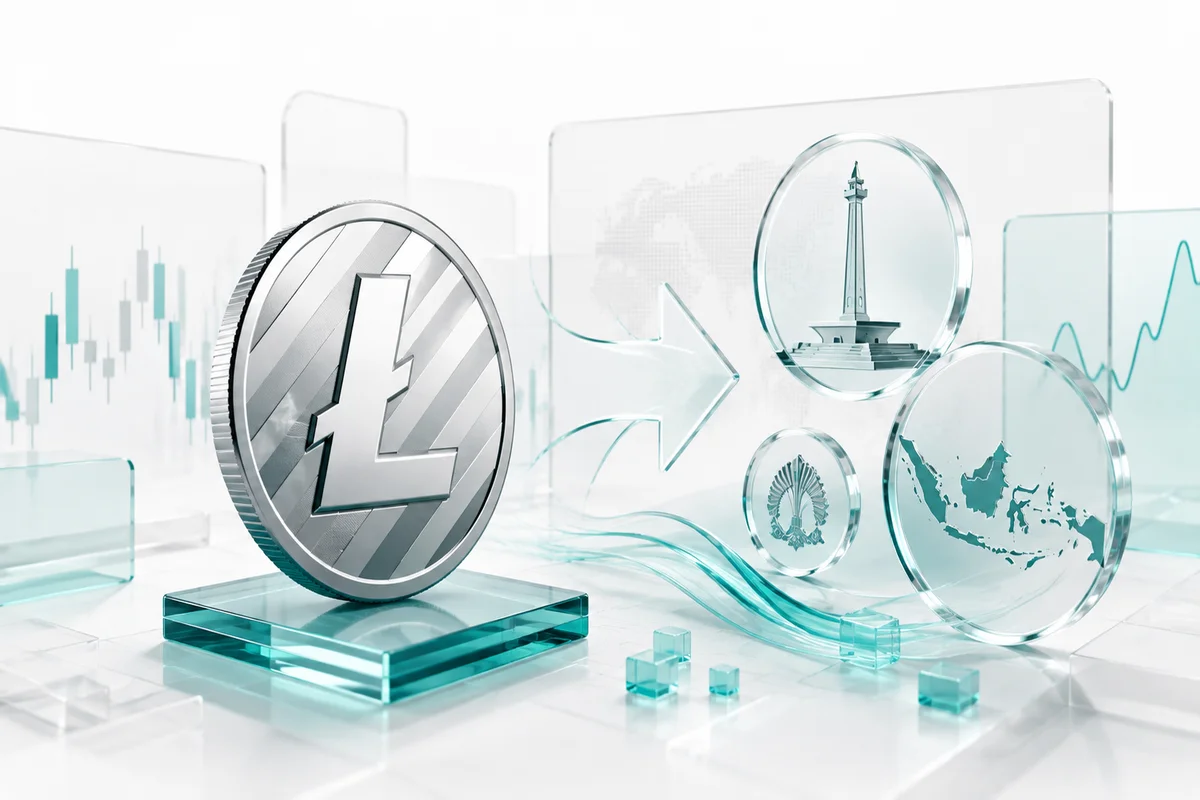
Litecoin to IDR is the exchange rate that shows how much Indonesian Rupiah you receive when selling or converting one Litecoin. This conversion is the main reference for crypto investors in Indonesia who want to cash out digital assets into local currency. The LTC/IDR rate is not set by a single entity. It is formed by Litecoin's global price, demand on local exchanges, and the Rupiah exchange rate at that moment. types of crypto helps you understand where Litecoin sits among other digital assets.
Key Points
- Conversion rate: Litecoin to IDR is the real-time value of one LTC against the Indonesian Rupiah.
- Price drivers: The rate follows Litecoin's global price, market liquidity, and the US dollar exchange rate.
- Methods: You can sell LTC through local exchanges, peer-to-peer platforms, or instant selling features.
- Transaction costs: Bid-ask spread, trading fees, and crypto taxes determine your final Rupiah amount.
- Key risks: Price volatility and thin liquidity can push the conversion result far from your expectation.
What is Litecoin to IDR?
Litecoin to IDR is a trading pair that shows the price of one Litecoin in Indonesian Rupiah, similar to BTC/IDR or ETH/IDR. This pair is common on crypto platforms serving Indonesian users.
Litecoin was created by Charlie Lee in 2011 as a lighter alternative to Bitcoin. According to Litecoin Foundation, Litecoin has a block time of 2.5 minutes and a maximum supply of 84 million LTC. Because of this, the Rupiah conversion follows global supply and demand as well as each platform's market mechanism. on-chain analysis can help you read Litecoin network activity before deciding to convert.
How LTC to IDR conversion works
Converting Litecoin into Rupiah works like selling an asset on the spot market. You place a sell order at your preferred price. When a buyer matches your order, Rupiah enters your account balance. After that, you can withdraw the funds to a bank account or e-wallet.
The general steps are:
1. Open an exchange account: Choose a platform with an LTC/IDR pair and complete identity verification.
2. Send Litecoin: Transfer LTC from a private wallet to the deposit address provided by the exchange.
3. Sell LTC for IDR: Execute a sell order on the spot market or use an instant sell feature.
4. Withdraw Rupiah: Move the balance to a bank or e-wallet using the platform's withdraw fiat service.
On platforms like Spot Trade, this process takes seconds when liquidity is available. Always use the correct network address because sending LTC to another token address can cause permanent loss.
Key factors affecting the LTC/IDR rate
The LTC/IDR rate does not move independently. Several variables push the price up or down every second.
• Bitcoin price: Litecoin often follows Bitcoin's direction, so a BTC sell-off also weighs on LTC.
• Market liquidity: Thin trading volume in the LTC/IDR pair widens the bid-ask spread.
• Market sentiment: Halving news, new listings, and payment adoption act as catalysts for LTC price.
• US dollar strength: Global LTC prices are quoted in USD, so a weaker Rupiah automatically raises the LTC/IDR rate.
• Domestic regulation: Changing tax rules and OJK supervision can affect trading volume on local exchanges.
Understanding these factors helps you choose a better conversion time. crypto trading tips explains how to read situations like this.
How to monitor the Litecoin to IDR price accurately
To get a fair rate, you cannot rely on only one source. Local exchange prices usually differ from a direct USD conversion.
1. Check the global price: Monitor LTC price on CoinGecko or CoinMarketCap in USD.
2. Convert to Rupiah: Multiply the USD price with the Rupiah rate from an official source such as Bank Indonesia's middle rate.
3. Compare local order books: Look at buy and sell prices on the exchange with the largest LTC/IDR liquidity.
4. Use real-time calculators: Some exchanges show the estimated Rupiah amount before you confirm the sale.
5. Watch the timing: The rate can shift by hundreds of Rupiah when volatility is high.
Comparison of LTC to IDR conversion methods
Each conversion method has different speed, costs, and risk. The best choice depends on your transaction size and liquidity needs.
Before choosing a method, calculate the total fees that will be deducted from your sale result. Licensed platforms usually provide clearer cost transparency.
Fees, price gaps, and taxes in LTC to IDR transactions
The Rupiah amount you receive is not simply the sale price multiplied by the number of LTC. Trading fees, spread, and taxes also cut into the result.
• Trading fees: Most local exchanges charge 0.1-0.3% per spot transaction.
• Spread: The market sell price is usually 1-3% lower than the market price because of liquidity.
• Final income tax: Under PMK 68/2022, income tax on crypto asset sales is set at 0.1% of transaction value.
• VAT: PMK 68/2022 also regulates a 1.1% VAT collection for appointed platforms.
• New rules: Crypto tax regulations are still being evaluated, so check the latest crypto tax update before counting your final result.
Risks to watch when converting LTC to IDR
Converting crypto into Rupiah is not risk-free. Beginners often face several issues.
• Price volatility: LTC can drop 5-10% within hours when macro conditions worsen.
• Low liquidity: If trading volume is thin, your sell order may wait long or execute at a lower price.
• Regulatory risk: Tax changes or new rules can affect the ability to withdraw funds.
• Illegal platforms: Apps offering above-market prices are usually linked to scams.
• Network mistakes: Sending LTC through the wrong network makes the transaction hard to recover.
To reduce these risks, always use an exchange supervised by OJK and confirm the deposit address before sending.
Safe strategies for beginners
Beginners should avoid selling their whole position at once. A safer approach is to cash out gradually with clear price targets.
1. Use a licensed platform: Make sure the exchange is registered and supervised by OJK.
2. Compare at least 3 platforms: Compare selling prices, fees, and withdrawal speed.
3. Place limit orders: Set a minimum sell price so the result stays close to your target.
4. Keep transaction records: Save proof for tax reporting and financial planning.
5. Avoid all-or-nothing moves: Sell 25-50% of the position to avoid bad execution.
Simple LTC to IDR conversion simulation
Assume LTC global price is USD 120 and the Rupiah exchange rate is Rp16,000. The base LTC/IDR rate becomes Rp1,920,000 per LTC.
If you sell 1 LTC, the deductions include a 0.2% trading fee, a 2% spread, and roughly 1.2% for taxes. The total deduction is around 3.4%, or about Rp65,280. That means the Rupiah entering your account is about Rp1,854,720.
This figure is an estimate because spreads and fees vary across platforms. Always use real-time numbers from the exchange before executing.
Conclusion
Litecoin to IDR is a conversion rate that every crypto investor in Indonesia should understand before cashing out. Global prices, spot market liquidity, and domestic tax regulations all play a role.
By choosing the right conversion method, monitoring spreads, and calculating taxes, you can avoid unnecessary losses. Only transact on licensed platforms and keep records of every trade.
FAQ
Start with Mobee
Mobee is a digital asset platform licensed and supervised by OJK, helping users explore crypto and investment products with clearer access and practical learning. Start your investment journey through Mobee and choose products that match your goals and risk profile.