Uang BRICS: Analysis of Impact on Dollar and Markets

BRICS money is a term for the proposed common currency or cross-border payment system discussed by parts of the BRICS bloc, not a single physical currency that has been officially issued. As of May 2026, no BRICS central bank has launched a retail currency called the BRICS.
What exists instead is a patchwork of local currency settlement, digital payment links, and gold reserve accumulation. This distinction matters because headlines often blur political ambition with investable reality. The topic also connects to fiat vs crypto and the changing role of central banks.
Key Points
-
Core definition: BRICS money is not an official single currency, but a mix of payment and settlement proposals.
-
Reserve data: IMF COFER Q1 2026 estimates put the US dollar near 57% of global reserves.
-
Infrastructure: CIPS, mBridge, and local currency swaps are expanding non-dollar payment routes slowly.
-
Catalysts: BRICS expansion, sanctions, and 2026 gold demand keep de-dollarization in focus.
-
Risks: Liquidity gaps, policy divergence, and unclear rules prevent fast adoption or easy investing.
Why the Idea Keeps Returning
The idea returns because dependence on the US dollar creates costs and political risks. Sanctions on Russia and Iran accelerated the search for alternative settlement. Developing countries also want to reduce exposure to Federal Reserve policy shifts.
• Sanctions and geopolitics: Countries under sanctions struggle to use dollar payment routes.
• Conversion costs: Transactions through the dollar add cost and settlement time.
• Dollar dominance: The dollar is still used in most trade and reserves.
• Multipolar ambition: BRICS wants to strengthen its voice in the global economy.
Pressure from devaluation of local currencies is another trigger. Still, political desire does not automatically create a stable new currency.
How a BRICS Payment Network Would Work
The most realistic model is not a single currency but a local currency settlement network. Central banks create swap lines, then commercial banks use those lines for trade. The process looks like an international transfer but passes through fewer dollar intermediaries.
1. Identify banks: Local and partner banks agree on a bilateral payment route.
2. Convert currencies: The transaction is converted directly without passing through the US dollar.
3. Settle funds: Money is settled through correspondent accounts or a digital platform.
4. Report activity: Monetary authorities monitor fund flows for compliance.
5. Reconcile positions: Both parties record positions and exchange rate differences.
This model is more realistic than a single currency because it does not need a shared central bank. Some platforms use stablecoin for liquidity, although rules are not yet uniform.
BRICS Money vs National Currencies
The main differences are the issuer, legal status, and monetary policy. National currencies have been tested for decades, while BRICS money is still a proposal. This comparison matters so you do not misread the risk.
• Issuer: National money is issued by a central bank, while BRICS money has no single issuer.
• Legal tender: National money is valid for taxes and wages, while BRICS money is not.
• Monetary policy: National money has its own interest rate, while BRICS money would be hard to agree on.
• Function: BRICS money is better suited as a trade settlement unit, not a daily payment tool.
• Stability: National money has history and institutions, while BRICS money is still a concept.
Do not imagine BRICS money as a mature euro. Gold and bitcoin vs gold often appear as reserve alternatives, but both carry different risks.
2026 Data Worth Watching
Several 2026 data points help measure how far this idea has progressed. They also show why the dollar remains hard to replace in the short term.
• IMF COFER Q1 2026: The estimated US dollar share of global reserves is around 57%, still dominant despite a slow decline.
• SWIFT RMB Tracker March 2026: The yuan share of global payments is around 3.5%, far below the dollar.
• World Gold Council Q1 2026: Central banks added about 290 tonnes of gold, signaling reserve diversification.
• BIS Triennial Survey 2026: The US dollar was involved in around 88% of global foreign exchange transactions, showing it remains the market backbone.
• BRICS Sherpa statement 2026: The focus is on local currency settlement, not a single currency.
These numbers suggest de-dollarization is slow and uneven. For investors, RWA may be more relevant in the short term than waiting for BRICS money to launch.
Main Catalysts Through 2027
Catalysts are triggers that could speed up or slow down the BRICS money debate. Not all catalysts are positive for crypto or gold.
• Geopolitical catalyst: New sanctions or trade conflicts could accelerate alternative adoption.
• Institutional catalyst: BRICS expansion adds more countries that want local settlement.
• Technology catalyst: mBridge and CIPS increase cross-border transaction capacity.
• Gold catalyst: Central bank gold buying strengthens the non-dollar asset narrative.
• Regulatory catalyst: Stablecoin and CBDC rules shape the direction of digital payments.
These catalysts do not automatically create BRICS money. What changes first is the payment plumbing and reserve composition.
Key Risks and How to Monitor Them
The biggest risk is not that BRICS money fails to launch. The bigger risk is treating a political narrative as an investment certainty. Several specific risks deserve attention.
• Political risk: BRICS countries have different interests, so negotiations can stall; monitor official summit statements.
• Liquidity risk: Local currency markets are still thin, so transaction costs can be high; compare bank spreads.
• Regulatory risk: Cross-border rules are not uniform, so compliance can be complex; check central bank policies.
• Technology risk: Digital payment systems are exposed to outages and cyberattacks; monitor infrastructure incident reports.
• Sentiment risk: De-dollarization headlines can fuel asset speculation; avoid large positions without data.
Each risk has a mitigation path, from diversification to verifying official sources. Do not rely on one headline or one political statement.
Scenario Table for 2026-2030
Three main scenarios can help set expectations. They are not precise predictions, but a thinking framework.
• Base scenario: No single currency, but local settlement rises.
• Fast scenario: Geopolitical conflict accelerates alternative payment blocs.
• Slow scenario: The dollar stays dominant because of liquidity and market trust.
| Scenario | Trigger | Impact on the Dollar | Potential Assets |
|---|---|---|---|
| Base Case | BRICS focuses on local-currency settlement | Dollar dominance remains | Gold, stablecoins, yuan |
| Fast | Sanctions and fragmentation increase | Dollar share declines faster | Gold, CBDCs, crypto assets |
| Slow | Dollar liquidity remains strong | Dollar dominance remains stable | U.S. dollar, U.S. bonds, equities |
Use this table to evaluate news, not to make emotional trades. If the triggers do not appear, the base scenario remains most likely.
What This Means for Investors
The direct impact of BRICS money for most investors comes through exchange rates, inflation, and transaction costs. You do not need to wait for a new currency to manage risk.
• Diversification: Do not put your entire portfolio in dollar or local currency assets.
• Gold: Gold remains relevant as a hedge when currency uncertainty rises.
• Crypto: Bitcoin and stablecoins can be alternatives, but volatility and regulation remain high.
• Data watch: Check COFER, SWIFT, and gold data every quarter to see the trend.
• Risk control: Use small positions and avoid leverage when macro themes are hot.
For global investors, the practical step is to monitor official data and set asset allocation. Do not take large risks just because a headline sounds dramatic.
Conclusion
BRICS money is a narrative and an infrastructure project, not a single currency ready for daily use. What is changing faster is local payment settlement and gold reserve composition. The dollar remains dominant in 2026, but fragmentation is progressing gradually. Investors should focus on data, diversification, and risk management.
FAQ
Does an official BRICS currency already exist?
No. As of May 2026, there is no single BRICS currency issued by a central bank or used as legal tender. What currently exists are agreements for local-currency settlement and digital payment projects.
What is the difference between a BRICS currency and the yuan?
The yuan is China's official currency and is issued by the People's Bank of China. A BRICS currency is an umbrella term for proposed joint initiatives, so the yuan is only one of the currencies used in settlement rather than a BRICS currency itself.
Could a BRICS currency replace the U.S. dollar?
In the short term, this is unlikely. IMF COFER Q1 2026 estimates place the U.S. dollar at around 57% of global foreign-exchange reserves, while BIS 2026 estimates suggest the dollar is involved in around 88% of foreign-exchange transactions. Fully replacing it would require comparable liquidity, trust, and financial infrastructure.
Which assets could benefit from this trend?
Gold, stablecoins, and non-dollar assets are often mentioned. World Gold Council data for Q1 2026 recorded central-bank gold purchases of around 290 tonnes, indicating continued interest in diversification. However, asset prices can still decline if market sentiment changes.
How can you track developments around a BRICS currency?
Monitor IMF COFER releases, the SWIFT RMB Tracker, BRICS Summit statements, and World Gold Council data each quarter. Compare them with movements in the U.S. dollar and U.S. Treasury yields. Always verify the latest figures because published data may be revised.
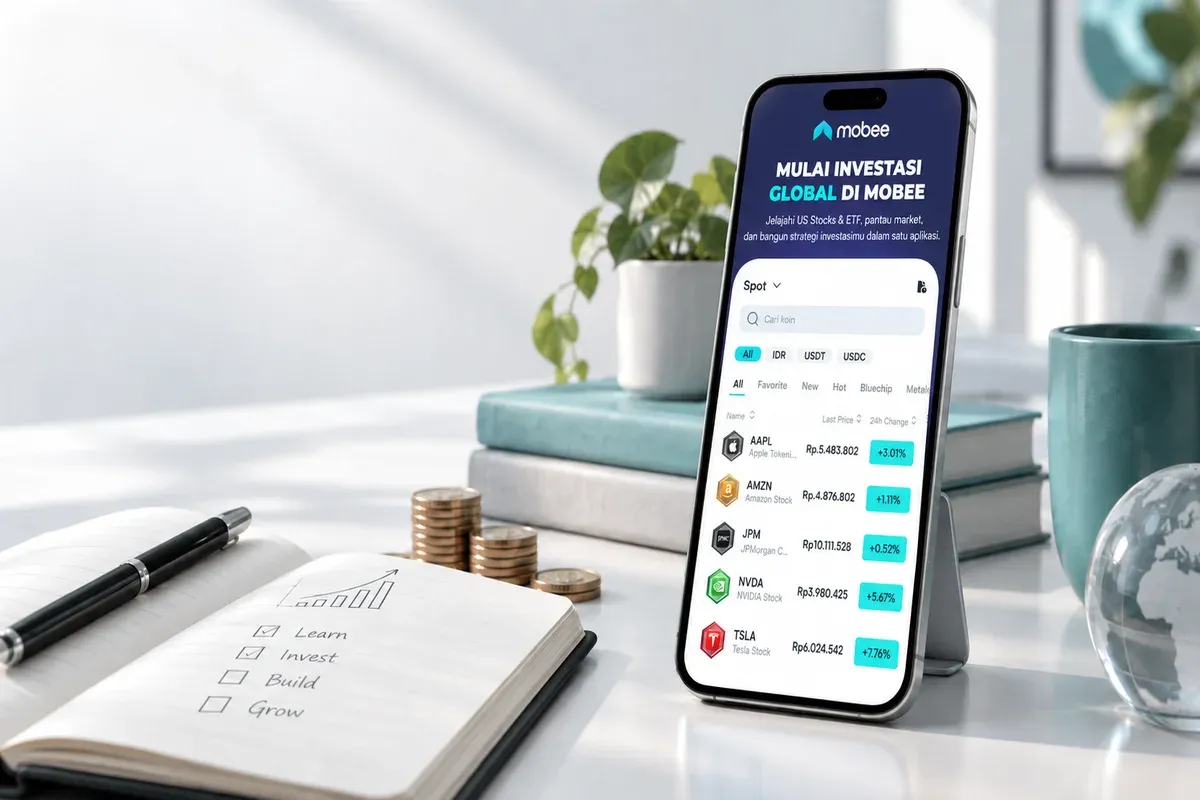
Start with Mobee
Mobee is a digital asset platform licensed and supervised by OJK, helping users explore crypto and investment products with clearer access and practical learning. Start your investment journey through Mobee and choose products that match your goals and risk profile.
 Direct market access from the app
 Start exploring digital assets with Mobee
Track the market, learn about digital assets, and start trading more conveniently with the Mobee App.
Mobee is licensed and supervised by the OJK. Not a solicitation to buy or sell any asset.