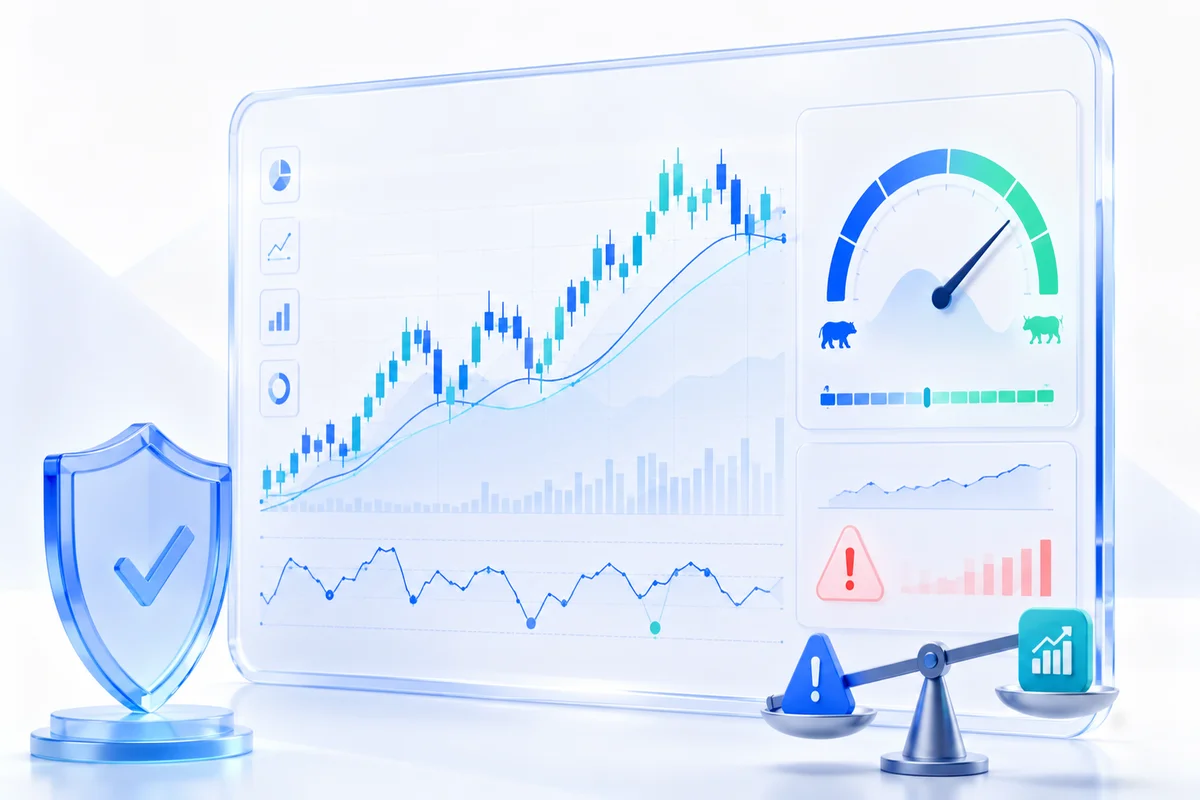
Sentiment is the collective attitude or feeling of investors toward an asset or market, often driving short-term price movements. In crypto and stocks, sentiment can shift rapidly due to news, rumors, or whale activity. Understanding sentiment helps you identify periods of euphoria or panic, enabling more rational decisions. Learn more about tips trading crypto to capitalize on sentiment changes.
Key Points
- Definition of sentiment: Collective market feeling that influences asset prices.
- Types of sentiment: Bullish (optimistic), bearish (pessimistic), and neutral.
- Measurement tools: Fear & Greed Index, funding rate, social volume, on-chain data.
- Benefits: Better entry/exit timing and emotional control during trading.
- Risks: Sentiment can mislead without confirmation from fundamental data.
Types of Market Sentiment
• Bullish sentiment: Investors expect price increases, shown by high buy volume and positive news.
• Bearish sentiment: Investors fear price drops, visible through heavy selling and negative news.
• Neutral sentiment: The market moves sideways without strong momentum, often before a catalyst.
Each type can last from days to weeks, depending on the strength of the driving catalyst. You can track sentiment changes via on-chain analysis for more accurate confirmation.
How to Measure Market Sentiment
- Fear & Greed Index: A 0-100 index from Alternative.me updated daily. Scores below 25 indicate extreme fear, above 75 indicate extreme greed.
- Funding rate: The cost of perpetual contracts on exchanges. According to Coinglass as of April 2026, funding rates above 0.1% signal overheated bullish sentiment.
- Social volume: The number of mentions on social media. LunarCrush data as of April 2026 shows that spikes in social volume often precede price movements.
- On-chain metrics: Whale transactions, exchange inflow/outflow ratios. Santiment notes that sudden increases in whale transaction count can hint at sentiment shifts.
- Sentiment surveys: For example, the AAII survey for US stocks, where bullish sentiment above 50% often precedes corrections.
How Sentiment Affects Prices
Sentiment influences prices because buy/sell decisions are driven by emotion, not just fundamentals. During bullish sentiment, investors tend to ignore risks, pushing prices above intrinsic value. Conversely, during bearish sentiment, panic selling drives prices too low. A real example occurred in crypto: during extreme fear in April 2026, Bitcoin dropped 20% in a week despite healthy on-chain fundamentals. Therefore, combining sentiment analysis with day trading crypto can help spot turning points.
Benefits of Understanding Sentiment
- Better entry/exit timing: Enter during fear, exit during greed based on sentiment indices.
- Emotional management: Recognize that market sentiment can mislead, preventing FOMO or panic.
- Confirmation of technical signals: Extreme bearish sentiment can strengthen reversal signals.
- Early catalyst detection: Social volume spikes can reveal new narratives before price moves.
- Strategy diversification: Use sentiment as a filter alongside technical and fundamental analysis.
Risks of Relying on Sentiment
• False signals: Sentiment can reverse quickly without volume confirmation. Example: social volume surge from fake news (FUD).
• Data lag: Fear & Greed Index and funding rates are historical, not always predictive.
• Manipulation: Whales can create fake sentiment with large orders or rumor spreading. High risk for small-cap coins.
• Confirmation bias: Traders tend to seek data that matches their sentiment instead of being objective.
• Overreliance: Focusing only on sentiment can ignore long-term fundamentals. Study crypto types to understand asset fundamentals.
To reduce risk: use multiple indicators and confirm with on-chain data or trading volume.
Examples of Sentiment in Crypto Markets
1. Extreme fear: Bitcoin hits support, fear index below 20, high sell volume. Often a long-term accumulation zone.
2. Extreme greed: Altcoins surge 50% in a day, funding rate above 0.1%, many influencers promoting coins. Often precedes a sharp correction.
3. Prolonged neutral sentiment: Prices range-bound for weeks, low volume, index between 40-60. Market waiting for a catalyst.
These examples show that sentiment is a powerful tool when combined with other strategies. Consider using stake crypto to earn yield during neutral markets.
Summary Table of Sentiment Indicators
This table helps you choose the right indicator for your trading style. Beginners can start with the Fear & Greed Index. You can also start with how to trade crypto to learn without risk.
Sentiment Analysis Checklist
1. Check the daily Fear & Greed Index for overall market sentiment.
2. Monitor funding rates to see if leverage is excessive.
3. Observe social volume on LunarCrush or Santiment for trending narratives.
4. Review whale transaction count for big player activity.
5. Compare with technical data like support/resistance for confirmation.
6. Note news catalysts (regulation, adoption, listings) that could shift sentiment.
This checklist helps you avoid being swayed by short-term price moves. Remember, sentiment is a tool, not the sole reference.
Conclusion
Sentiment is the emotional pulse of the market, heavily influencing short-term price action in crypto and stocks. By understanding its types, measurement methods, and associated risks, you can make more objective trading decisions. Use indicators like the Fear & Greed Index, funding rates, and social volume as confirmation, not as standalone signals. Apply the sentiment analysis checklist every time you enter or exit a position.
FAQ
Start with Mobee
Mobee is a digital asset platform licensed and supervised by OJK, helping users explore crypto and investment products with clearer access and practical learning. Start your investment journey through Mobee and choose products that match your goals and risk profile.