Crypto Fundamentals: How to Evaluate Assets Before Buying
Crypto fundamental analysis is a method to determine the intrinsic value of a digital asset using real data, not price speculation. Similar to stock fundamental analysis that examines financial statements, crypto fundamentals combine on-chain metrics, tokenomics, network adoption, and development reports. This approach helps investors separate long-term projects from short-lived trends. In this guide, you’ll learn key metrics, how to read data, and mistakes to avoid.
Key Points
- Crypto fundamental analysis evaluates projects through on-chain data, tokenomics, and developer activity rather than relying solely on price charts.
- Metrics like total value locked (TVL) and active wallet addresses measure real adoption and user trust in a network.
- Fundamental analysis helps investors avoid pump-and-dump projects driven by temporary hype.
- Combining fundamental metrics with market sentiment and regulatory outlook provides a more balanced investment perspective.
- Understanding token distribution and unlock schedules prevents surprises from inflationary supply shocks.
What is crypto fundamental analysis?
Crypto fundamental analysis is an evaluation framework that leverages public blockchain data, project reports, and digital economic indicators. This approach differs from technical analysis, which only reads price charts. With fundamentals, investors can answer: is this project actually used and does it have a sustainable business model? Before diving into specific metrics, explore types of crypto to identify which assets to analyze.
In essence, crypto fundamentals combine three pillars: network metrics (on-chain), financial metrics (tokenomics), and development metrics. They are interconnected. A project with cutting-edge technology but no user adoption won’t last long.
Why do crypto fundamentals matter for investment decisions?
Without fundamentals, investors rely on sentiment and rumors, often leading to emotional choices. Fundamentals provide an objective basis to judge whether an asset’s price is fair. According to CoinMarketCap data from March 2026, the total crypto market cap reached $3.8 trillion, up 45% year-over-year, signaling a maturing market. Amid this growth, selecting assets with strong fundamentals reduces the risk of severe losses.
Moreover, fundamentals help identify adoption cycles. Projects that consistently grow users and developers tend to survive bear markets. You can combine this approach with crypto trading tips to time entries and exits more effectively.
Which fundamental metrics should you track?
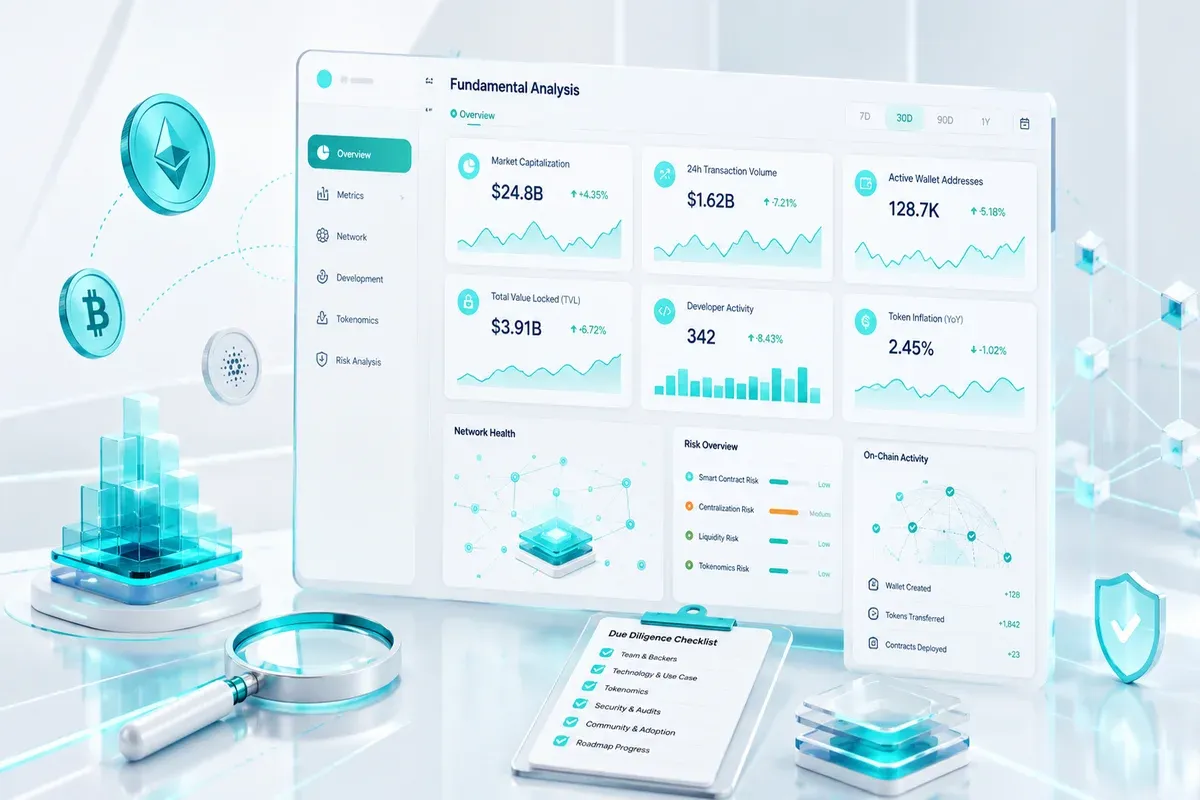
Not all metrics are equally important. Beginners can focus on three main categories: market indicators, on-chain data, and project metrics. Market indicators like market cap and volume provide a snapshot of scale. On-chain data such as active addresses and transaction fees show real activity. Project metrics include tokenomics and GitHub activity.
Here’s a summary of key metrics and their roles:
| Metric | What It Measures | Why It Matters |
|---|---|---|
| Market Capitalization | Total value of all circulating tokens | Illustrates project scale and adoption |
| Daily Transaction Volume | Tokens traded in the last 24 hours | Gauge of liquidity and market interest |
| Active Wallet Addresses | Unique users transacting | Shows genuine network growth |
| Total Value Locked (TVL) | Funds locked in DeFi protocols | Measures trust in the platform |
| Developer Activity | Frequency of commits and GitHub updates | Signals team commitment to building |
| Token Inflation Rate | Percentage of new supply minted per year | Can depress prices if too high |
These metrics work together. A large market cap with low active addresses might indicate uneven distribution. Conversely, high active addresses with a small market cap often signal an undervalued project.
How can you read on-chain data as part of crypto fundamentals?
On-chain data is the public record on a blockchain that anyone can analyze. Sources include Etherscan for Ethereum or Glassnode for aggregated data. With this data, you can see how many wallets are holding, the frequency of large transactions, and funds flowing to exchanges. Glassnode reported in February 2026 that 72% of Bitcoin supply hadn’t moved in over a year, signaling long-term holder confidence.
For beginners, easy-to-follow indicators are active wallet addresses and average transaction fees. A spike in fees usually signals high demand, while a drop in active addresses could indicate waning interest. Dive deeper with on-chain analysis to master these tools.
What’s the difference between fundamental and technical analysis in crypto?
Fundamental and technical analysis often seem opposing, but they complement each other. Fundamentals focus on “why” an asset has value, while technicals focus on “when” to trade. If fundamentals indicate a strong project, technical analysis can help find entry points at discounted prices.
In crypto, fundamentals lean heavily on on-chain data rather than financial reports. On the other hand, technicals use chart patterns and indicators like RSI or moving averages. Long-term investors typically rely on fundamentals, while active traders gravitate toward technicals.
What are common mistakes when evaluating crypto fundamentals?
The first mistake is looking only at market capitalization. A high market cap doesn’t guarantee healthy fundamentals if the token has an unlimited supply. Second, ignoring tokenomics: large token unlock schedules can suddenly depress prices.
Another mistake is trusting manipulated metrics, such as fake volume or artificial wallet addresses. Moreover, beginners often chase high yields from crypto staking without accounting for token inflation that can erode value. Always verify data from multiple independent sources.
How do crypto fundamentals help spot long-term projects?
Long-term projects usually show organic growth in fundamental metrics. Rising active addresses and TVL without instant spikes are positive signs. Additionally, teams that regularly ship updates and have realistic roadmaps demonstrate long-term commitment.
You can also compare several projects within the same sector. For instance, two DeFi platforms can be compared by TVL and protocol revenue. This way, fundamentals act as an initial filter before deeper analysis.
What does a real-world crypto fundamental example look like?
Take Ethereum. According to Messari data for Q4 2025, Ethereum had 450,000 daily active addresses and annual transaction fees of $2.8 billion, reflecting real demand. These metrics confirm Ethereum is not just a speculative asset but a decentralized computing platform.
In contrast, many new projects claim to be “Ethereum killers” yet have only thousands of active addresses. This is the power of fundamentals: separating narrative from reality. Bitcoin, as the largest asset in the, can also be analyzed through metrics like hash rate and holder count to gauge stability.
Conclusion
Crypto fundamental analysis is an essential tool for investors aiming to escape speculation traps. By consistently checking on-chain metrics, tokenomics, and project progress, you can make more rational decisions amid market volatility. No single metric is perfect, so combine several indicators to strengthen your analysis.
In 2026, the crypto industry is more mature and regulation is becoming clearer. With solid fundamentals, opportunities to find undervalued projects are abundant. Start with simple metrics like active addresses and TVL, then deepen your understanding over time.
FAQ
Crypto fundamental analysis is a way to evaluate crypto assets based on real data, such as user numbers, technology, and token economics, instead of just guessing prices.
The most basic ones are market capitalization, transaction volume, active wallet addresses, and TVL. For DeFi projects, protocol revenue is also key. It is best to monitor at least three metrics concurrently.
Start by visiting platforms like CoinMarketCap or DeFi Llama. Check market cap, then look up active addresses on a block explorer. Do not forget to read the whitepaper to understand tokenomics. Do this weekly to build a habit.
No guarantee. Strong fundamentals only increase the probability of a project surviving and growing long term. Short-term prices are still influenced by sentiment and macro news.
There is no fixed number, but assets with a market cap above $10 billion tend to be more stable than micro-caps below $500 million. Diversification remains essential.
Start with Mobee
Mobee helps users explore crypto and investment products through a platform designed for easier access and practical learning. Start your investment journey through Mobee and choose products that match your goals and risk profile.
 Direct market access from the app
 Start exploring digital assets with Mobee
Track the market, learn about digital assets, and start trading more conveniently with the Mobee App.
Mobee is licensed and supervised by the OJK. Not a solicitation to buy or sell any asset.