7 Risks of Using ChatGPT for Investment Decisions

ChatGPT is genuinely useful for understanding investment terms, summarizing market news, or drafting an early research outline. But once its answers start becoming the basis for a buy or sell decision, there are seven risks you need to recognize first. Here they are, along with why each one is dangerous and how to handle it.
1. The Data It Uses Can Be Stale, or Even Made Up
ChatGPT is not connected to the market in real time. It answers based on patterns from its training data, not by checking a live price. If you ask for today's Bitcoin or stock price, there is a real chance the number is outdated, or worse, entirely fabricated, because the model's basic mechanism is predicting the most plausible-sounding words, not retrieving verified facts.
How to handle it: always check prices and market data from a direct source such as an exchange or trading app, not from a chatbot's answer. A more reliable framework for reading market signals is covered in the how to analyze crypto guide.
2. The Error Rate on Financial Questions Is Fairly High
This isn't just speculation. A test by Investing in the Web put 100 finance-related questions to ChatGPT, and industry experts then reviewed the answers. The result: only 65% of the answers were rated correct, while the remaining 35% were flagged as incomplete, misleading, or wrong. In other words, roughly one in three financial answers has the potential to steer you toward the wrong conclusion.
How to handle it: treat ChatGPT's answers on financial matters as a hypothesis that needs checking, not a finalized fact.
3. It Can Trigger Emotional, Impulsive Decisions
FINRA, the US securities regulator, has specifically warned that interacting with an AI chatbot can lead investors toward decisions that are misinformed, emotional, or impulsive. ChatGPT's confident, coherent tone makes it feel convincing, but confidence in tone is not the same as accuracy in substance.
How to handle it: put a gap between reading a chatbot's answer and acting on it. Don't trade immediately while you're still carried along by the confident tone of its response.
4. It Doesn't Understand Your Risk Profile or Financial Situation
ChatGPT doesn't know the size of your emergency fund, how much risk you can tolerate, or whether you were just laid off. It only answers based on the question you typed, without the full context of your financial situation. A recommendation that sounds reasonable in general can be completely unsuitable for your specific circumstances.
How to handle it: use ChatGPT to understand a concept, not to decide what percentage of your funds should go into a particular asset. Build your own evaluation framework through the crypto fundamentals guide, which accounts for personal risk profile rather than a generic answer.
5. It's an Easy Cover for AI-Branded Scams
The US Investor.gov alert has documented a surge in scams that dress themselves up with the AI label: unregistered trading platforms claiming "our proprietary AI system can't lose," deepfake videos of company CEOs announcing false news to move a stock price, and pump-and-dump schemes spread through AI-related claims on social media. A big name like ChatGPT is often invoked as if it were the source of the recommendation, when the party actually spreading it is someone with no accountability at all.
How to handle it: verify any investment platform or advisor through an official regulator's search tool, and never trust an "guaranteed profit" claim in any form, especially one dressed up in AI branding.
6. It's Not a Licensed Entity That Can Be Held Accountable
If a licensed financial advisor gives you a recommendation that causes losses through negligence, there's a clear complaint process and legal accountability. ChatGPT isn't supervised by any financial authority and cannot be held responsible for losses arising from its answers, no matter how convincing they sound.
How to handle it: for major financial decisions, prioritize platforms and advisors that are genuinely licensed and supervised by an official regulator, not a chatbot's answer. Details of Mobee's own compliance and protection as an OJK-supervised platform can be checked in Mobee's security policy.
7. The Portfolio Data You Type In Can Become a Privacy Risk
To get a more relevant answer, many people are tempted to type in portfolio details, asset amounts, or even account numbers. That data is stored on the service provider's side, and however small the chance, there's a risk of leakage or misuse that simply wouldn't exist if the data had never been typed into a chatbot in the first place.
How to handle it: use rounded figures or general scenarios when asking ChatGPT questions, and never enter an account number, password, or identity data into any conversation.
FAQ
Can ChatGPT be used to analyze crypto or stocks?
Yes, as a tool for understanding basic terms and concepts, but not for final analysis. ChatGPT isn't connected to real-time market data, and in a test of 100 financial questions, 35% of its answers were flagged as incomplete, misleading, or wrong.
What is AI hallucination in an investment context?
AI hallucination is when ChatGPT answers confidently even though the information is wrong or made up, such as an asset price or market statistic that isn't actually accurate. The risk is higher for fast-changing data like crypto prices.
Is it safe to enter portfolio data into ChatGPT?
It's best avoided for sensitive data such as account numbers or specific asset amounts. Anything typed into a chatbot is stored on the provider's side, so it's safer to use rounded figures or general scenarios when asking.
Can ChatGPT replace a financial advisor?
No. ChatGPT isn't a licensed entity supervised by a financial authority, so it can't be held accountable for losses arising from its answers, unlike a genuinely licensed advisor or platform.
How do I use ChatGPT safely for investment research?
Use it to understand concepts and draft an early research outline, then verify every important number and claim through an official source or live market data before basing a decision on it.
Conclusion
All seven risks above share one common thread: ChatGPT is built to produce answers that sound plausible, not to verify truth or fully understand your financial situation. That's not a reason to stop using it altogether, but a reason to place it where it belongs, as a tool for understanding concepts, not as a source of buy or sell signals.
Start With Mobee
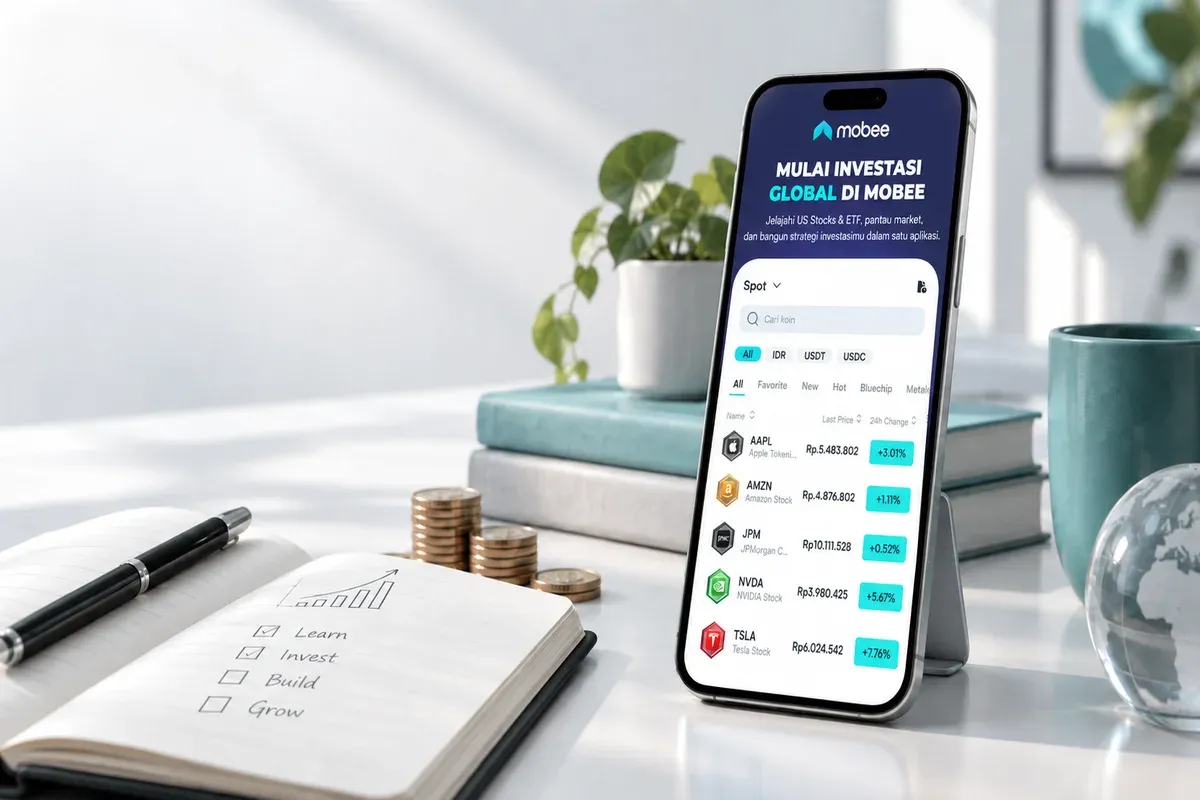
Mobee is a licensed digital asset platform supervised by OJK, so you can track market data and investment products from a source with clear accountability, rather than from a chatbot with no connection to real-time markets. Start your investment journey with Mobee and choose products that fit your goals and risk profile.
Disclaimer. This article is for educational purposes and is not investment advice. Always do your own research, verify every important claim through an official source, and match your financial decisions to your own risk profile.
 Direct market access from the app
 Start exploring digital assets with Mobee
Track the market, learn about digital assets, and start trading more conveniently with the Mobee App.
Mobee is licensed and supervised by the OJK. Not a solicitation to buy or sell any asset.