For several years, TRON has often been perceived as a network with limited differentiation amid the dominance of Ethereum and the emergence of new Layer-1 blockchains. However, entering 2026, TRON’s position has undergone a notable shift.
Rather than competing at the highest level of technological innovation, TRON has directed its development toward a more specific role: low-cost, high-speed stablecoin transfer infrastructure, with broad adoption at the institutional and cross-border levels.
Read more: MidNIGHT Network: Rational Privacy for Regulated Blockchains
TRON as Stablecoin Transfer Infrastructure
TRON’s growth in recent years has been primarily driven by the use of stablecoins—particularly USDT—for payments and settlements.
Problem Context
- Cross-border transfers through traditional banking systems require relatively long processing times.
- Transaction fees on certain networks can fluctuate significantly and become inefficient for small-value transfers.
- Demand for fast settlement and low transaction costs continues to increase, especially in emerging markets.
TRON’s Approach
- Short transaction confirmation times.
- Relatively low and stable transaction fees.
- Network capacity that supports high transaction volumes.
These conditions position TRON as one of the primary networks for USDT circulation, accounting for a significant share of the global USDT supply. In practice, TRON functions as a digital dollar–based value settlement network, rather than a general-purpose smart contract platform.
Regulatory Aspects and Institutional Involvement
TRON’s development in 2026 is shaped not only by technical factors but also by institutional engagement and jurisdictional considerations.
Partnerships with Nation States
TRON has established partnerships with several countries for the use of TRON-based assets in specific payment contexts. These arrangements provide limited legal certainty within the respective jurisdictions, although they do not automatically apply globally.
Access to Traditional Markets
Through affiliated entities listed on U.S. stock exchanges, exposure to the TRON ecosystem has become more accessible to conventional capital market investors, albeit indirectly.
This approach reflects TRON’s effort to position itself at the intersection of crypto infrastructure and traditional financial systems.
TRX Tokenomics and Supply Dynamics
From a token economics perspective, TRON applies mechanisms that result in TRX token burning alongside network activity.
- Transactions, including USDT transfers, require network resources (energy).
- The use of these resources leads to TRX being burned.
- Historically, the amount of TRX burned exceeds the number of newly issued tokens.
As a result, TRX exhibits net deflationary supply dynamics, with a consistent daily reduction in circulating supply. In addition, there are no remaining locked allocations for early investors or the core team, reducing the risk of supply pressure from these sources.
TRON’s Position Compared to Other Major Blockchains
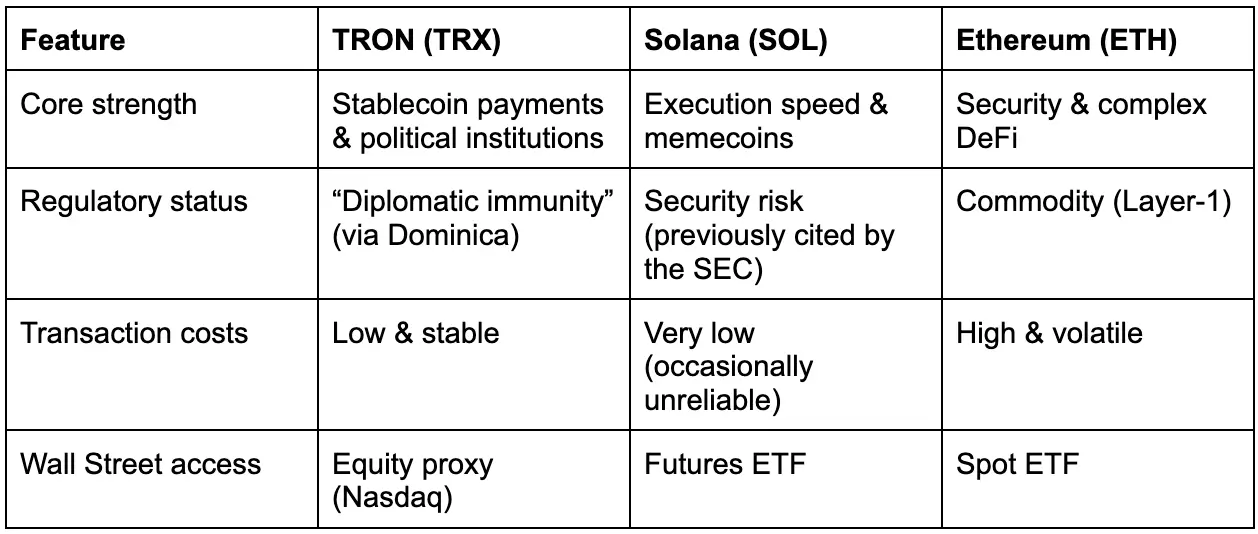
This comparison indicates that TRON does not compete directly across all dimensions, but instead occupies a more specialized usage niche.
Factors Influencing Future Development
Several factors may influence the future performance of the TRON ecosystem:
- Institutional investment products if TRX is included in offerings by global asset managers.
- Treasury activities by affiliated entities that hold TRX as a reserve asset.
- Cross-chain integrations, including connectivity with other networks to support stablecoin liquidity.
These factors are conditional and depend on market dynamics and regulatory developments.
Read more: What is WLFI? World Liberty Financial’s DeFi Token
Risks to Consider
Despite its strengths, TRON faces several structural risks:
- High dependence on USDT as the primary driver of network activity.
- Jurisdictional and political risks, given its involvement with specific entities and regions.
- A relatively high degree of validator centralization compared to some other blockchains.
These risks should be considered in medium- to long-term evaluations.
TRX Availability on Mobee
TRX is available on the Mobee application. Users can buy, sell, and trade this token by following these steps:
- Registration and Verification: Register and complete the account verification (KYC) process.
- Deposit Funds: After verification, deposit funds into your Mobee wallet.
- Open the Trade Menu: Access the Trade menu at the bottom of the app.
- Select TRX: Find TRX in the asset list or search using the keyword “TRX.”
- Choose a Trading Pair: Select a trading pair, such as TRX/USDT.
- Select Order Type:
- Market Order for the current market price.
- Limit Order for a price you specify.
- Enter Amount: Input the amount of TRX you wish to buy and review the transaction details.
- Confirm: Click “Confirm” to process the purchase.
Once the transaction is completed, TRX will appear in your Wallet.
Conclusion
In 2026, TRON has evolved into an efficient stablecoin payment infrastructure integrated with the global financial system, supported by a deflationary token economic model. While it does not stand out in terms of decentralization or advanced smart contract innovation, its specific role within the crypto ecosystem provides sustained relevance.
An evaluation of TRON should balance practical utility, structural risks, and the evolving regulatory landscape.