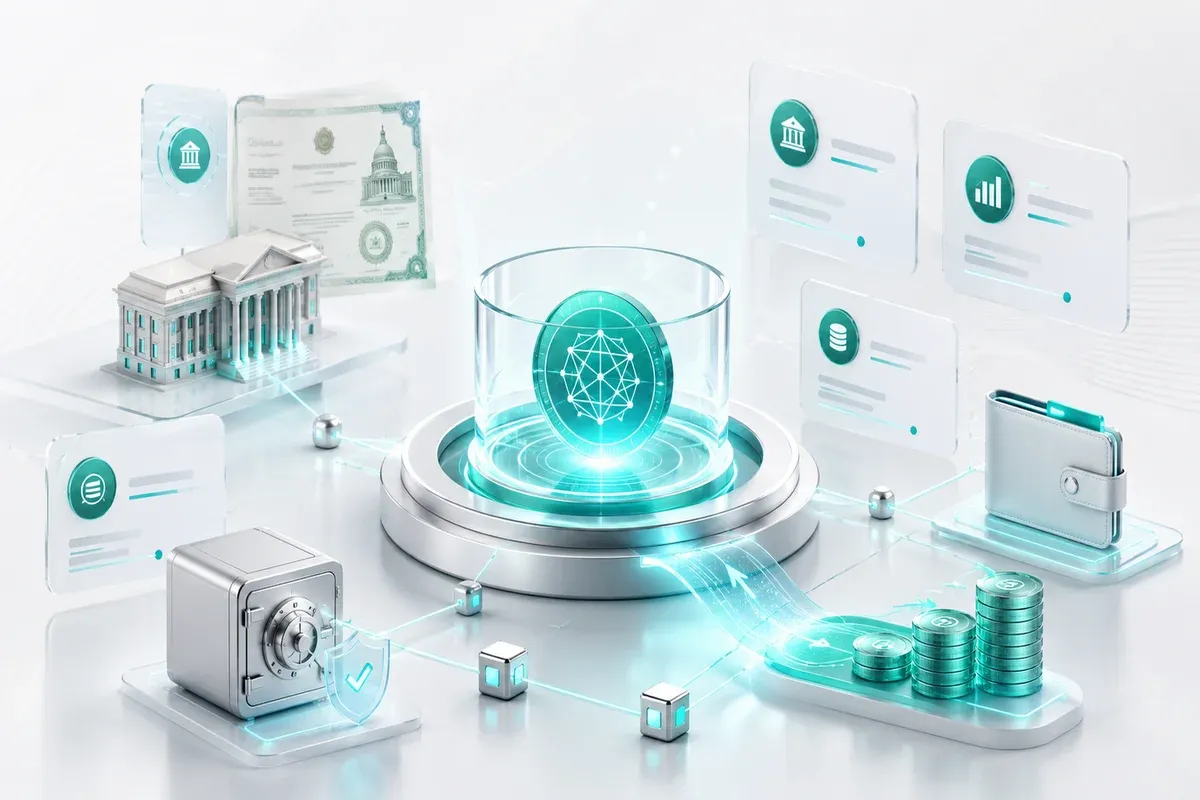
Asset Tokenization: Meaning, How It Works, and Examples
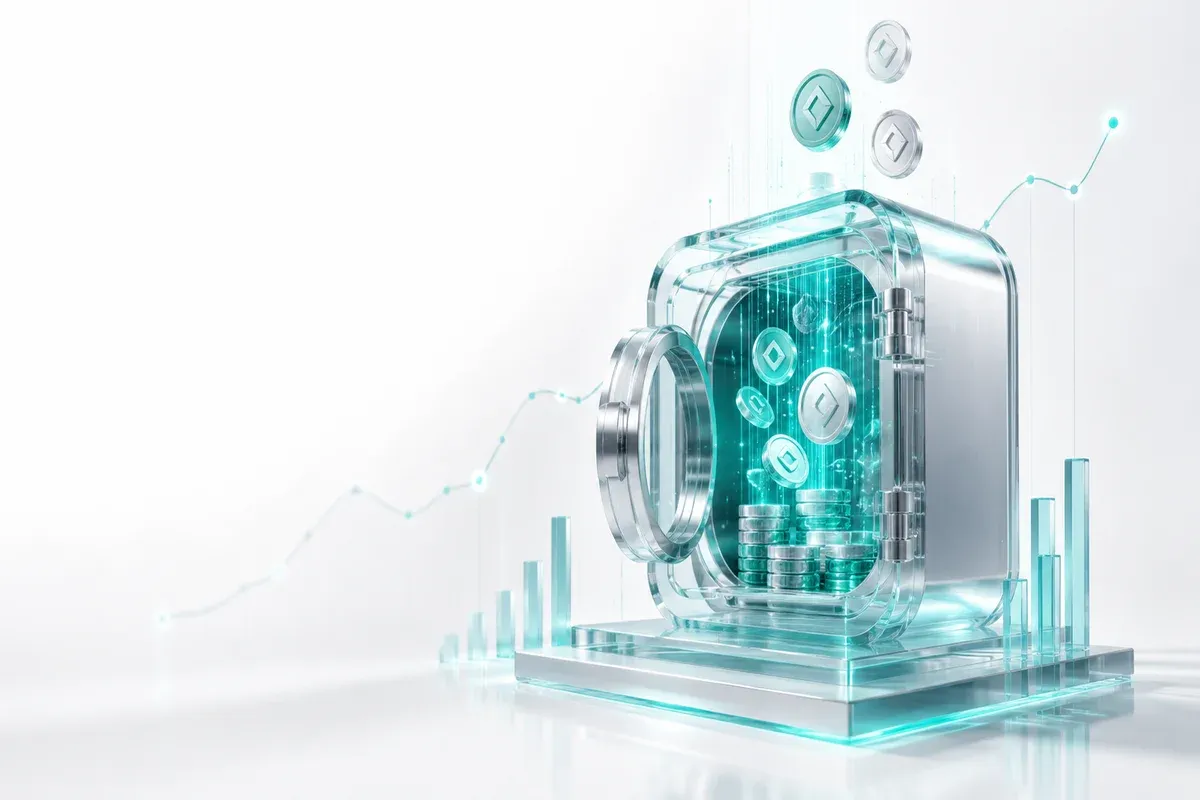
The token represents part or all of the asset's value, can be split into small pieces, and can be transferred digitally.
This article explains the meaning, the stages, the types of assets that can be tokenized, how it differs from securitization, and where the rules stand in Indonesia. Data was updated on 14 October 2026. For the big picture on real-world assets on the blockchain, start with what RWA is.
Key Points
- Asset tokenization records rights to a real asset as a token on a blockchain. The result is often called an RWA (Real World Asset).
- The process has five stages: asset valuation, custody, token issuance, trading, then redemption and reporting.
- Tokenization does not create a new asset. The original asset still exists, and the token is only its representation.
- According to rwa.xyz as of 13 October 2026, the value of real-world assets distributed on blockchains is about US$39.11 billion, with more than 5.2 million holders.
- In Indonesia, OJK supervises digital financial assets and is still drafting a dedicated rule for offering tokenized assets (as of 8 October 2026).
- The main benefits are fractional ownership and digital access. The risks lie with issuers, custodians, legal rights, and liquidity.
Asset Tokenization: Meaning and a Simple Example
Imagine a one-troy-ounce gold bar in a vault. With tokenization, the issuer records one token for that ounce. The token can be bought and sold, while the gold stays in the vault. The token holder holds a claim designed to follow the price of that gold.
An important note: the word "tokenization" has another meaning. In payment systems, card tokenization means replacing the real card number with a random code to make transactions safer. That is different from the asset tokenization discussed here, which means representing the value of an asset as a token that can be traded.
How Asset Tokenization Works in 5 Stages
1. Asset valuation and verification
The asset is valued by an independent party, and its ownership documents are checked. For a Rp100 billion building, for example, this stage confirms the asset really exists and is legally owned by the issuer. The harder an asset is to verify, the more important this stage is.
2. Legal structure and custody
The asset is usually placed in a specific legal vehicle and held by a custodian, for example a vault for gold or a custody institution for bonds. This stage determines what the token holder actually has a right to. A deeper look is in from real assets to digital tokens.
3. Token issuance through a smart contract
The issuer mints tokens using a smart contract, an automated program on the blockchain. The code sets the number of tokens, the transfer rules, and who may hold them.
4. Distribution and trading
Tokens are sold in a primary market, then traded on exchanges. This is where fractionalization shows up: an asset that could once only be bought whole can be owned in small pieces.
5. Redemption and reporting
Certain holders can exchange the token for the asset or its value, under the product's terms. Issuers also usually publish reserve reports regularly. An attestation report is not the same as a full audit, so check who issued it.
What Assets Can Be Tokenized
Technically almost any asset with economic value can be tokenized. The more mature cases so far are assets that are easy to price and store:
| Asset type | Examples | Notes |
|---|---|---|
| Gold | XAUT, PAXG | One token represents one troy ounce. About US$3.0 billion (XAUT) and US$1.8 billion (PAXG) as of 13 October 2026 (rwa.xyz). See XAUT and PAX Gold |
| Bonds | US government bond funds (BUIDL, USDY) | About US$2.2 billion (BUIDL) and US$2.3 billion (USDY) as of 13 October 2026 (rwa.xyz). See Ondo Finance |
| Stocks and ETFs | Tokenized US stocks | Gives price exposure, not voting rights. See how tokenized stocks work |
| Commodities | Oil, silver | See USOon |
| Property and credit | Property ownership shares, receivables | Hardest to verify, higher risk |
| Alternative assets | Artworks, collectibles | Secondary markets are usually thin |
Tokenization, Securitization, and Ordinary Crypto: What's the Difference
| Aspect | Asset tokenization | Securitization | Ordinary crypto (for example Bitcoin) |
|---|---|---|---|
| Underlying asset | A real asset | A pool of receivables or assets | No underlying asset |
| Form | Token on a blockchain | Security in the capital market | Token on a blockchain |
| Value comes from | The asset it represents | Cash flows of the underlying assets | Supply, demand, the network |
| Record-keeping | Blockchain | Capital market custody and settlement institutions | Blockchain |
The core difference: tokenization is a way of recording and transferring rights, while securitization is a way of packaging assets into securities. The two can meet in certain products.
Asset Tokenization in Indonesia as of October 2026
The supervisor is OJK. Since 10 January 2025, supervision of digital financial assets, including crypto assets, moved from Bappebti to OJK, with POJK Number 27 of 2024 as the implementing regulation.
A dedicated RWA tokenization rule has not been issued. OJK's Head of Executive Supervision for IAKD, Adi Budiarso, said on 8 October 2026 that the draft regulation on offering tokenized assets (RPOJK) is still being prepared, with drafting starting in October 2026 (Republika, 9 October 2026). The scope mentioned includes gold, government securities (SBN), the economic benefits of property, and token trading in closed ecosystems. In June 2026, OJK had targeted finalizing a related rule by the third quarter of 2026 at the latest, but as of 14 October 2026 we have not found confirmation that it has been issued.
OJK also runs a regulatory sandbox, and seven participants have passed. Their business models include gold tokenization, SBN tokenization, property ownership benefits, a rupiah stablecoin, digital asset custody, and crypto fund management. Through September 2026, OJK recorded 372 consultation requests, with 236 consultations held.
OJK gave an example of the benefit of fractionalization for SBN: a purchase that usually starts around Rp1 million could be split into Rp10 thousand or Rp100 thousand. That still depends on rules that are being drafted. The principle is "same activities, same risk, same regulation": activities with the same risk are regulated the same way, regardless of the technology.
A full discussion of the rules, tax, and risks is in RWA regulation, tax, and risks in Indonesia.
How Big Is the Tokenization Market
According to rwa.xyz as of 13 October 2026, the value of real-world assets distributed on blockchains is about US$39.11 billion, up about 0.28% over 30 days, with about 5.23 million holders (up about 20.6% over 30 days). On 8 October the figure was US$39.03 billion, so the value is roughly flat while the number of holders is growing. For comparison, an older projection from Boston Consulting Group and ADDX from 2022 estimated that the tokenized asset market could reach about US$16 trillion by 2030. Projections like this depend on adoption assumptions and are not guarantees.
Benefits and Risks of Tokenization
Benefits
- Fractional ownership makes high-value assets more affordable.
- Digital access and 24-hour trading, although the reference price still follows the original market.
- Transparent on-chain records, plus reserve reports from the issuer.
- Faster transaction settlement than conventional systems.
Risks
- Issuer and custodian. A token is only as good as the party that holds and guarantees the asset behind it.
- Legal rights. A token holder does not necessarily have a direct right to the underlying asset. Product terms and jurisdiction decide. For stocks, read what you actually hold when a stock becomes a token.
- Liquidity. Not every token has an active secondary market.
- Smart contract. Code can have security flaws.
- Changing rules. The dedicated framework is still being drafted.
Trading RWA on Mobee
Want to start with tokenized assets? Mobee is operated by PT CTXG Indonesia Berkarya, which is licensed and supervised by OJK, and you can access several types of tokenized assets in one app.
Why trade RWA on Mobee:
- In rupiah. Pairs such as XAUT/IDR and PAXG/IDR trade directly in rupiah, so you do not need to convert to dollars or a stablecoin first.
- OJK-supervised. For assets that are already high risk, a licensed platform supervised by the regulator is a sensible starting point. You can check the list of licensed platforms in OJK-supervised crypto exchanges.
- Several types of RWA in one place. Besides gold tokens, there are commodity tokens such as USOon, stock tokens such as LLYX (Eli Lilly, issued by Ondo), and tokenized US stocks. There is also ONDO, Ondo's governance token. You can compare the types without switching platforms.
- You can start small. Tokens can be bought in fractions, so you do not need to buy a full unit. Mobee's tokenized US stock product page says you can start investing from US$1. Check the minimum order for each pair in the app.
- Tools to keep track. Set a price alert on Mobee so you do not have to watch the screen, and learn about order types in trading before you trade. For gold, there is a daily update in digital gold price today.
What to know first. Not every example in this article is on Mobee. As of 14 October 2026 we did not find pairs for tokenized bond products such as BUIDL and USDY. Availability can change, so check directly in the app.
Steps to start:
- Open the Mobee app and complete identity verification.
- Add rupiah to your balance.
- Look up the asset you want to study, for example XAUT/IDR, or see other options in the Mobee RWA category.
- Start small, set a price alert, and spread your positions. A guide to choosing assets is in how to choose assets.
Trading crypto assets is high risk, and RWA tokens depend on their issuer and custodian. Use only funds you are prepared to lose.
Conclusion
Asset tokenization is a way of recording rights to a real asset as a token on a blockchain, so it can be split and traded digitally. The five stages show that the quality of the asset, the custodian, and the issuer matters more than the technology.
In Indonesia, the basic framework already exists through OJK and POJK 27/2024, while the dedicated RWA tokenization rule is still being drafted. Understand the mechanism, check the issuer and custodian, and treat tokens as high-risk instruments.
Frequently Asked Questions
What is asset tokenization?
Asset tokenization is the process of turning rights to a real asset, such as gold, stocks, or property, into a digital token on a blockchain. The token represents part or all of the asset's value and can be split and traded.
What is tokenization, and is it the same as card tokenization?
No. Card tokenization replaces the real card number with a random code to keep transactions safe. Asset tokenization represents the value of a real asset as a token that can be traded.
How does asset tokenization work?
The asset is valued and verified, held by a custodian, and then a token is issued through a smart contract. After that the token is traded, and certain holders can redeem it under the product's terms.
What is the difference between tokenization and securitization?
Tokenization is a way of recording and transferring rights to an asset as a token on a blockchain. Securitization is a way of packaging assets or receivables into securities in the capital market. The two can meet in certain products.
Is asset tokenization legal in Indonesia?
Digital financial assets, including crypto assets, are supervised by OJK and governed by POJK 27/2024. A dedicated rule for offering tokenized assets is still being drafted by OJK as of October 2026, so the status of each product needs to be checked.
Does holding a token mean owning the real asset?
Usually not. You hold a token that represents the asset, while the real asset is kept by a custodian. Redemption rights and legal claims depend on the issuer's terms.
Can tokenized assets be traded on Mobee?
Some can. As of 14 October 2026 Mobee offers rupiah pairs for gold tokens (XAUT, PAXG), a commodity token (USOon), stock tokens (for example LLYX), and ONDO. We did not find pairs for tokenized bond products such as BUIDL and USDY. Check the app for the latest availability.
Disclaimer
This article is for information and education only and is not investment, legal, or tax advice. Crypto assets and real-world asset tokens are high-risk instruments with large volatility. Do your own research and use only funds you are prepared to lose. Mobee is operated by PT CTXG Indonesia Berkarya, which is licensed and supervised by the Indonesian Financial Services Authority (OJK).
 Direct market access from the app
 Start exploring digital assets with Mobee
Track the market, learn about digital assets, and start trading more conveniently with the Mobee App.
Mobee is licensed and supervised by the OJK. Not a solicitation to buy or sell any asset.