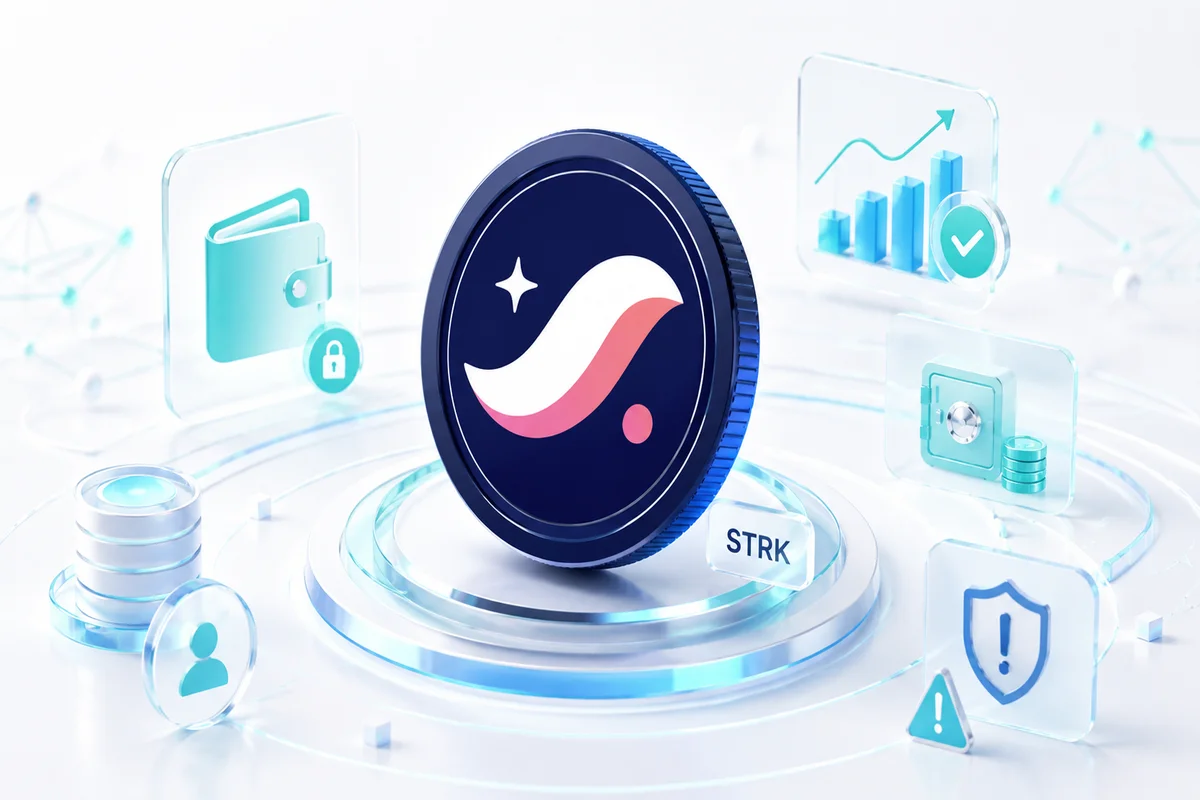
STRK is the governance token of StarkNet, a layer-2 scaling solution for Ethereum that uses Zero-Knowledge Rollup (zk-Rollup) technology. This token allows holders to participate in network governance, pay transaction fees, and stake for security. As Ethereum adoption grows and scalability needs rise, STRK has become one of the most anticipated layer-2 tokens in 2026. It offers a unique approach within the Ethereum ecosystem with significant long-term growth potential for crypto investors.
Key Points
- STRK is the governance token of StarkNet, used for voting, gas fees, and staking.
- StarkNet leverages zk-Rollup technology to boost speed and reduce transaction costs on Ethereum.
- The total supply of STRK is capped at 10 billion tokens, with gradual distribution until 2030.
- dApp adoption on StarkNet is growing, with total value locked (TVL) reaching $1.2 billion as of June 2026.
- Key risks include competition from zkSync and Arbitrum, as well as high price volatility.
What Is STRK?
STRK is the native token of StarkNet, a layer-2 network designed to scale Ethereum by processing transactions off-chain and submitting cryptographic proofs to the main chain. Unlike Optimistic Rollups that rely on fraud proofs, StarkNet uses validity proofs (zk-Stark) that are faster and more secure. The token was first launched in 2024 and has since become one of the most liquid tokens on centralized exchanges like Binance and Coinbase. According to CoinGecko data as of June 2026, STRK has a market capitalization of approximately $2.8 billion, ranking it among the top 50 cryptocurrencies.
Main Functions of STRK
STRK serves three primary functions within the StarkNet ecosystem:
• Governance: Holders can vote on protocol changes, such as fee adjustments or feature upgrades.
• Fee Payment: All transaction fees on StarkNet are paid in STRK, making it the primary utility token.
• Staking: Token holders can stake to secure the network and earn rewards in STRK.
Additionally, STRK is used to incentivize developers building dApps on StarkNet. The developer grant program has allocated 10% of the total supply to foster ecosystem growth.
Recent Performance and On-Chain Data
STRK's performance in the first half of 2026 showed significant improvement, driven by the launch of several major dApps in DeFi and NFT sectors. This activity is reflected in on-chain metrics:
• StarkNet TVL reached $1.2 billion as of June 2026, up 150% from the start of the year (source: L2Beat, June 2026).
• Average daily transaction volume on StarkNet hit 500,000, with an average fee of $0.05 per transaction (source: StarkScan, June 2026).
• The annual inflation rate of STRK is currently around 4%, with plans to gradually decrease to 1% by 2030.
These figures show that the StarkNet ecosystem is growing faster than the average layer-2 project, though it still trails Arbitrum in TVL.
Growth Catalysts
Several factors are driving STRK growth in the remainder of 2026:
• Widespread Ethereum adoption: More users are moving to layer-2 solutions to reduce costs.
• Technological innovation: StarkNet continues to develop Cairo, an efficient smart contract programming language.
• Strategic partnerships: Collaborations with major DeFi projects like Aave and Uniswap have landed on StarkNet.
• Supportive regulation: Crypto regulatory frameworks in Indonesia and globally are becoming clearer, providing investor certainty.
However, these catalysts do not guarantee price increases as markets remain influenced by macroeconomic factors.
Key Risks
Investing in STRK carries risks that need to be understood:
• Intense competition: zkSync and Arbitrum have larger user bases and stronger funding.
• Price volatility: STRK price can drop more than 50% in a month, as seen in January 2026 during a market correction.
• Market sentiment: Negative news about zk-Rollup security or regulation could pressure prices.
• Liquidity: Although listed on major exchanges, trading volume is still concentrated in a few pairs.
Therefore, investors should only allocate funds they can afford to lose and diversify their portfolios.
Comparison with Other L2s
StarkNet excels in low fees and security but lags in EVM compatibility. For developers seeking quick migration, zkSync or Arbitrum may be more attractive.
Strategies for Investors
For investors interested in STRK, consider these strategies:
1. Accumulation: Buy during dips to build a long-term position.
2. Staking: Stake STRK to earn rewards, either on exchanges or through platforms like Mobee.
3. Monitor metrics: Track TVL and transaction volume on StarkNet to gauge adoption.
4. Diversify: Don't focus solely on one L2 token; combine with ETH or other L2 tokens.
As a first step, ensure you understand the risks and have a clear investment plan.
Conclusion
STRK is a promising token in the Ethereum layer-2 ecosystem with superior zk-Rollup technology. Growth in TVL and transaction volume indicates solid adoption, but competition from other projects remains a challenge. For investors seeking exposure to Ethereum scaling, STRK could be an option, provided it is managed carefully. Always do your own research before buying.
FAQ
Mobee helps users explore crypto and investment products through a platform designed for easier access and practical learning. Start your investment journey through Mobee and choose products that match your goals and risk profile.