What Is a Stablecoin? Types, How It Works & Examples
A stablecoin is a type of cryptocurrency designed to maintain a stable value by pegging it to a real-world asset, such as a fiat currency (USD, EUR), a commodity like gold, or through a specialized algorithmic mechanism. In short, a stablecoin is a crypto asset that does not fluctuate with market sentiment.
That is what fundamentally sets it apart from Bitcoin. Many beginners ask whether Bitcoin is a stablecoin; the answer is no. Bitcoin is a highly volatile asset whose price can move by tens of percent in a single day. Stablecoins exist precisely to solve that problem, offering predictable value for transactions and hedging within the digital asset ecosystem.
Read also:
How Does a Stablecoin Work?
A stablecoin maintains its value through reserve assets held in equivalent amounts. These reserves serve as a guarantee that every coin in circulation can be redeemed for its underlying asset at a fixed rate, for example 1 USDT is always worth 1 USD.
Some stablecoins use an over-collateralization system, where the value of assets locked as collateral exceeds the value of coins issued, providing an extra buffer against market volatility. For instance, to mint $100 worth of DAI, a user must lock up $150 or more in crypto collateral.
Others rely entirely on algorithms to automatically expand or contract the coin supply, with no physical reserves at all. Each approach carries a different level of security and risk, something worth understanding before choosing the right stablecoin for your needs.
Types of Stablecoins
Stablecoins fall into four main categories based on the mechanism used to maintain their stability:
1. Fiat-Backed Stablecoins
These are directly backed by fiat currencies such as USD, EUR, or JPY, held in reserve accounts by the issuer. Every coin in circulation is guaranteed at a 1:1 ratio with the underlying currency.
Stablecoin examples: Tether (USDT) and USD Coin (USDC). USDC, developed by Circle and Coinbase, is widely considered more transparent as its reserves are audited regularly by independent accounting firms.
Advantage: High stability, backed by liquid real-world assets. Risk: Centralized and dependent on trust in the issuing party.
2. Commodity-Backed Stablecoins
Their value is supported by physical commodities such as gold, silver, or oil. Each token represents ownership of a quantity of commodity stored in a licensed, audited facility.
Stablecoin examples: Paxos Gold (PAXG) and Digix Gold (DGX), both pegged to the price of gold per troy ounce.
Advantage: Potential long-term protection against inflation. Risk: Commodity price fluctuations still affect the stablecoin's value, though movements are far slower and more measured than speculative crypto assets.
3. Crypto-Backed Stablecoins
Collateralized by other crypto assets. Because crypto values can swing sharply, these systems apply over-collateralization as a safety buffer.
Stablecoin examples: DAI, backed by Ethereum (ETH) and other crypto assets through the MakerDAO protocol.
Advantage: More decentralized than fiat-backed stablecoins, no single entity holds full control. Risk: An extreme drop in the value of collateral assets can threaten the system's stability.
4. Algorithmic Stablecoins
These have no physical reserves. Stability is maintained by an algorithmic protocol that automatically increases or decreases the coin supply in the market to keep the price at its target.
Stablecoin examples: TerraUSD (UST) — before its catastrophic depegging in May 2022. Within less than a week, UST lost nearly all of its value, wiping out more than $40 billion from the global crypto market.
Advantage: Fully decentralized with no dependence on physical reserves. Risk: Vulnerable to a death spiral, where the algorithm's mechanism amplifies a price crash rather than stabilizing it.
Top 5 Stablecoins Right Now
If you're wondering what the top 5 stablecoins are, here are the names that consistently dominate by market capitalization and trading volume:
1. Tether (USDT) holds the number one position as the world's largest stablecoin. USDT is the primary trading pair on virtually every major crypto exchange globally and remains the go-to instrument for fast cross-platform transactions.
2. USD Coin (USDC) ranks second and is the preferred choice among institutional players. Its strict reserve audit standards make USDC one of the most transparent stablecoins available.
3. DAI is a decentralized, Ethereum-based stablecoin and the most widely used in the DeFi (Decentralized Finance) ecosystem. DAI lets users access stable value without relying on any centralized institution.
4. First Digital USD (FDUSD) is a fast-growing newcomer, fully backed by First Digital Trust and widely adopted on the Binance platform since 2023.
5. PayPal USD (PYUSD) is issued directly by PayPal, making it the first stablecoin launched by a global-scale payments company — a strong signal about the direction of mainstream stablecoin adoption.
Stablecoin vs Bitcoin, What's the Difference?
The question "is Bitcoin a stablecoin?" comes up often among newcomers, and the answer is clear: no. Bitcoin and stablecoins are two instruments with fundamentally different purposes in the crypto ecosystem.
Bitcoin is designed as a long-term store of value, "digital gold" with a hard supply cap of 21 million coins. Its price depends entirely on market demand and can fluctuate dramatically. Stablecoins, by contrast, are built so their value doesn't move. The focus is not on price appreciation, but on reliability and ease of transaction.
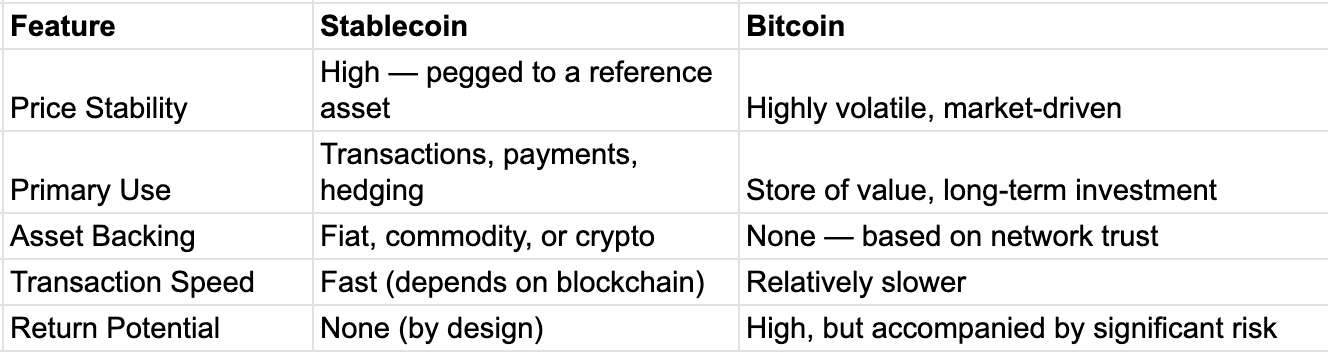
Simply put: if Bitcoin is an instrument to grow, stablecoins are an instrument to preserve. Both can have a role in a well-planned portfolio.
Which Is the Safest Stablecoin?
Among all stablecoin types, fiat-backed stablecoins like USDC are generally considered the safest. Their reserves consist of the most liquid assets (cash and short-term U.S. Treasury securities) and are audited regularly by independent third parties.
USDT is also highly safe in terms of liquidity and adoption, though it faced controversy over its reserve composition in the past. Meanwhile, algorithmic stablecoins like UST proved that the absence of real reserves can be a fatal weakness when markets come under extreme pressure.
In general, three factors determine how safe a stablecoin is:
1. Reserve transparency is the most critical factor. Choose a stablecoin that publishes regular, publicly verifiable reserve audit reports.
2. Regulation and oversight. In many jurisdictions, crypto assets, including stablecoins, are subject to financial regulation. Transacting through a regulated platform provides clear legal protection for users.
3. Type of stability mechanism. Fiat-backed > commodity-backed > crypto-backed > algorithmic. This order reflects the risk level from lowest to highest, based on historical performance and fundamental structure.
The Role of Stablecoins in the Future of Digital Finance
Stablecoins are no longer just a place to "park" crypto assets temporarily. Their ability to bridge conventional financial systems with blockchain infrastructure is making them increasingly relevant to global financial institutions.
Cross-border payments that previously took 2-5 business days and significant fees can now be settled in minutes at near-zero cost using stablecoins. A number of multinational corporations have even begun using them for real-time B2B transaction settlements.
Beyond that, many central banks worldwide — including those in Southeast Asia — are developing CBDCs (Central Bank Digital Currencies), which are essentially government-issued versions of stablecoins. This is a strong signal that the concept behind stablecoins is not a passing trend, but rather the foundation of the next generation of digital financial infrastructure.
Read also:
Stablecoins are among the most practical innovations in the digital asset ecosystem — delivering stability and predictability in a market full of surprises. Whether for cross-border transactions, portfolio hedging, or as an entry point into the world of DeFi, stablecoins offer a clear, measurable, and increasingly relevant solution.
Invest in stablecoins and other crypto assets safely on Mobee, an app regulated and supervised by OJK. Download it now on the App Store or Google Play!
Sources:
Stablecoins: Definition, How They Work, and Types. Accessed in 2026. Investopedia.
What Is a Stablecoin? A Beginner's Guide. Accessed in 2026. Be(In)Crypto.
Disclaimer:
This content is intended to provide additional information to readers. Always conduct your own research before investing. All buying, selling, and investment activities in crypto assets are entirely the reader's responsibility.
 Direct market access from the app
 Start exploring digital assets with Mobee
Track the market, learn about digital assets, and start trading more conveniently with the Mobee App.
Mobee is licensed and supervised by the OJK. Not a solicitation to buy or sell any asset.