SpaceX Stock (SPCX) in 2026: Analysis, Outlook & How to Buy
On June 12, 2026, SpaceX began trading on the Nasdaq under the ticker SPCX — and in doing so, rewrote the record books. Priced at $135 per share and raising $75 billion, it became the largest IPO in history, surpassing Saudi Aramco's 2019 debut by more than double. The implied valuation at listing was approximately $1.75 trillion, placing SpaceX immediately among the ten most valuable companies on any public exchange in the world.
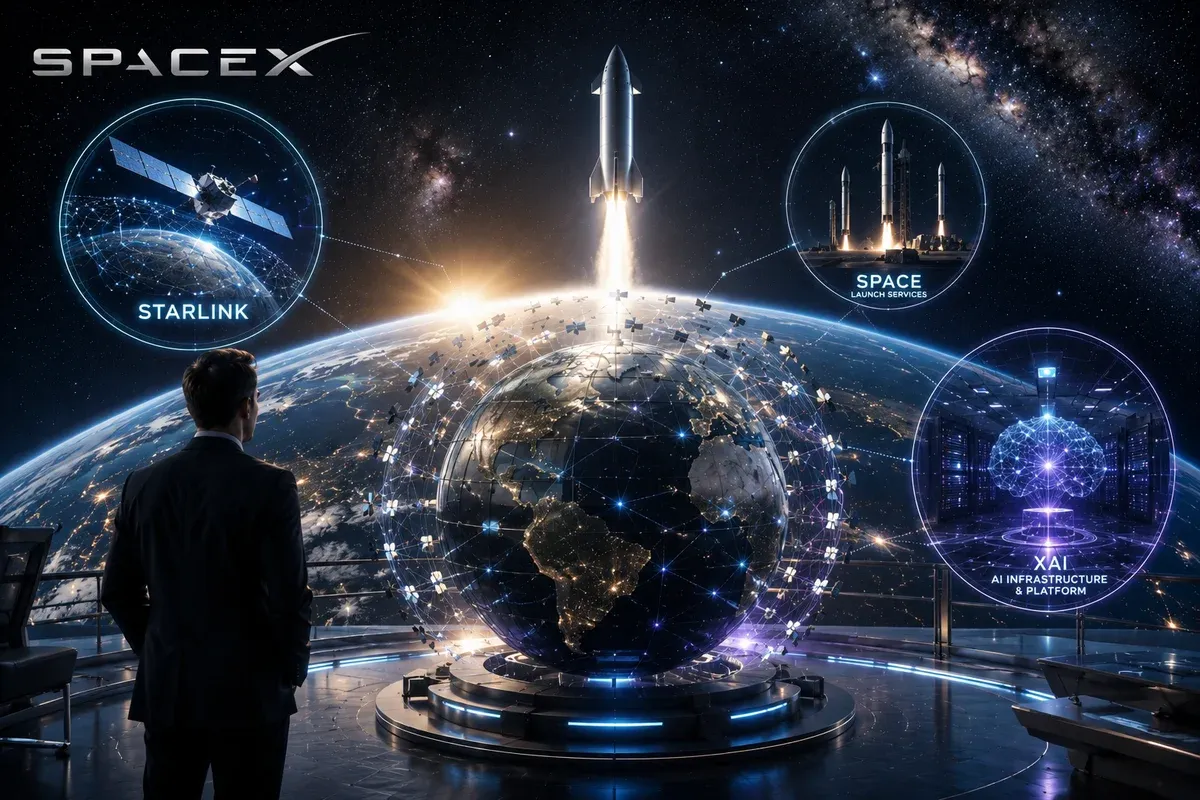
But the size of the IPO is almost beside the point. What makes SPCX worth understanding — and what separates it from most large-cap tech listings — is the underlying business model. SpaceX is not one company. It is three fundamentally different businesses operating under a single corporate structure, each with radically different economics, and only one of them is actually profitable.
This is a full breakdown: what the financials show, what the market is pricing in, where the real risk sits, and how investors outside the US can access SPCX through regulated tokenized stock infrastructure.
Key Points
- SpaceX raised $75 billion in the largest IPO in history, pricing at $135/share on June 11, 2026
- Total 2025 revenue: $18.7 billion (+33% YoY), with Adjusted EBITDA of $6.6 billion
- Starlink is the only profitable segment — $4.4B operating income in 2025 at a 39% margin
- Starlink subscriber growth: 2.3M (2023) → 4.4M (2024) → 8.9M (2025) → 10.3M in Q1 2026
- xAI segment posted a $6.35B operating loss in 2025 — the primary driver of SpaceX's net loss
- Net loss in 2025: $4.94 billion — despite strong Starlink profitability
- Analyst consensus: Buy, average 12-month price target of $164 (range: $63–$227)
- SPCX trading at ~$160.95 as of June 14, up ~19% from IPO price
- Tokenized SPCX is now accessible to international investors via regulated platforms including Mobee
The Financial Reality Behind a $1.75 Trillion Valuation
SpaceX's S-1 filing, submitted to the SEC in May 2026, gave public markets their first detailed look at the company's books. The top-line numbers are strong. The segment breakdown is where the story gets complicated.
| Segment | 2025 Revenue | Share of Total | Operating Income/(Loss) |
|---|---|---|---|
| Starlink (Connectivity) | $11.4B | 61% | +$4.4B |
| Space (Launch) | $4.1B | 22% | -$657M |
| xAI (AI & Platform) | $3.2B | 17% | -$6.35B |
| Total | $18.7B | 100% | -$2.59B |
The picture that emerges is of a company where one division — Starlink — is generating serious recurring cash flow, while two others are burning capital aggressively. The question SPCX's valuation ultimately rests on is whether the cash Starlink generates today is large enough, and growing fast enough, to fund the speculative bets in Space and AI until those bets pay off.
In Q1 2026, total revenue grew 15% YoY. Starlink alone generated $3.26B in that quarter with $1.19B in operating income — a 36% margin, accelerating from a standing start just a few years ago. The trajectory is real. But it's being asked to carry an enormous amount of weight.
Starlink: The Engine That Makes the Whole Thesis Work
Strip away Starship, strip away xAI, strip away the Elon Musk narrative — and the investment case for SPCX rests almost entirely on Starlink. That's not a criticism. Starlink is genuinely one of the most impressive subscription businesses built in the last decade.
The subscriber growth curve tells the story better than any prose:
| Period | Starlink Subscribers | Growth YoY |
|---|---|---|
| 2022 | ~1 million | — |
| 2023 | 2.3 million | ▲ +130% |
| 2024 | 4.4 million | ▲ +91% |
| 2025 | 8.9 million | ▲ +102% |
| Q1 2026 | 10.3 million | ▲ +16% |
That's a compound annual growth rate of roughly 97% over three years. Quilty Space projects Starlink will reach 16.8 million subscribers by year-end 2026. And critically, Starlink operates across 164 countries and territories, supported by approximately 9,600 satellites in low Earth orbit — representing 75% of all actively maneuverable satellites currently in orbit globally.
The economics of a satellite network have a characteristic that traditional infrastructure businesses don't: once the constellation is deployed, each new subscriber adds revenue at near-zero marginal cost. This is why Starlink's operating income grew 120% in 2025 even as revenue grew "only" 50%. The leverage in the model increases as the subscriber base scales.
In May 2026, SpaceX raised Starlink plan prices by up to $10/month — the first meaningful price increase after years of deliberate underpricing to drive volume. The fact that subscriber growth continued through that price increase suggests the product's value proposition is robust enough to sustain it. For long-term investors, this is the most important data point in the entire SpaceX story. Understanding why durable, recurring businesses command premium valuations is central to any serious long-term investment framework.
Space: Loss-Making by Design
The launch business generated $4.1B in revenue in 2025 — but posted a $657M operating loss, driven almost entirely by Starship development costs. SpaceX already handles more than 80% of all mass launched to orbit globally. No other launch provider comes close.
The operating loss is deliberate. Starship, SpaceX's next-generation fully reusable rocket, is designed to reduce cost-per-kilogram to orbit by an order of magnitude compared to Falcon 9. If it reaches commercial viability — which remains a significant "if" — it would unlock mission categories that are currently economically impossible: large-scale in-orbit manufacturing, deep-space cargo, eventually crewed missions to Mars.
The bear case is that Starship's development timeline has slipped before and could slip again, with FAA regulatory approvals representing a bottleneck that SpaceX cannot control. The bull case is that SpaceX's track record on Falcon 9 — once considered impossibly ambitious — should be taken seriously as evidence of execution capability.
xAI: The Most Speculative Piece
The February 2026 merger with xAI — Elon Musk's AI company — added a third business to SpaceX's structure. xAI includes the X (Twitter) platform, the Grok large language model, and wholesale AI compute infrastructure called COLOSSUS.
In 2025, xAI generated $3.2B in revenue. It also generated $6.35B in operating losses, driven by $12.7B in capital expenditure on data center chips and infrastructure. In Q1 2026 alone, the segment added another $2.47B in operating losses.
SpaceX's pitch is that Starlink's satellite network, combined with solar-powered data centers in space, creates a cost structure for AI compute that terrestrial providers cannot replicate. The company plans to begin deploying orbital data centers as early as 2028. This is genuinely novel infrastructure thinking. It is also unproven at scale, years away from revenue contribution, and in direct competition with OpenAI, Google DeepMind, and Anthropic — all of which have substantially more AI research momentum today.
The xAI segment is the primary reason SpaceX reported a $4.94B net loss in 2025 despite Starlink's $4.4B operating profit. Investors need to decide whether they believe the xAI bet will eventually generate returns that justify the capital being deployed. The track record of AI infrastructure spending translating into durable competitive advantage is, to put it charitably, mixed. Sound portfolio risk management means pricing this uncertainty correctly before sizing a position.
Where the Stock Stands: Valuation and Analyst Targets
SPCX opened strong and has held above its IPO price. Here's where the consensus sits:
| Metric | Value |
|---|---|
| IPO Price | $135 |
| Current Price (June 14, 2026) | $160.95 |
| 52-Week High | $176.52 |
| Average Analyst Price Target | $164 |
| High Estimate | $227 |
| Low Estimate | $63 |
| Consensus Rating | Buy (4 Buy, 1 Sell) |
The $227 bull target reflects a scenario where Starlink scales to 20M+ subscribers, Starship achieves commercial viability on schedule, and xAI finds a path to profitability. The $63 bear target reflects a scenario where Morningstar's $780B intrinsic value estimate — roughly half the IPO valuation — proves more accurate and the market reprices accordingly.
The price-to-sales ratio at IPO was approximately 60x. For context, that's higher than almost any established technology company in the S&P 500. The multiple is pricing in years of future growth, which means the stock is unusually sensitive to any negative surprise in Starlink's growth trajectory. A deceleration from 97% subscriber CAGR to, say, 40% would still be extraordinary by any conventional measure — but the market might not read it that way given what it's currently paying. This dynamic is not unique to SPCX; understanding how premium valuations behave through earnings cycles is essential context.
Key Risks
Before building any position in SPCX, five risks deserve serious weight:
- Extreme valuation — At 60x trailing revenue, there is almost no margin for disappointment. Even a strong quarter that misses elevated expectations could trigger significant selling
- Elon Musk's super-voting control — Public shareholders have limited ability to influence corporate strategy. Decisions are made at Musk's discretion, including capital allocation between the three segments
- FAA regulatory exposure — Every Starship launch requires FAA approval. Regulatory delays have blocked launch windows before and could do so again at commercially critical moments
- xAI's capital intensity — The AI segment is currently burning more money than Starlink earns. If xAI's spending accelerates without corresponding revenue growth, it could erode the entire financial picture
- Thin free float — Only approximately 7% of shares were available to the public at launch, making early price action highly susceptible to volatility. This does not reflect the underlying business — but it affects entry and exit economics significantly
Applying a disciplined diversification framework matters here as much as it does with any high-conviction, high-valuation position.
Conclusion
SpaceX is a genuinely singular business. Starlink has built a global satellite internet infrastructure that no competitor can replicate in the near term, and it is generating real, expanding operating profit at a margin that would be impressive in any industry. The Space segment's dominance of launch services gives the company a structural cost advantage that funds the rest. xAI is the biggest question mark — a $6B+ annual burn rate chasing a market that the most well-resourced AI labs in the world are fighting over simultaneously.
At $1.75 trillion, SPCX is pricing in a future where all three of these bets work. That future is plausible. It is not guaranteed. Investors who enter at this valuation need patience, high tolerance for short-term volatility, and a portfolio structure that doesn't require SPCX to perform on any particular timeline.
FAQ
Starlink's fundamentals are genuinely strong — 10.3 million subscribers, 39% operating margins, and accelerating growth across 164 countries. The complication is valuation: at roughly 60x trailing revenue, the stock is pricing in years of continued outperformance. Long-term investors with high risk tolerance and a multi-year horizon have a credible case. Short-term traders should treat the thin free float and elevated multiple as significant volatility risks.
SpaceX operates through three segments: Starlink (satellite internet connectivity), Space (rocket launches and payload delivery), and xAI (artificial intelligence infrastructure, the Grok LLM, and the X platform). Only Starlink is currently profitable, generating $4.4 billion in operating income during 2025 with a 39% margin. The Space segment posted a $657 million operating loss, while xAI recorded a $6.35 billion loss due to aggressive AI infrastructure investments.
As of June 2026, five analysts covering SPCX maintain a consensus "Buy" rating with an average 12-month price target of $164. Estimates range from $63 on the bearish end to $227 on the bullish end, reflecting considerable uncertainty about whether the company's IPO valuation can be sustained over time.
The combination of a premium 60x price-to-sales valuation and xAI's ongoing multi-billion-dollar losses represents the most immediate risk. Investors are effectively paying a premium for Starlink's cash flow while funding a large AI expansion with an uncertain path to profitability. Additional risks include Elon Musk's super-voting control structure and regulatory exposure related to Starship launches.
International investors who cannot directly purchase SPCX through a US brokerage may be able to access tokenized SpaceX stock through regulated platforms offering blockchain-based equity exposure. These instruments are designed to track SPCX prices in real time and can often be traded outside traditional market hours. Availability, eligibility requirements, and redemption mechanisms vary by platform and jurisdiction.
Trade SpaceX Stock on Mobee — Available Now
International investors can now access SpaceX (SPCX) through Mobee's xStocks feature — tokenized US stocks that track real-time Nasdaq prices, tradeable 24/7 without a US brokerage account. Fractional trading means you don't need $160+ for a full share. You can start with whatever allocation fits your portfolio.
Mobee is supervised by Indonesia's Financial Services Authority (OJK) and registered as a member of ICEx — a regulated framework that brings access to global equity markets without the complexity of offshore brokerage accounts.
Download Mobee on the App Store or Google Play and start trading SPCX today.
 Direct market access from the app
 Start exploring digital assets with Mobee
Track the market, learn about digital assets, and start trading more conveniently with the Mobee App.
Mobee is licensed and supervised by the OJK. Not a solicitation to buy or sell any asset.