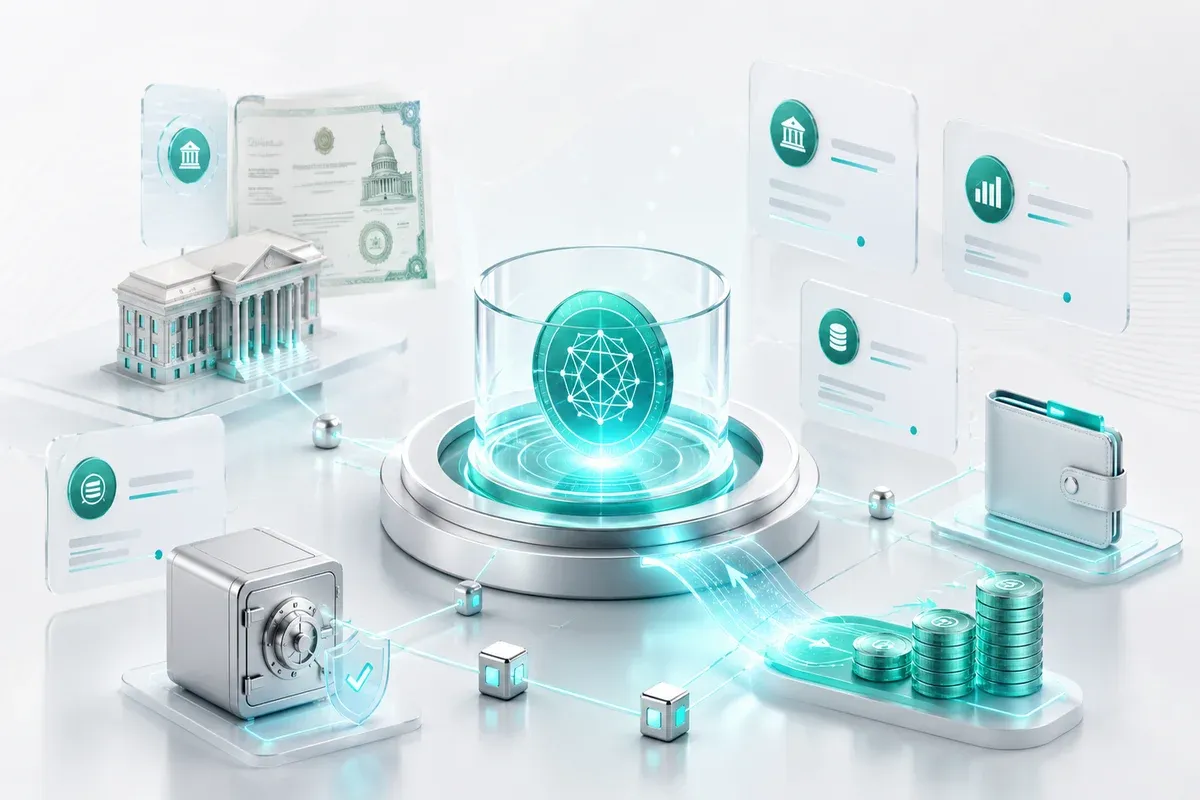
Chainlink and Oracles: Connecting Blockchain to Real-World Data

Chainlink is a decentralized oracle network that connects smart contracts with real-world data, and LINK is the native token that powers this ecosystem. Smart contracts on blockchains cannot directly access external information such as live market prices, temperature records, or sports results.
Chainlink solves this problem by pulling data from multiple sources, verifying it through a network of nodes, and delivering the verified result on-chain. That makes Chainlink one of the most important infrastructure layers across DeFi and asset tokenization. You can understand its position better by building a foundation in crypto.
Key Points
-
Decentralized oracle: Chainlink bridges smart contracts with external data through independent node operators.
-
LINK token: LINK pays for oracle services, staking, and incentives for accurate data reporting.
-
Data feeds: Chainlink Price Feeds support liquidation decisions across many DeFi protocols.
-
CCIP: Chainlink's interoperability protocol eases data and token transfers across blockchains.
-
Risk remains: LINK volatility and competition from other oracles must be monitored by investors.
What Is Chainlink and LINK?
Chainlink is a blockchain oracle project developed since 2017 according to its whitepaper, while LINK is an ERC-20 token that functions as payment within the network. Separating the network from the token matters because Chainlink adoption does not automatically push LINK higher. Based on CoinGecko data as of March 2026, LINK remains among the largest crypto assets by market capitalization, making it easier to analyze than small-cap tokens. You can build a stronger reading of the trend with on-chain analysis.
Why Chainlink matters:
- Oracle problem: Blockchains cannot validate external data internally without a trusted source.
- Decentralization: Chainlink uses multiple nodes to reduce data manipulation risk.
- Network effect: More protocol integrations strengthen the LINK economic model.
How Chainlink Works Through Decentralized Nodes
Chainlink turns a smart contract data request into a structured process involving multiple parties. The main flow looks like this:
1. Contract request: A smart contract sends a request for external data through an on-chain task.
2. Node selection: Operators choose tasks based on reputation and reward.
3. Data aggregation: Reports from many sources are combined using a median mechanism to filter outliers.
4. On-chain delivery: The verified result is sent to the requesting contract for execution.
According to Chainlink's 2024 documentation, each major price feed relies on diverse node networks with economic incentives to maintain accuracy. Users who want to follow network activity can check community dashboards and blockchain explorers.
Main Functions: Data Feeds, CCIP, and Staking
Through 2026, Chainlink has three core functions that dominate the ecosystem:
• Data Feeds: Provide real-time asset prices for lending protocols, DEXs, and derivatives.
• CCIP: Connect different blockchains for data, token, and instruction transfers.
• Staking: Allow LINK holders to lock tokens and contribute to network security.
According to the Chainlink Staking dashboard in early 2026, estimated staking rewards range between 4-6% per year, though the rate changes with staked volume. You can learn the mechanics in this staking crypto guide.
LINK Performance and Key Metrics to Watch
Based on DefiLlama data as of March 2026, the total value secured by DeFi protocols that rely on Chainlink oracles is estimated at tens of billions of dollars. That figure shows how deeply LINK sits inside the ecosystem, but it is not a direct price signal. Useful metrics include:
• Price action: Watch moving averages and support levels to identify trend direction.
• Trading volume: Volume confirms whether a price move is backed by liquidity.
• Total value secured: Measures how much of DeFi depends on Chainlink data.
• Integration count: More projects using Chainlink suggests stronger token demand.
Investors often compare LINK with the largest assets to assess growth potential. Still, oracle fundamentals are better measured by data accuracy and adoption than by price alone.
Key Catalysts for LINK
LINK movements are driven by a combination of macro conditions and sector trends:
• Macro: Looser Federal Reserve policy tends to increase appetite for crypto assets.
• Sector: Real-world asset tokenization needs reliable price oracles.
• Product: Institutional adoption of CCIP, such as Swift's proof-of-concept, reinforces Chainlink's credibility.
• Liquidity: LINK's deep market supports easier entry and exit for traders.
According to Swift's 2023 report, a proof-of-concept with Chainlink successfully tested tokenized value movement across blockchains. This momentum stays relevant because RWA projects require dependable valuation data.
Main Risks of LINK
LINK offers opportunity, but several risks should be understood before entering:
• Volatility: LINK can drop sharply during market corrections; a 30-40% decline in weeks is possible when sentiment reverses. Mitigation: keep position size small and define risk limits.
• Competition: Protocols like Pyth and Band could take market share. Mitigation: monitor adoption and data volume relative to Chainlink.
• Smart contract bugs: Network contracts could contain security flaws. Mitigation: use audited protocols and follow security notices.
• Regulation: The legal status of LINK can change across jurisdictions. Mitigation: understand local rules before buying.
Bullish and Bearish Scenarios for LINK
The table below gives a simple framework for interpreting LINK conditions:
| Scenario | Supporting Conditions | Potential Impact on LINK |
|---|---|---|
| Bullish | CCIP adoption grows, RWA sector expands, volume rises | LINK demand increases and price gains strength |
| Bearish | Regulatory pressure, oracle competition, crypto downturn | LINK corrects and trading volume weakens |
| Neutral | Sideways market, stable staking participation | LINK follows Bitcoin with moderate volatility |
This framework helps you build a plan instead of guessing price direction. Combine the table with on-chain analysis and fresh market news to make more objective decisions.
Strategy for Beginners Reading LINK Opportunities
Beginners should avoid buying LINK simply because price is moving. Use this step-by-step approach:
1. Learn project fundamentals: Study the whitepaper, tokenomics, and LINK's role before buying.
2. Monitor on-chain signals: Check volume, active addresses, and staking flows.
3. Apply risk management: Use a small portfolio allocation and set clear targets.
4. Use a trusted platform: Trade directly through Spot Trade.
5. Review periodically: Read tips trading crypto to build a healthy buy-sell framework.
Conclusion
Chainlink is a leading decentralized oracle network whose core value comes from the data infrastructure it provides to DeFi and tokenized assets. LINK gives investors exposure to that infrastructure, but the token still carries volatility, regulatory, and competition risks. Beginners should treat LINK as a learning asset, not a shortcut to fast profits. Use on-chain analysis, position sizing, and a disciplined strategy before entering the market.
FAQ
Is Chainlink the same as LINK?
No. Chainlink is the oracle network, while LINK is the native ERC-20 token launched in 2017. Based on CoinGecko data as of March 2026, LINK remains among the top 20 crypto assets by market capitalization.
How does Chainlink get data?
Chainlink requests data from multiple independent nodes, aggregates the results using a median mechanism, and delivers the verified value on-chain. According to Chainlink's documentation, major price feeds use many independent sources to improve accuracy.
Can LINK be staked?
Yes. According to the Chainlink Staking dashboard in early 2026, estimated rewards range around 4-6% per year, but the rate depends on total staked value and market conditions.
What is the difference between Chainlink and other oracles?
Chainlink focuses on decentralized data feeds, cross-chain messaging through CCIP, and staking incentives. Competitors like Pyth or Band may offer faster or cheaper data, but Chainlink has a wider integration history.
Is LINK safe for beginners?
LINK is a liquid and widely researched asset, but it is not safe from extreme price swings. Beginners should start with a small allocation, use Spot Trade, and monitor risk continuously.
Start with Mobee
Mobee is a digital asset platform licensed and supervised by OJK, helping users explore crypto and investment products with clearer access and practical learning. Start your investment journey through Mobee and choose products that match your goals and risk profile.
 Direct market access from the app
Start exploring digital assets with Mobee
Track the market, learn about digital assets, and start trading more conveniently with the Mobee App.
Mobee is licensed and supervised by the OJK. Not a solicitation to buy or sell any asset.