What Is RWA? Meaning, Examples, and How Real World Assets Work

RWA stands for Real World Assets: real-life assets such as gold, bonds, property, or stocks that are recorded as tokens on a blockchain. With tokens, ownership can be split into small pieces and traded digitally. This article explains the meaning, how it works, examples, benefits, and risks.
If you are looking for "bank RWA" or "RWA Bhineda," that is something different. It is explained in the section RWA in banking below.
Key Points
- RWA (Real World Assets) are real assets represented as tokens on a blockchain, such as gold, debt securities, stocks, and property.
- Tokens let ownership be split (fractional) and traded 24 hours a day, but you generally hold a token, not the underlying asset.
- According to rwa.xyz as of 8 October 2026, the value of RWAs distributed on blockchains is about US$39.03 billion, with more than 5.1 million holders.
- Gold and US government debt are the largest categories. Property and private credit are smaller and harder to verify.
- The main risks are the issuer, the custodian, asset verification, and rules that are still developing. No returns are guaranteed.
RWA Explained: What Real World Assets Mean
An RWA is an asset whose value comes from the real world and is then "re-recorded" as a token on a blockchain. The process of turning an asset into a token is called asset tokenization.
A simple analogy: a land certificate. The land stays where it is, and the certificate is proof that can be transferred. In RWA, the token plays the role of that proof, which can be bought, sold, and split into small pieces, while the underlying asset is held by a party appointed by the issuer.
The most common RWA examples:
- Gold: one token represents one troy ounce of gold, such as XAUT and PAXG.
- US government debt: tokenized money market funds or short-term bonds.
- Stocks and ETFs: tokens whose price follows a stock or index, such as Apple or the S&P 500.
- Other commodities: oil, silver, and metals.
- Property and credit: fractional property ownership or receivables, which are the hardest to verify.
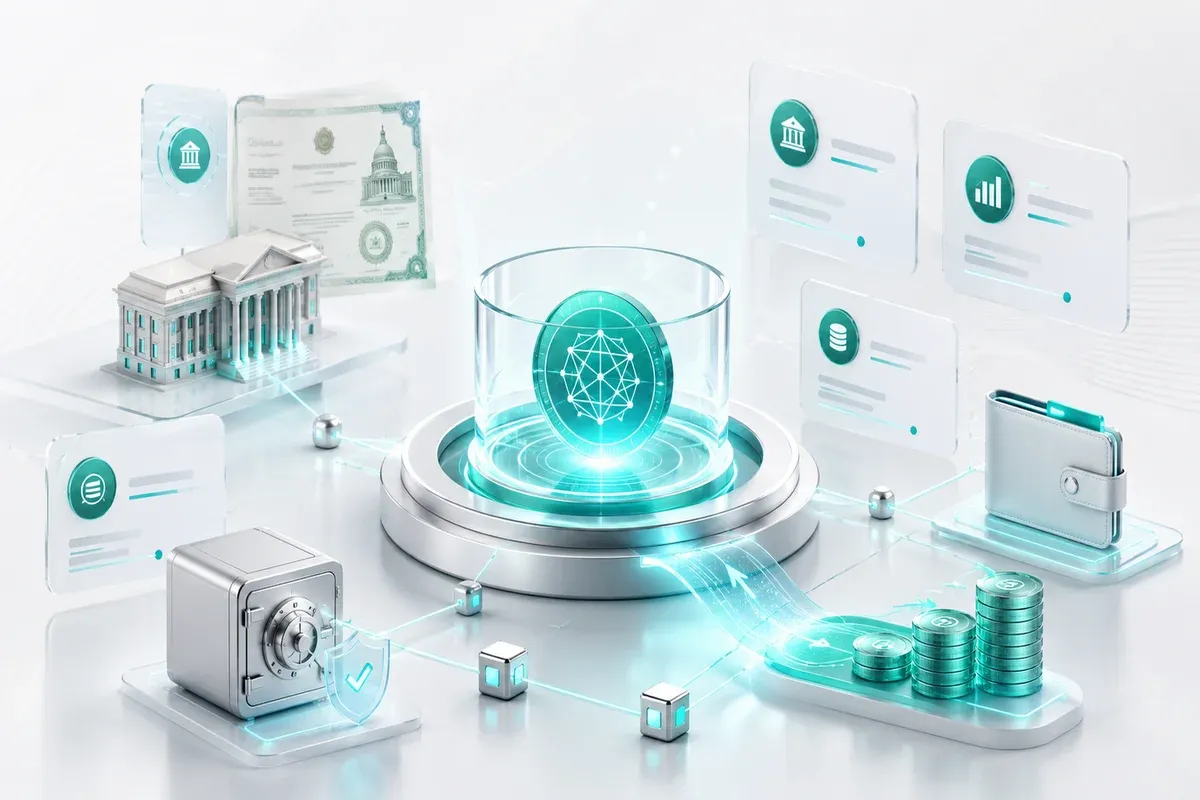
How RWA Works in 5 Steps
- The asset is valued and verified. An independent party values the asset and checks the ownership documents.
- The asset is held by a custodian. Gold is kept in a vault, debt securities at a custody institution. A token is valid only if there is an asset behind it.
- The token is issued through a smart contract. An automated program on the blockchain mints tokens that represent the asset, complete with transfer rules.
- The token is distributed and traded. You can buy it on an exchange, often in small fractions and around the clock.
- Redemption and reporting. Certain holders can exchange tokens for the asset or its value, and the issuer publishes reserve reports.
The details of each step, including how it differs from securitization, are in the asset tokenization guide.
Real-World RWA Examples and Availability on Mobee
The figures in the table come from rwa.xyz as of 8 October 2026 and change every day. The Mobee column refers to the Mobee crypto asset list, so check the status in the app.
| Asset class | Example product | Distributed value (US$) | On the Mobee asset list |
|---|---|---|---|
| Gold | XAUT (Tether Gold) | about 2.9 billion | Yes, see XAUT |
| Gold | PAXG (PAX Gold) | about 1.8 billion | Yes, see PAX Gold |
| US government debt | USYC, USDY, BUIDL (BlackRock), BENJI (Franklin Templeton) | about 1.7 to 2.4 billion per product | Not listed |
| US stocks and ETFs | Stock and ETF tokens | varies | Yes, see how stock tokens work |
| Fund-based commodities | Oil, silver | varies | Yes, see USOon |
| Private credit | JAAA and others | hundreds of millions | Not listed |
A fuller list of RWA coins and tokens, including the difference between asset tokens and ecosystem coins, is in the article on which RWA coins exist.
RWA vs DeFi
DeFi (Decentralized Finance) is a set of financial services built on smart contracts, such as lending and token swaps, which generally use native crypto assets. RWA is real-world assets brought onto a blockchain. The two can meet: RWA tokens are often used in DeFi protocols. An introduction to DeFi is in what is DeFi.
| Aspect | RWA | DeFi |
|---|---|---|
| Underlying asset | Real-world assets | Native crypto assets |
| Examples | Gold, debt securities, stocks | ETH, stablecoins, DeFi tokens |
| Price driver | Price of the reference asset | Crypto market and protocols |
| Typical risks | Issuer, custodian, legal | Smart contract, liquidity |
| Regulation | More complex because a real asset is involved | Varies |
Benefits of RWA
- Fractional ownership. Expensive assets can be bought in small pieces.
- 24-hour access. Tokens can be traded outside traditional market hours, although the reference price still follows the original market.
- Transparent records. Transactions are recorded on the blockchain, and many issuers publish reserve reports.
- Access to global assets. Gold, debt securities, and US stocks can be reached without an overseas account.
- Faster settlement. Settlement can happen in seconds to minutes, compared with days in conventional systems.
These benefits depend on the quality of the issuer and the platform. Easier access does not reduce price risk.
RWA Risks and Challenges
- Issuer and custodian. A token is only as good as the party that holds and guarantees the asset behind it.
- Asset verification. The harder an asset is to verify, such as property, the greater the risk.
- Legal rights. You hold a token, not the asset in your own name. Redemption rights depend on the product terms.
- Liquidity and price gap. Small fractions are not automatically easy to sell, and the token price can differ from the reference asset.
- Exchange rate and smart contract. Many assets are denominated in US dollars, and smart contracts can have flaws.
- Regulation. In Indonesia, dedicated rules for RWA tokenization are still being drafted by OJK as of October 2026.
A full discussion of OJK rules, tax, and the risk checklist is in RWA regulation, tax, and risks in Indonesia.
RWA in Banking Means Something Different
In banking, "RWA" means Risk-Weighted Assets (called Aset Tertimbang Menurut Risiko, or ATMR, in Indonesian). It is a measure banks use to calculate minimum capital based on the risk level of their assets, for example in the capital adequacy ratio (CAR). Risk-weighted assets are a banking accounting and regulatory concept, unrelated to tokenization or crypto.
So if you come across "bank RWA" or "Bank Mandiri RWA example," it refers to risk-weighted assets. This article covers RWA as Real World Assets on a blockchain.
How to Get Started with RWA on Mobee
Mobee is operated by PT CTXG Indonesia Berkarya, licensed and supervised by OJK. You can see RWA assets such as gold, stock tokens, and ETFs on the Mobee RWA page, then check them directly in the app because availability can change.
A sensible way to start:
- Learn about the asset types and their risks, starting with gold or a stock token whose reference asset you know.
- Download the Mobee app and complete identity verification.
- Top up your rupiah balance and start with a small amount.
- Spread your positions, and follow the rules and issuer news.
Conclusion
RWA is a way to bring real-world assets onto a blockchain as tokens. The benefits are real: fractional ownership, 24-hour access, and transparent records. The risks are real too: the issuer, the custodian, asset verification, and rules that are still being drafted.
Start with assets you understand, use an OJK-licensed platform, and treat a token as an instrument that depends on its issuer, not as a real asset that is automatically safe.
Frequently Asked Questions
What is RWA?
RWA stands for Real World Assets: real-life assets such as gold, bonds, property, or stocks that are recorded as tokens on a blockchain. The tokens can be split and traded digitally.
What does RWA mean in crypto?
In crypto, RWA means Real World Assets, which are real assets that have been tokenized. Examples include gold tokens such as XAUT and PAXG, stock tokens, and tokens of US government debt.
What is an RWA coin?
RWA coin is a general term for coins and tokens in the RWA sector. Some tokens represent an asset, such as XAUT, while ecosystem coins such as ONDO or LINK are not automatically backed by a real asset.
What are examples of RWA?
Examples of RWA include gold (XAUT, PAXG), US government debt (BUIDL, USDY), US stock and ETF tokens, commodities such as oil, and tokenized property and credit.
What is bank RWA, and is it the same as crypto RWA?
No. RWA in banking means Risk-Weighted Assets (ATMR in Indonesian), a measure of asset risk used to calculate a bank's capital. Crypto RWA means tokenized Real World Assets.
What is the benefit of fractional ownership in RWA tokenization?
Fractional ownership lets high-value assets be bought in small pieces, so the starting capital is more affordable. But small fractions are not automatically liquid, and price risk remains.
Is RWA safe?
There is no guarantee. RWA carries price, issuer, custodian, asset verification, liquidity, and developing regulation risk. Start with a small amount and use an OJK-licensed platform.
Disclaimer
This article is for information and education only and is not investment, legal, or tax advice. Crypto assets and real-world asset tokens are high-risk instruments with large volatility. Do your own research and use only funds whose risk you can afford to bear. Mobee is operated by PT CTXG Indonesia Berkarya, licensed and supervised by the Indonesian Financial Services Authority (OJK).
 Direct market access from the app
 Start exploring digital assets with Mobee
Track the market, learn about digital assets, and start trading more conveniently with the Mobee App.
Mobee is licensed and supervised by the OJK. Not a solicitation to buy or sell any asset.