How to Start Trading Indonesian Stocks on Your Phone: 8 Steps (2026)
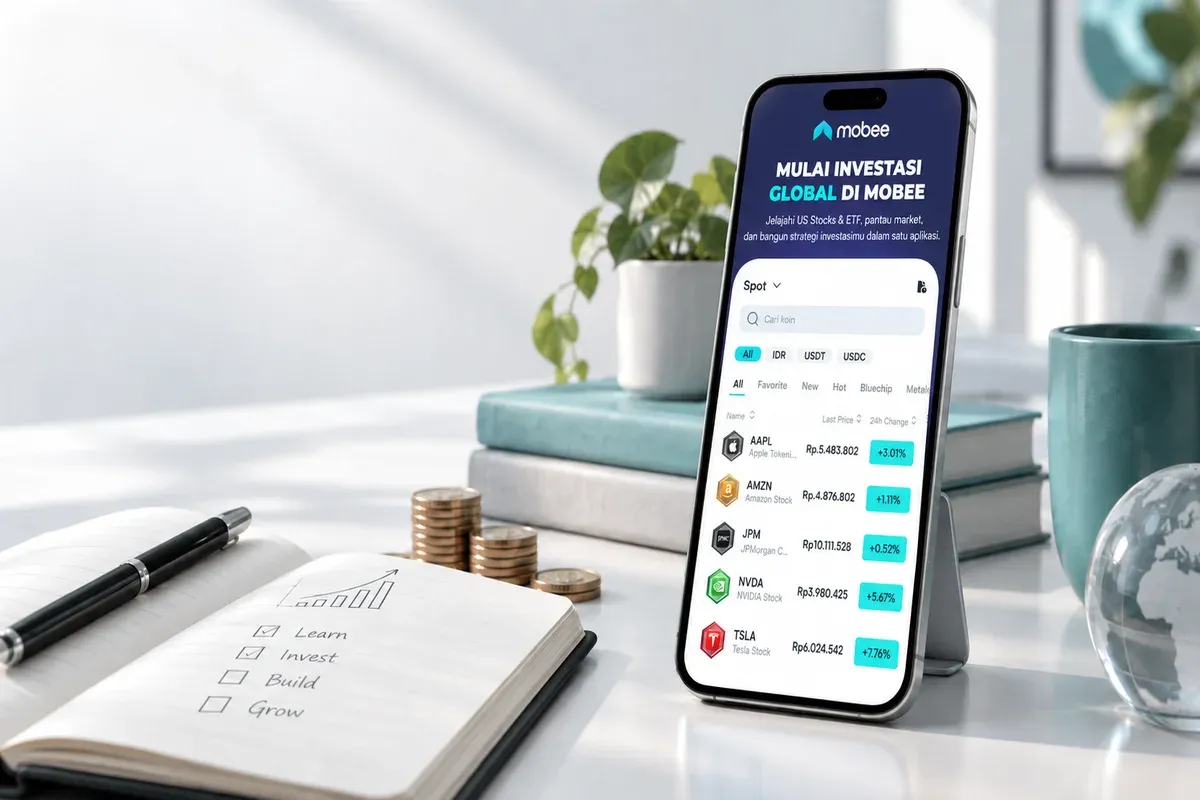
You do not need big capital to start, because some brokers let you buy 1 lot with a few hundred thousand rupiah.
But the convenience asks for discipline, because an order can be filled in seconds. Learn the basics of stock investing for beginners, understand the costs, and set a risk limit before you tap the buy button.
This article walks you through it from zero: requirements, 8 practical steps, how to choose a safe app, a worked example, strategies, and the mistakes that happen most often.
How to trade stocks on your phone in 8 steps:
-
Open an account in a securities app licensed by the OJK, then upload your ID card and a selfie.
-
Complete KYC verification (Know Your Customer, which is identity verification).
-
Deposit funds into an RDN (customer fund account) in your own name.
-
Find a stock in your watchlist and check its fundamentals.
-
Set your buy price with a limit order.
-
Place a buy order, at least 1 lot (100 shares).
-
Monitor the price, volume, and company news.
-
Record your transactions and review every month.
Key Points
-
Starting capital: Beginners can start from around Rp100,000 in some apps, depending on the price per share. Build an emergency fund first.
-
Choosing stocks: Start with liquid stocks and businesses that are easy to understand, not just whatever is trending.
-
Transaction costs: Fees are set by each securities firm, with a total range of about 0.15-0.35 percent per transaction according to IDX Channel (January 2024). The more often you trade, the more it affects your results.
-
Risk management: Use a 5-10 percent stop loss and at most 5-10 percent of your portfolio in one stock.
-
Practice: Use a demo account or a small amount for 3-6 months before adding capital.
Read What Fits Your Needs
This article is a practical guide: the order and the buttons you use in a phone app, with examples of Indonesia Stock Exchange stocks through a securities firm. For other topics, start here:
-
Strategy and allocation: stock investing guide for beginners
-
No emergency fund yet: investment order for beginners
-
Capital per lot: 1 lot of stock guide
-
US stocks with small amounts: US stocks for everyone
What Is a Stock, and Why Can You Trade It on Your Phone?
A stock is proof of ownership of a small part of a company. If the business grows, the stock's value can rise and the company can pay dividends. If the business worsens, the value can fall.
It used to mean visiting a securities office. Now the process lives in an app: the app passes your order to the exchange through a broker (a securities firm that is an exchange member).
As of 7 August 2026, Indonesia had 30.30 million SIDs (Single Investor Identification, an investor ID number) according to KSEI. That figure covers all capital market investors, not only stock investors, but it shows how easy access has become.
That ease has another side: decisions can be made in seconds, including hasty ones.
Requirements for Trading Stocks on Your Phone
The basic requirements are simple, but the details differ by securities firm. Check the terms in the app you choose before you sign up.
-
Valid ID card: Used for identity verification (KYC).
-
Selfie: Usually requested to match your face to your ID.
-
Active phone number and email: For verification and transaction notifications.
-
Bank account in your own name: For depositing and withdrawing funds.
-
Starting funds: Enough to buy at least 1 lot, which is 100 shares.
One requirement that is not on any form: the money you use is not your emergency fund and not borrowed money.
How to Trade Stocks on Your Phone: 8 Steps from Zero
Follow this order so your first run goes smoothly. Do not jump to buying before verification and funding are done.
Step 1: Open an Account with an OJK-Licensed Securities Firm
Download the securities app from an official app store, then sign up with an active phone number and email. Upload your ID photo and selfie as instructed.
Before signing up, make sure the firm is licensed by the OJK and is an exchange member.
Step 2: Complete KYC Verification
KYC (Know Your Customer) is identity verification. You will fill in personal and employment details and agree to a risk profile.
Approval time differs by securities firm. Wait until the status is active before continuing.
Step 3: Deposit Funds into Your RDN
An RDN (customer fund account) is a dedicated account where your investment money is held, separate from the securities firm's own money. Transfer only to an RDN number in your own name, following the official instructions in the app.
Never transfer to someone else's personal account, however convincing the offer sounds.
Step 4: Find a Stock and Check Its Fundamentals
Add a few stocks to your watchlist, then check the basics: profit, debt, cash flow, and valuation such as PER and PBV. The strategy section below explains how to choose.
Use simple fundamental analysis to check revenue, margins, and debt.
Step 5: Set Your Buy Price
There are several order types, and your choice decides the execution price:
-
Market order: Fast execution at the market price, suited to high liquidity.
-
Limit order: You set the maximum buy or sell price.
-
Stop loss: An automatic sell order if the price falls to a certain level.
-
Take profit: An automatic sell order when your profit target is reached.
Beginners should use limit orders so the price does not jump when you tap buy.
Step 6: Place Your Buy Order
Enter the stock code, price, and number of lots. One lot is 100 shares, and it is the minimum purchase on the exchange.
Read the order summary once more before confirming. Mistyping the number of lots is the most common error in apps.
Step 7: Monitor Your Position
Once the order is filled, the stock goes into your portfolio. Check the price, volume, and company news from time to time.
Monitor in moderation. Staring at prices every minute pushes you toward impulsive decisions.
Step 8: Record Transactions and Review
Keep your transaction receipts, write down why you bought, and schedule a review once a month. Compare your results with the index and add up total fees and taxes.
For an example with US stocks through tokens, see the guide to buying Apple and Tesla stock through tokens.
How to Choose a Safe Securities App
No single app suits everyone. What you can use is criteria, not a ranking. Compare a few securities firms with this table:
| Criterion | What to check | Why it matters |
|---|---|---|
| License and membership | OJK-licensed and an exchange member | Your funds and trades are under supervision |
| Fund account | RDN in your own name | Funds are kept separate from the firm's cash |
| Fees | Buy and sell rates, and any other charges | Fees eat into returns, especially if you trade often |
| Order types | Limit order, stop loss, take profit | Gives control over price and loss limits |
| Account security | Two-factor authentication, PIN, alerts | Prevents account takeover |
| Education and simulation | Learning material or a demo account | Helps you practice before using real money |
| Support | Official help and complaint channels | Important when a transaction or fund problem comes up |
Check a securities firm's license on the OJK website, not from ads or group messages. If anyone promises guaranteed profit, stay away.
Keep in mind that an app that is pleasant to use is not necessarily cheap, and a cheap app is not necessarily safe. Judge both.
Worked Example: Your First Stock Purchase
This example is an illustration of how to calculate lots, not a recommendation of any specific stock.
Say you want to buy a stock priced at Rp500 per share, with a buy fee of 0.15 percent.
-
Price of 1 lot: Rp500 x 100 shares = Rp50,000.
-
Buy fee: 0.15 percent of Rp50,000 = about Rp75.
-
Total for 1 lot: about Rp50,075.
With Rp100,000, you can buy 1 lot and still have money left for the sell fee. Two lots need about Rp100,150, slightly above Rp100,000.
For a higher-priced stock, the capital for 1 lot rises too. So check the price per share before deciding how much to put in. A fuller calculation is in the 1 lot of stock guide.
Costs and Taxes of Trading Stocks on Your Phone
Transaction costs eat into returns, especially if you trade often. Buy and sell fees are set by each securities firm, not a single rate from the exchange.
According to IDX Channel (19 January 2024), total buy and sell costs generally range from 0.15-0.35 percent of the transaction value. That figure includes VAT and the 0.1 percent final income tax on sales.
| Component | Estimate | Note |
|---|---|---|
| Buy and sell fee | Total about 0.15-0.35 percent | Set by each securities firm. Includes VAT and the 0.1 percent final income tax on sales (IDX Channel, January 2024). |
| Final income tax on sales | 0.1 percent of gross sale value | Only when selling. Legal basis is Government Regulation 41 of 1994 and KMK 282/1997. |
| Exchange levy | About 0.04 percent | Split among IDX, KPEI, KSEI, and KPEI Guarantee, 0.01 percent each. Check whether it is already inside your firm's fee. |
| Minimum lot | 1 lot | Equal to 100 shares. |
| Dividend tax | 0 percent or 10 percent | Exempt if the dividend is reinvested in Indonesia under the conditions (at least 3 tax years). Otherwise 10 percent final income tax. |
| Platform fees | Varies | Check your firm, for example whether extra charges apply to certain order types. |
As an illustration (not any specific firm's rates), assume a buy fee of 0.15 percent and a sell fee of 0.25 percent. If you buy Rp1 million and sell at the same price, the round-trip cost is about Rp4,000, or about 0.4 percent.
So your profit target must be larger than the total cost. Recalculate with your own firm's rates.
Investing or Trading: What Is the Difference?
Many beginners use these two terms interchangeably, but their goals and risks differ. Decide first which side you are on.
| Aspect | Investing | Trading |
|---|---|---|
| Goal | Grow with the business, dividends | Short-term price differences |
| Time frame | Months to years | Minutes to weeks |
| Basis for decisions | Business fundamentals | Price movement and volume |
| Trade frequency | Rare | Frequent |
| Effect of fees | Small | Large, because every trade is charged |
| Time needed | Periodic review | Near-constant monitoring |
| Main risk | Business worsens, prices stay down | Wrong direction fast, costs pile up, emotional decisions |
For beginners, investing with small amounts is usually easier to control. Trading demands time, discipline, and clear exit rules.
You can combine the two, but separate the funds and write down your rules before you start.
4 Stock Investing Strategies for Beginners
The strategies below are a general framework, not advice to buy any specific stock. Adjust them to your risk profile and financial goals.
1. Choose Stocks You Understand
Your first stock should not be chosen because it went viral on social media. Focus on business quality, liquidity, and valuation.
-
High liquidity: Large daily trading value makes buying and selling easier.
-
Healthy fundamentals: Check profit, debt, and cash flow for the last 3 years.
-
Understood business: Pick products you use day to day.
-
Fair valuation: Compare PER and PBV with the sector average.
-
News catalysts: Avoid stocks that rise only on rumors.
If you struggle to explain the business in one sentence, hold off on buying.
2. Buy in Stages with DCA
DCA (dollar cost averaging) means buying a fixed amount at regular intervals, without trying to guess the bottom. Learn the principle in the dollar cost averaging guide.
Here is an illustration with a budget of Rp1 million per month, a buy fee of 0.15 percent, and a fictional stock. Because you buy in lots, some money may be left over.
| Month | Price per share | Lots bought | Funds used |
|---|---|---|---|
| January | Rp1,000 | 9 | Rp900,000 |
| February | Rp800 | 12 | Rp960,000 |
| March | Rp1,250 | 7 | Rp875,000 |
| April | Rp1,000 | 9 | Rp900,000 |
| Total | 37 lots (3,700 shares) | Rp3,635,000 |
Your average buy price comes to about Rp982 per share, while the simple average of the four prices is Rp1,012.5. When the price falls, the same amount buys more lots.
This is only an illustration of the math. DCA does not guarantee profit, and it does not protect you from a stock whose fundamentals are getting worse.
3. Spread Risk with Diversification
Do not put all your capital in one stock. Spread it across 3-5 stocks in different sectors, and cap any one stock at 5-10 percent of your portfolio.
When dividends come in, you can look at options for rebalancing and dividend reinvestment to keep your allocation balanced.
4. Review on a Schedule, Not Every Minute
Review once a month with data: return versus the IHSG and your sector, the drop from your portfolio's peak, quarterly financial reports, and total costs.
If a stock falls because its fundamentals worsen, do not average down. If it falls because the market is weak but profit keeps growing, revisit your target price and investment horizon.
Where Is It Safe to Buy Stocks?
Safe means two things: the platform is legitimate and the way you trade is sound.
-
Legitimate platform: A securities firm licensed by the OJK and an exchange member. Verify on the OJK website.
-
Separated funds: Your money goes into an RDN in your own name, not anyone's personal account.
-
Protected account: Turn on two-factor authentication and never share your PIN or OTP code.
-
Official links: Download the app from an official store. Avoid links from messages or groups.
-
Doubt promises: Guaranteed profit, fixed returns, or "leaked" stock tips are red flags.
Being safe from fraud does not mean risk-free. Stock prices can still fall even when the platform is legitimate.
5 Costly Beginner Mistakes When Trading Stocks on a Phone
The first mistake is usually not analysis but emotional control. A fast app makes impulsive decisions feel easier.
1. FOMO
Buying because the price jumped, without analysis. A stock that is rising can also correct sharply in a short time.
2. Over Trading
Trading too often so that costs swell. Remember the example above: one buy and sell round trip alone costs about 0.4 percent.
3. No Loss Limit
Holding a loss too long, hoping the price recovers. Learn about stop loss and set your limit before the order, not after the price falls.
4. Using Emergency Funds or Debt
A stock that drops 20 percent can recover, but if you need the money next month, you are forced to sell at a loss. Use only funds whose risk you can afford.
5. Following Signals Without Checking the Source
Buying based on a group or an influencer without checking the data. Doing your own research is always cheaper than the loss from following the crowd.
Stock Investing Risks You Need to Understand
Risk cannot be removed, but it can be managed. First understand its forms.
-
Market risk: All prices can fall when sentiment shifts.
-
Company risk: Profit falls, debt rises, or the business runs into trouble.
-
Liquidity risk: A thinly traded stock is hard to sell at a fair price.
-
Behavioral risk: Emotional decisions often hurt more than a missed analysis.
As a snapshot of the market, exchange trading value was about Rp10.5 trillion on 13 October 2026 according to Okezone, and the IHSG closed at 5,925, down 0.17 percent from the previous session. Bisnis.com (7 October 2026) reported that analysts saw a fairly deep correction through September.
Swings like this are normal, so measure your performance over months, not days.
A simple rule to contain risk: if one position loses 10 percent and it is 10 percent of your portfolio, the portfolio loses only 1 percent. This number is a rule-of-thumb example, not advice. Adjust it to your risk profile.
Before you tap buy, ask five things: are KYC and funds ready, what are the limit price and loss limit, how many lots fit your maximum risk, what is your reason and review date, and are you panicking or euphoric right now. If any one is unclear, wait. Opportunities in the stock market do not vanish in a single day.
Conclusion
Trading stocks on your phone can start with small capital, as long as you choose a licensed broker, understand order types, and manage risk.
Your first focus is not fast profit but building a process you can repeat. Use limit orders, stop losses, and monthly reviews.
With 6-12 months of discipline, you will be better prepared to add capital gradually.
FAQ
What is the minimum capital to trade stocks on your phone?
The minimum depends on the price per share, because you buy in lots (1 lot = 100 shares). For example, at Rp500 per share, 1 lot is Rp50,000, plus the buy fee.
In many apps, starting capital of Rp100,000 to Rp500,000 is enough to begin. Make sure the money is not your emergency fund.
Can you trade stocks on your phone with no capital?
There is no way to buy real shares without money. What you can do for free is learn the basic terms and try a simulation account if your securities firm offers one.
When you are ready, start with a small amount that does not touch your monthly needs. Be wary of offers of stocks with no capital that promise profit, because they can be a scam.
Is trading stocks on a phone safe?
It is safe if you use a securities firm licensed by the OJK that is an exchange member, and customer funds are held in a separate account. Never transfer to a personal account or follow unofficial links.
Turn on two-factor authentication and check the firm's license on the OJK website. Being safe from fraud does not mean risk-free, because stock prices can still fall.
Which stocks suit beginners?
There is no single answer for everyone, and this article does not recommend any specific stock. Criteria beginners commonly use are high liquidity, healthy fundamentals, an easy-to-understand business, and fair valuation.
Check PER, PBV, and debt, then compare with the sector. Avoid stocks that rise only on rumors or signal groups.
When is the best time to buy stocks?
There is no exact time, but avoid buying in euphoria or when volume looks unusual. Use limit orders and split your purchase into 2-3 stages. Review after 3-6 months, not after 1 day.
Can you start with Rp100,000?
Yes, if the price per lot allows it. For example, at Rp500 per share, 1 lot is Rp50,000, so Rp100,000 covers 1 lot with money left for fees.
Two lots need about Rp100,150 if the buy fee is 0.15 percent, slightly above Rp100,000. Also set aside the sell fee for when you sell.
How much does it cost to trade stocks on a phone?
Fees are set by each securities firm. According to IDX Channel (19 January 2024), total cost per transaction generally ranges from 0.15-0.35 percent of the transaction value, including VAT and the 0.1 percent final income tax on sales. The exchange levy is about 0.04 percent.
As an illustration, if the buy fee is 0.15 percent and the sell fee is 0.25 percent, buying and selling Rp1 million at the same price costs about Rp4,000. Check your own firm's rates before you start.
Can I buy Indonesia Stock Exchange stocks on Mobee?
No. IDX stocks are bought through a securities firm that is an exchange member, and Mobee is not an IDX stock broker.
Mobee offers crypto assets and US stock tokens through xStocks, which you can buy with rupiah or crypto assets. A token is not direct ownership of a share on a US exchange, and its risks differ from regular stocks.
Mobee is operated by PT CTXG Indonesia Berkarya, which is licensed and supervised by the OJK.
Get Started with Mobee
This article covers stocks on the Indonesia Stock Exchange (IDX), which you buy through a securities firm licensed by the OJK. Mobee is not an IDX stock broker, so you do not buy IDX stocks in the Mobee app.
What Mobee offers is crypto assets and xStocks, US stock tokens whose price follows the underlying stock. You can buy them from about US$1 with rupiah or crypto assets. A token is not direct ownership of a share on a US exchange, and its risks differ from regular stocks.
Mobee is operated by PT CTXG Indonesia Berkarya, which is licensed and supervised by the OJK.
If you want to try with a small amount, install the Mobee app and first read how xStocks works. For how the two markets compare, see also US stocks.
Disclaimer: This article is for education only. It is not an invitation to buy or sell any specific stock, and it is not investment, legal, or tax advice. Stock investing carries risk, values can fall, and past results do not guarantee future results. Cost and tax figures can change and differ by securities firm, so check the latest terms. Do your own research and use only funds whose risk you can afford.
 Direct market access from the app
 Start exploring digital assets with Mobee
Track the market, learn about digital assets, and start trading more conveniently with the Mobee App.
Mobee is licensed and supervised by the OJK. Not a solicitation to buy or sell any asset.