Asset Management Adalah: How to Read Reports and Benefits

Asset management is the professional process of managing an investment portfolio on behalf of a client, following a mandate, risk profile, and agreed objectives. It covers asset allocation, security selection, monitoring, and reporting across instruments such as stocks, bonds, mutual funds, ETFs, and digital assets. Unlike self-directed investing, asset management delegates daily decisions to a manager while the client retains ownership of the funds. For beginners, this service can provide diversification and research access that is hard to replicate alone. Learn the basics of an investment portfolio before choosing a manager.
Key Points
-
Core definition: Asset management manages client portfolios through mandates, research, asset allocation, and continuous risk monitoring.
-
Manager role: The investment manager decides the asset mix, but the client still owns the funds and bears the outcome.
-
Main costs: Management fees, transaction costs, and administrative charges can erode net returns if not checked early.
-
Risk factors: Past performance does not guarantee results, and market, liquidity, and default risks remain present.
-
Beginner step: Start with goals, time horizon, and risk tolerance, then choose transparent and licensed products.
How asset management works for clients
Asset management starts with identifying risk profile, then the manager designs allocation and executes transactions. Clients usually receive periodic reports and can monitor investment value through an app or statement. According to ICI data April 2026, U.S. long-term mutual funds and ETF assets were estimated near $35 trillion, reflecting broad adoption of pooled management. For Indonesian investors, the flow can differ depending on product and platform. Use a Mobee strategy as an initial framework.
1. Complete risk profile: Answer questions about risk tolerance, goals, and time horizon.
2. Sign the mandate: Understand manager authority and investment limits.
3. Fund the account: Money goes to a custodian account, not the manager personal account.
4. Track reports: Check monthly performance, fees, and allocation changes.
5. Review periodically: Assess whether the portfolio still matches original goals.
Core components of an asset management service
A healthy asset management service has mandatory components that protect clients. First, there is a written investment policy explaining instruments and risk limits. Second, there is an independent custodian that safekeeps assets so the manager does not hold the money.
Third, there are transparent reports on performance, fees, and portfolio positions. Without these components, misuse risk increases. Understand risk management before handing over large funds.
• Investment policy: A document governing portfolio objectives and limits.
• Custodian: An independent party that safekeeps and administers assets.
• Performance report: Gives a view of net return after fees.
• Audit and compliance: Ensures operations follow applicable rules.
Benefits for beginner investors
The main benefit of asset management is access to professional research and diversification that is hard to build alone with small capital. Beginners do not need to analyze every company financial report or watch the market all day.
According to Morningstar Global Fund Flows Report Q1 2026, passive funds and model portfolios kept attracting large flows as investors sought lower costs and simpler processes. However, these benefits only appear if you choose transparent products. Also check mutual funds risk to compare options.
• Fast diversification: Small capital can spread across many assets at once.
• Process discipline: Managers have allocation and rebalancing rules.
• Time saving: You do not need to monitor the market every hour.
• Global access: Some products open foreign stocks and bonds.
Risks you must understand
Asset management risk does not disappear just because professionals manage it. Market risk can make portfolio value fall sharply when macro conditions worsen. Liquidity risk appears when assets are hard to sell quickly without a discount. Concentration risk occurs if the manager puts too much money into one instrument. Cost risk is also real because annual fees can erode net returns.
According to Vanguard How America Invests Report March 2026, the median expense ratio was about 0.05% for index funds and 0.60% for active funds, a gap that compounds over 10 years.
• Market risk: Asset values fall due to interest rates, inflation, or recession.
• Liquidity risk: Assets are hard to sell quickly at a fair price.
• Concentration risk: The portfolio depends too much on one asset or sector.
• Cost risk: Fees and transaction costs reduce final results.
• Default risk: Bonds or credit products may fail to pay coupons.
Every risk needs monitoring through monthly reports and exposure limits. If a manager is not transparent about costs or strategy, that is a warning sign.
Asset management vs self-directed investing
Asset management and self-directed investing have clear trade-offs. Asset management suits people who are busy, want diversification, and accept paying fees. Self-directed investing suits people with research time and strong discipline.
According to BlackRock Q1 2026 Earnings Release April 2026, BlackRock managed around $12.5 trillion in AUM, showing the massive scale of global asset management. However, scale does not guarantee superior returns; product fit with your goal matters more.
• Control: Self-directed gives more control; asset management delegates daily decisions.
• Cost: Self-directed is cheaper; asset management includes fees and administration.
• Time: Self-directed requires routine research; asset management saves time.
• Diversification: Asset management is usually faster to diversify.
• Transparency: Self-directed is more transparent because you see every trade.
Fees and minimum investment to check
Fees are often ignored by beginners. In asset management, you may find management fees, custody fees, subscription fees, and redemption fees. Minimum investments also vary, from IDR 10,000 for mutual funds to billions of rupiah for private mandates.
According to OJK Capital Market Statistics March 2026, growth in retail mutual fund products widened access, but investors still must read the prospectus. Learn investment options so you are not surprised.
• Management fee: Annual manager compensation, usually a percentage of AUM.
• Custody fee: Fee for safekeeping and asset administration.
• Subscription fee: Fee when buying product units.
• Redemption fee: Fee when selling or cashing out an investment.
• Minimum investment: Can start at IDR 10,000, but some products are much higher.
How to choose an asset manager
Choosing an asset manager is not only about the highest return. You need to check track record, strategy consistency, cost transparency, and business license.
In Indonesia, make sure the manager is registered with OJK and the product has a clear prospectus. According to Investment Company Institute April 2026, flows into ETFs and index mutual funds remained strong because investors are cost-sensitive. Use this framework to filter choices.
1. Check license: Ensure the manager and product are registered with the regulator.
2. Compare costs: Calculate total expense ratio, not only management fee.
3. Review consistency: Compare 3-5 year performance, not just 1 year.
4. Read prospectus: Understand instruments, risks, and investment policy.
5. Test communication: Ask for reports and responses during volatile markets.
A simple asset allocation example
An allocation example can help explain how asset management works. For instance, a 30-year-old investor with a 20-year retirement goal might use 60% stocks, 30% bonds, and 10% alternative assets.
An investor near retirement might flip the mix to 40% stocks and 60% bonds. These numbers are not recommendations, only illustrations. A professional manager will adjust for risk profile, market conditions, and liquidity needs.
• Long-term goal: Higher stock weight for growth.
• Short-term goal: Higher bond or money market weight.
• Low risk tolerance: Reduce volatile assets and add cash.
• Liquidity need: Keep an emergency fund outside the portfolio.
• Rebalancing: Return weights to target every 6-12 months.
Quick table: investor profiles and asset management focus
This table summarizes how asset management focus differs by investor profile. Use it as an initial guide, not a final decision.
| Investor Profile | Horizon | Asset Focus | Main Risk | Reasonable Fee |
|---|---|---|---|---|
| Conservative | 1-3 years | Money market, short-term bonds | Inflation, liquidity | 0.5-1% per year |
| Moderate | 3-7 years | Mix of stocks and bonds | Market volatility | 1-1.5% per year |
| Aggressive | 7+ years | Stocks, ETFs, digital assets | Large drawdowns | 1-2% per year |
| Institutional | 5+ years | Special mandates, multi-asset | Compliance, liquidity | Varies, potentially below 1% |
Conclusion
Asset management is a way to manage investments through professional managers using mandates, diversification, and risk monitoring. You remain the fund owner and outcome bearer, so fees, licenses, and transparency must be checked. For beginners, start with goals and risk tolerance, then choose simple products such as index mutual funds or model portfolios. If you want digital assets, understand volatility and custodian risk. With a careful approach, asset management can become a long-term discipline tool.
FAQ
What is the difference between asset management and self-directed investing?
Asset management delegates day-to-day investment decisions to an investment manager, while self-directed investing means you choose and monitor the assets yourself. Asset management usually charges fees but provides professional research and diversification. Self-directed investing can be cheaper and gives you full control, but requires more time and discipline.
What is a reasonable asset management fee?
In Indonesia, equity mutual fund management fees can be around 1-2% per year, while money market funds may charge around 0.5-1% per year. According to Vanguard in March 2026, the median expense ratio for US index funds was around 0.05%, compared with around 0.60% for actively managed funds. Always review the total cost rather than focusing on only one fee component.
Is asset management guaranteed to be safe?
No. Asset management is not risk-free because asset values can decline. Independent custodians can help separate client assets, but market, liquidity, and default risks still exist. Make sure the investment manager is properly licensed and that the product has a prospectus.
What is the minimum investment for asset management?
Minimum investment requirements vary significantly. Retail mutual funds may start from around Rp10,000, while private mandates can require tens of millions to billions of rupiah. Check the official prospectus and platform for the latest requirements. Avoid forcing yourself to invest if your emergency fund is not yet ready.
Is asset management suitable for beginners?
It can be suitable if you have a clear goal, an investment horizon of at least 3-5 years, and want diversification without conducting daily research. Start with simple, low-cost, and transparent products. If you do not yet understand the risks, learn the basics of portfolio management and risk management first.
Start with Mobee
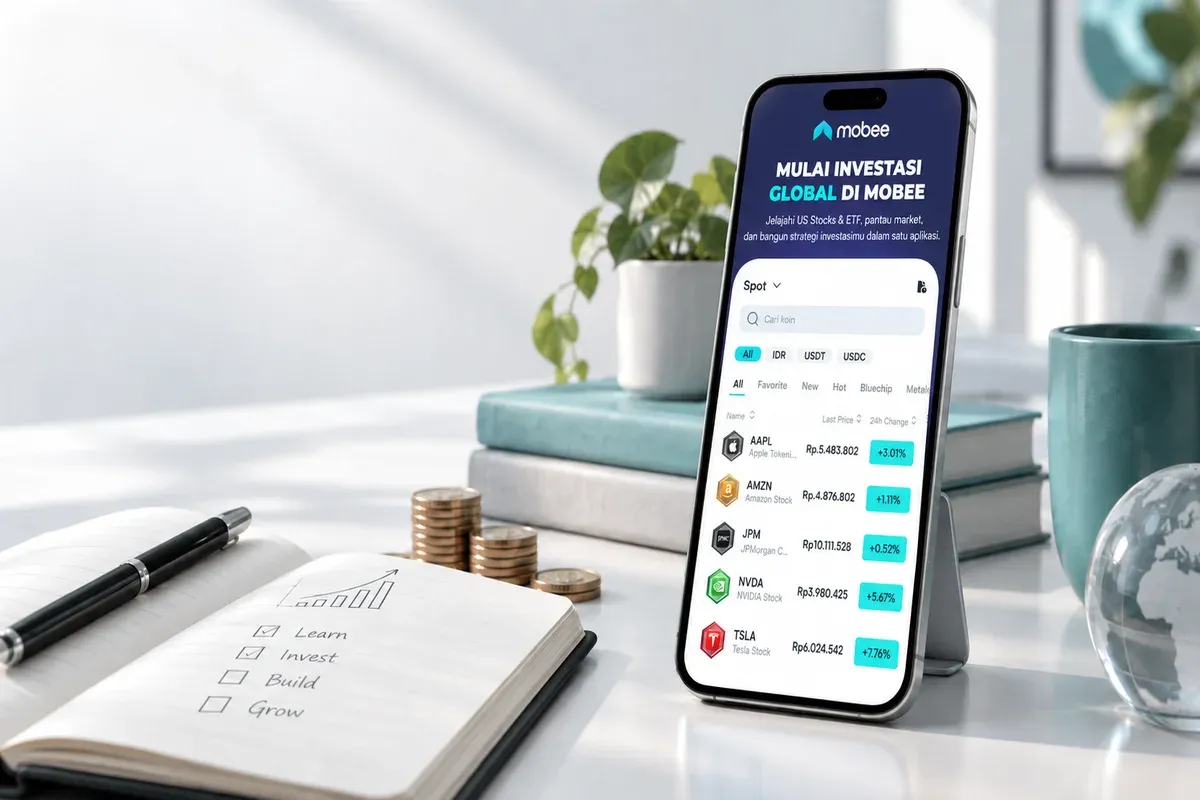
Mobee is a digital asset platform licensed and supervised by OJK, helping users explore crypto and investment products with clearer access and practical learning. Start your investment journey through Mobee and choose products that match your goals and risk profile.
 Direct market access from the app
 Start exploring digital assets with Mobee
Track the market, learn about digital assets, and start trading more conveniently with the Mobee App.
Mobee is licensed and supervised by the OJK. Not a solicitation to buy or sell any asset.