
The crypto asset market this week is navigating a complex mix of macroeconomic headwinds and institutional optimism. While Bitcoin’s performance against traditional safe-haven assets like gold has raised concerns among technical analysts, developments in AI infrastructure and renewed buying signals from MicroStrategy suggest the industry’s long-term thesis remains intact.
Bitcoin Enters a “Bear Market” Against Gold
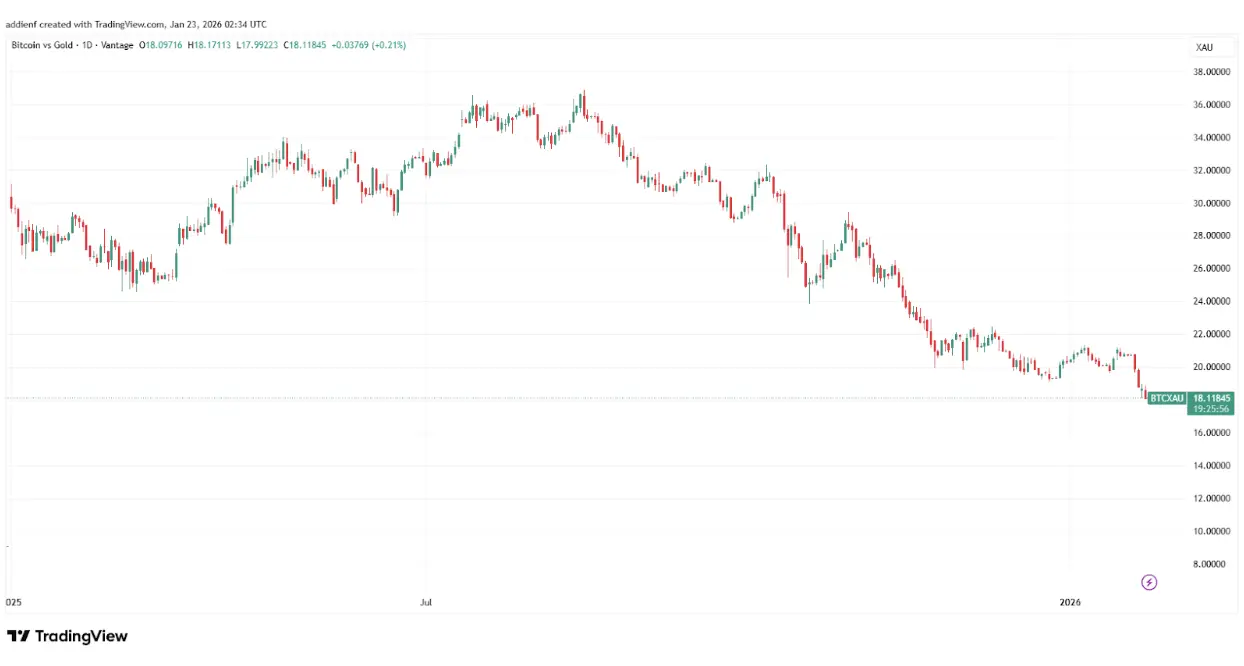
As of January 23, 2026, Bitcoin is facing substantial selling pressure compared to gold, based on the latest technical analysis supported by TradingView charts (BTCXAU).
The chart shows the Bitcoin-to-gold ratio currently at 18.11, slightly below earlier estimates. This level marks a new low, confirming a long-term bearish trend. Visually, the chart displays a consistent and steep downtrend since mid-2025. Bitcoin has failed to hold the psychological 20.00 level, which previously acted as a strong support.
A drop below this level technically indicates that global investors are currently favoring physical gold over “digital gold” as their primary hedge, with the potential for further weakness if the ratio fails to rebound in the near term.
ETF Selling Pressure Intensifies, While XRP and Solana Buck the Trend

Bearish sentiment is clearly visible in institutional markets, where combined outflows from Bitcoin and Ether ETFs have reportedly exceeded $1 billion in total. This capital flight reflects a risk-off shift among traditional investors toward gold.
However, the latest “Top Crypto ETFs by Net Inflow” data reveals an interesting anomaly, suggesting that investors are not exiting the market entirely but instead rotating assets:
- Bitcoin ETF (FBTC) and Ethereum ETF (ETHW) recorded net outflows of -$9.8 million and -$15.2 million, respectively, reinforcing selling pressure on blue-chip crypto assets.
- In contrast, altcoin-based ETFs attracted fresh interest. XRP ETFs posted positive net inflows of +$5.26 million, while Solana ETFs (BSOL) recorded inflows of +$1.7 million.
This divergence suggests that while large investors are reducing exposure to Bitcoin and Ethereum, they are selectively reallocating capital into alternative ecosystems such as Ripple and Solana, possibly in search of higher alpha opportunities amid stagnation in the core market.
Michael Saylor Signals a “Bigger Orange” Purchase
Despite the subdued price action, Michael Saylor, Executive Chairman of Strategy Inc. (formerly MicroStrategy), appears unfazed. This week, Saylor hinted at a new acquisition on social media by posting a chart labeled “Bigger Orange.”

Market analysts interpret this as a signal that the company may be preparing for another large-scale Bitcoin purchase, potentially exceeding its most recent acquisition of 13,627 BTC (worth approximately $1.25 billion). Saylor’s counter-cyclical strategy remains central to the firm’s approach, aiming to increase corporate holdings even as broader market conditions remain challenging.
AI Infrastructure Firm Secures $500 Million On-Chain Loan
In a landmark deal bridging artificial intelligence (AI) and decentralized finance (DeFi), Australian high-performance computing company Sharon AI has secured up to $500 million in financing from blockchain-based lender USD.AI.
Notably, Sharon AI bypassed traditional banks for this agreement. The non-recourse credit facility is backed by physical GPU hardware, which has been tokenized as on-chain collateral. The funds will be used to expand Sharon AI’s GPU infrastructure across the Asia-Pacific region. This deal underscores the growing utility of Real-World Assets (RWA) in DeFi, providing liquidity for capital-intensive industries such as AI infrastructure, where traditional banking may be too slow or restrictive.

.webp)