Governance Token vs Stock: Voting, Profit, and Legal Risks
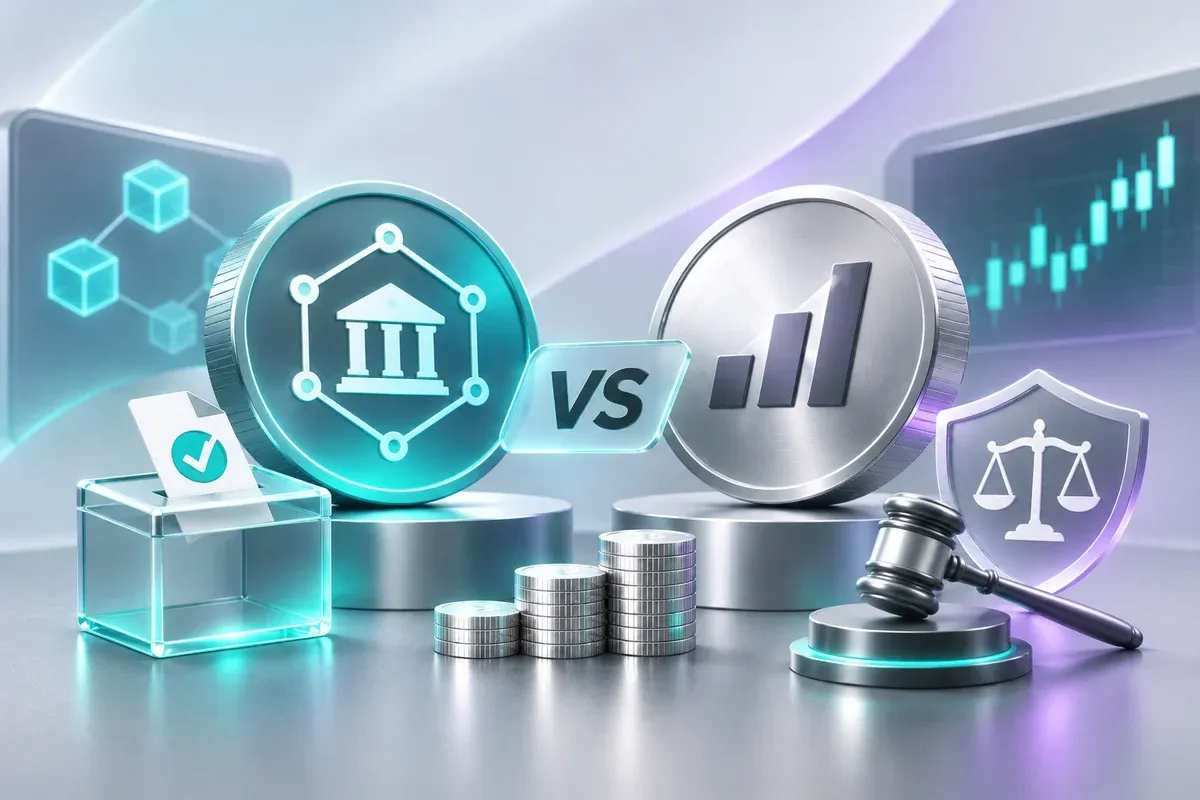
Governance token vs stock is a comparison between code-based governance rights and legally recognized equity ownership.
Stocks usually carry claims on profits, residual assets, and shareholder votes, while governance tokens typically grant limited voting power over a protocol.
Holding a token therefore does not automatically mean owning a business or receiving dividends.
Key Points
- Core definition: A stock is equity, while a governance token is a protocol governance tool whose rights depend on project documents.
- Voting: Shareholders vote at meetings, while token holders vote on protocol parameters through on-chain or snapshot systems.
- Profit rights: Dividends depend on company earnings, while a fee switch pays only if the protocol activates and funds it.
- Legal claims: Stock can carry equity claims, but tokens usually do not grant ownership unless the documents say so.
- Key risks: Regulation, liquidity, voting concentration, and buyback execution must be checked before buying.
Quick Differences Between Governance Tokens and Stocks
The core difference is the object of the right, not the venue where the asset trades. A stock connects the holder to a company structure, while a token connects the holder to protocol rules and smart contracts. The explanation of how stocks work (available in Indonesian).
• Form of Ownership
A stock represents an equity stake in a corporation and appears in the shareholder register. A governance token is usually a unit of access or voting inside a protocol, not a certificate of company ownership. This distinction shapes the claims you can enforce during disputes or liquidation.
• Source of Rights
Shareholder rights come from articles of association, company law, and shareholder meeting resolutions. Token holder rights come from smart contracts, snapshot voting, and project documentation that governance can change. Because the sources differ, the legal strength of each right also differs.
• What Is Owned
Shareholders hold claims on profits and residual assets after liabilities are paid. Token holders may hold rights to protocol functions, service access, or voting, depending on token design. Without an explicit clause, a token gives no claim on company revenue or assets.
Voting Rights: Mechanisms and Limits
Voting rights are often treated as proof that a token equals a stock, but the decision scope is different. Shareholders elect corporate organs, while token holders usually adjust protocol parameters. This approach also relates to US stock fundamental analysis (available in Indonesian).
• On-Chain Voting
Token holders can sign transactions to choose proposals, such as changing fees or allocating treasury funds. Voting weight often follows token quantity, so large holders have more influence. Low participation can let a small set of addresses control outcomes.
• Off-Chain Snapshot Voting
Many protocols use snapshots to measure balances at a set time before voting. This model is cheaper, but the result still needs execution by a team or multisig. You need to check whether the vote is binding or only advisory.
• Limits of Token Votes
Token votes often stop at protocol parameters and do not appoint directors or approve financial statements. Shareholders can hold management accountable through corporate mechanisms. With tokens, the limits depend on code and governance documents.
Profit Rights: Dividends Versus Fee Switches
Profit rights are the most misunderstood part of the token vs stock debate. Protocol revenue does not automatically become a dividend, and a fee switch may never activate. For more context, explore beginner stock investing (available in Indonesian).
• Stock Dividends
Dividends are paid when a company earns profit, holds adequate reserves, and receives shareholder approval. Shareholders can assess dividend sustainability through cash flow and payout policy. Dividends are not guaranteed and may be cut when financial conditions change.
• Token Fee Switches
A fee switch redirects part of protocol fees to token holders or the treasury. This right matters only if the switch is active, the fee source is real, and distribution rules are clear. Without those conditions, a fee switch is closer to a design promise than income.
• Stock and Token Buybacks
Stock buybacks reduce shares outstanding and are usually disclosed through company filings. Token buybacks may involve a protocol buying tokens from the market and burning or locking them. The effect depends on program size, liquidity, and execution transparency.
• Profit Is Not Automatic
Protocol revenue does not always become token holder profit because operating costs, incentives, and treasury allocations take a share. With stocks, net income supports residual claims after obligations. Do not confuse transaction volume with a legal right to profit.
Legal Rights and Claims on Assets
Whether a token grants legal rights to a business must be answered from documents and jurisdiction. Without binding clauses, a token holder stands much weaker than a shareholder.
• Shareholder Status
A shareholder is recorded as an equity owner and has information and voting rights based on share class. In a dispute, claims can refer to articles of association and company law. This position provides a clearer legal path than most tokens.
• Token Holder Status
A token holder is generally recognized as a protocol user or governance participant. Legal claims depend on jurisdiction, terms of service, and whether the token is classified as an investment product. Do not assume token rights equal stock rights without binding documents.
• Documents That Matter
Review the whitepaper, token terms, governance framework, and user agreement. Look for clauses on fee distribution, asset claims, voting rights, and dispute mechanisms. If the documents only describe utility, economic claims are usually very limited.
• Jurisdiction Risk
Crypto asset rules differ by country and can change. A token that is valid in one jurisdiction may receive different treatment elsewhere. For major decisions, verify the latest rules and seek professional legal advice.
Reading Fee Switches and Buybacks
Fee switch and buyback programs must be judged by funding sources and execution. An announcement alone does not prove that token holders receive economic rights.
• Fee Switch Triggers
Find the activation threshold, evaluation period, and authority allowed to turn on the switch. If the trigger is too loose, distribution can change quickly. If it is too strict, token holders may never receive the economic benefit.
• Funding Source
Fees should come from real activity, not token printing or temporary subsidies. Check treasury reports and operating cost allocation before assessing net results. An unsustainable funding source can make buybacks look good for only a short time.
• Execution and Transparency
Token buybacks need wallet addresses, schedules, and auditable transaction records. Without transparency, buyback claims are hard to distinguish from marketing. Shareholders benefit from issuer disclosure, and token holders need a similar standard.
• Impact on Token Holders
Fee distribution can improve a token appeal, but it does not necessarily create a legal claim on the business. Token prices are also affected by liquidity and market sentiment. Focus on real cash flow, not only program announcements.
Quick Comparison Table
The table below summarizes the most practical differences to review before buying or valuing a token.
| Aspect | Stock | Governance token |
|---|---|---|
| Ownership basis | Company equity | Protocol governance rights |
| Voting rights | Shareholder meetings and company policy | Protocol proposals and parameters |
| Profit rights | Dividends when approved | Fee switch when active |
| Asset claims | Residual assets after liabilities | Usually no direct claim |
| Protection | Company law and regulators | Contracts, code, and jurisdiction |
| Liquidity | Depends on stock market | Depends on token market and pools |
| Key documents | Articles and financial reports | Token terms and governance |
Due Diligence Checklist: Token Versus Stock
Use this checklist to separate enforceable rights from marketing narratives. Focus on documents, cash flows, and exit scenarios. A practical foundation is provided by stock trading from mobile (available in Indonesian).
1. Read the Legal Documents
Compare the company articles with the project token terms. Look for clauses on voting rights, fee distribution, and asset claims. If there is no economic clause, treat the token as a utility tool, not equity.
2. Check the Voting Mechanism
Confirm whether voting is on-chain, snapshot-based, or advisory. Review quorum, voting weight, and execution timing. A vague mechanism makes voting rights difficult to use in practice.
3. Trace the Fee Flow
Identify the fee source, operating costs, and parties receiving distributions. Read treasury reports and execution history. A fee switch that never activates provides no income to token holders.
4. Inspect Buybacks and Treasury
Assess program size, funding source, and wallets used. A buyback funded by treasury sales can have a different impact from one funded by cash flow. Execution transparency matters as much as the announcement.
5. Test the Exit Scenario
Ask how you would sell a token when liquidity is thin or rules change. With stocks, you also need to understand suspension and liquidity risk. The exit plan must be realistic, not only a price-up scenario.
Overlooked Risks
Token risks go beyond price movement. Governance, liquidity, regulation, and operational failures can change the value of token holder rights. Additional perspective comes from how to estimate fair stock value (available in Indonesian).
• Voting Concentration
A small group of token holders can control proposals when participation is low. They may change incentives, treasury policy, or protocol rules. Monitor ownership distribution and voting history before judging decentralization.
• Liquidity and Price
Small tokens can suffer large slippage when the market is quiet. A buyback without matching liquidity may not support the price. Use position limits and understand market depth.
• Regulation
Token treatment can change if regulators view a token as an investment product. Rule changes can affect market access and holder rights. Keep transaction records and monitor official announcements.
• Contract and Operational Risk
Bugs, exploits, or multisig errors can affect treasury and voting. Stocks also carry operating risk, but they have audit and reporting structures. For tokens, review audits, team history, and incident records.
When Stocks Fit Better and Tokens Are Utilities
The choice between stocks and tokens depends on your goal. If you seek profit and asset claims, stocks are more relevant. If you use a protocol and want governance, a token can make sense within clear risk limits.
• Seeking Profit Claims
Stocks are more relevant when your goal is a claim on company profit and assets. Dividends and financial reports provide clear analysis points. A token fits only if its documents genuinely provide economic distribution.
• Using the Protocol
Tokens are useful when you use protocol services and want governance participation. Value comes from function, incentives, and access, not automatic equity. Understand the token role in the product before buying.
• Short-Term Trading
Traders should watch liquidity, volatility, and protocol catalysts. Voting rights rarely drive short-horizon returns. Regulatory changes and sentiment remain major risks.
• Beginners
Beginners should separate token learning from stock learning. Start with simple documents, small position sizes, and decision notes. Do not buy because of a protocol name or community promises.
Conclusion
Governance token vs stock cannot be treated as equal just because both trade in markets. Stocks provide equity claims and a legal pathway, while tokens provide governance or utility rights under project documents. Before buying, check voting rights, fee flows, buybacks, and legal claims. If a project does not explain economic rights explicitly, treat the token as a high-risk product, not a stock.
FAQ
What is the main difference between a governance token and a stock?
A stock is equity recognized by company law and gives claims on profits and residual assets. A governance token is a protocol governance tool whose rights depend on smart contracts and project documents. The difference is not only the asset name, but the type of claim you can legally prove.
Do governance token holders have voting rights like shareholders?
Usually not the same. Token holders may vote on protocol parameters through on-chain or snapshot systems, while shareholders elect corporate organs at meetings. Check quorum, voting weight, and whether the vote is truly binding.
Does a token give rights to dividends or company profits?
Usually no, unless project documents explicitly define economic distribution. A fee switch pays only if active, funded by real fees, and governed by clear rules. Stock dividends are also not guaranteed because they depend on earnings and shareholder approval.
How do token fee switches and buybacks compare with stock dividends and buybacks?
A fee switch distributes part of protocol fees if activated, while stock dividends come from company profit and approval. Stock buybacks reduce shares outstanding, while token buybacks purchase tokens from the market to burn or lock. Value still depends on funding sources and execution transparency.
Does holding a token mean legally owning part of a business?
Usually not. A utility or governance token does not automatically provide equity, asset claims, or dividend rights. Exceptions appear only when documents, contracts, and jurisdiction clearly grant those rights. Without that, treat the token as a high-risk product.
What checklist should I use before buying a governance token?
Read the legal documents, check the voting mechanism, trace fee flows, inspect treasury and buybacks, and test the exit scenario. Also understand liquidity and regulatory risk. If the project does not explain economic rights, do not treat the token as stock.
Know the Rights Before You Buy
Knowing more about financial markets can help you approach your next investment decision with clearer expectations. When you feel ready, Mobee, operated by PT CTXG Indonesia Berkarya and licensed and supervised by OJK, offers beginner-accessible digital-asset choices with eligible options from IDR 10,000 depending on the product and deposit method.
Disclaimer
This article is for education only, not financial advice. Digital assets carry risk. Do your own research (DYOR) before making investment decisions.
 Direct market access from the app
Start exploring digital assets with Mobee
Track the market, learn about digital assets, and start trading more conveniently with the Mobee App.
Mobee is licensed and supervised by the OJK. Not a solicitation to buy or sell any asset.