ETF Investing in Indonesia: Benefits and Risks
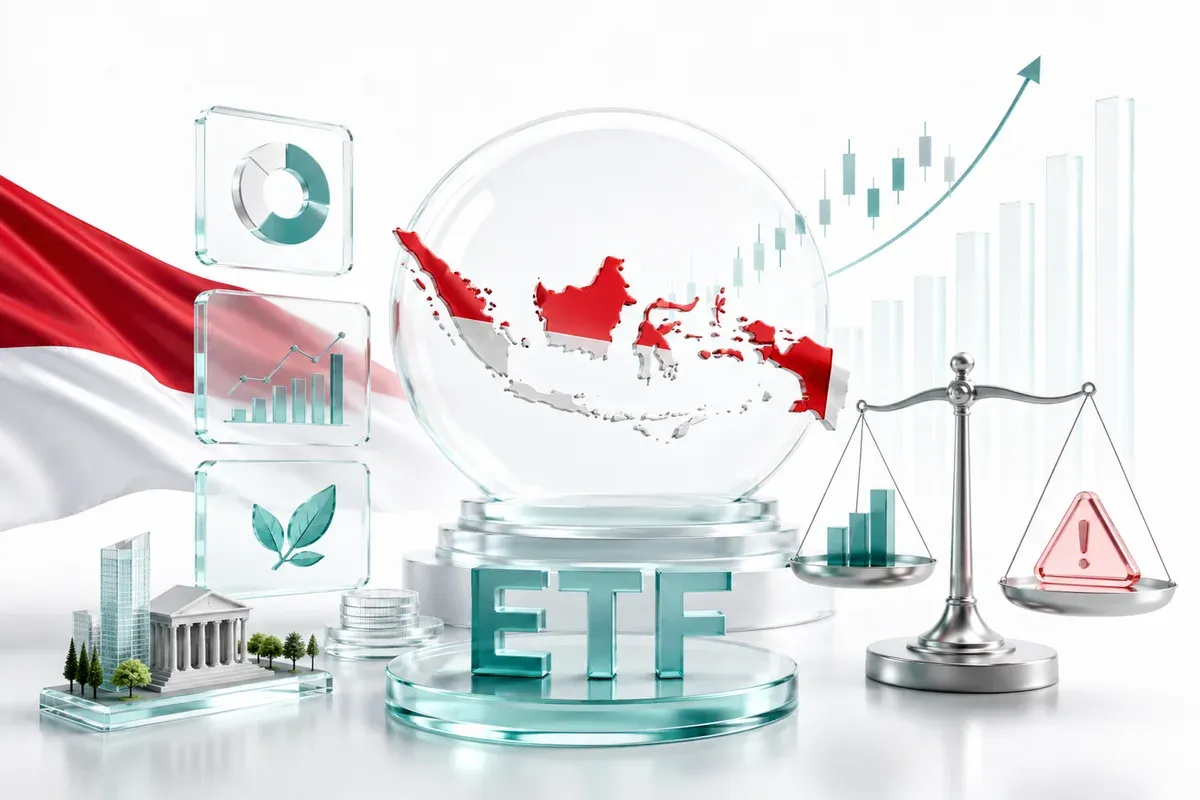
An ETF in Indonesia is a mutual fund listed on the Indonesia Stock Exchange that trades like a stock. It offers instant diversification because one unit can represent dozens of stocks or bonds. ETFs are managed by an investment manager, supervised by OJK, and valued daily.
Since the first ETF launched in 2007, they have become a practical option for beginner investors with small capital. This article explains how ETFs work, the types available in Indonesia, their benefits, risks, and how to start buying them.
Key Points
-
Clear definition: An ETF is a mutual fund listed on the Indonesia Stock Exchange and traded in real time like a stock.
-
Regulatory clarity: OJK supervises ETF products as officially recognized collective investment contract mutual funds.
-
Low entry barrier: Retail investors can start with about Rp70,000 to Rp150,000 while gaining diversified exposure across assets.
-
Real risks: ETF prices can decline when markets weaken, and liquidity remains dynamic depending on trading volume.
-
Good for beginners: ETFs support asset diversification and provide a practical first step for learning the Indonesian capital market.
What is an ETF in Indonesia?
According to Indonesia Stock Exchange data, the first Indonesian ETF was XO-IHSG, launched in 2007. Since then, the number of ETFs on the IDX has grown, although their share is still smaller than that of conventional mutual funds. OJK regulates ETFs under POJK Number 10/POJK.04/2017 on mutual funds in the form of collective investment contracts. Meanwhile, according to KSEI data as of December 2025, the estimated number of Indonesian capital market investors has surpassed 14 million.
An ETF is different from beginner stock investing, which requires analyzing stocks one by one. With an ETF, you simply buy one instrument to get a packaged portfolio in a single transaction.
How do ETFs work on the IDX?
An ETF combines the mechanics of a mutual fund and a stock. An investment manager builds a portfolio that tracks a specific index, and the fund units are listed on the exchange. Investors buy and sell ETFs on the secondary market at prices that move continuously.
The market price of an ETF can differ from its net asset value due to supply and demand. Small differences are normal, but a large gap may signal opportunity or risk. Always check liquidity before entering.
To understand how transactions work in the capital market, you can read the investment tutorial for a general overview of buying and selling.
Types of ETFs available on the IDX
Not all ETFs are the same. On the IDX, you can find several broad categories.
• Stock index ETFs: Track indices such as the IHSG, LQ45, IDX30, or IDX80.
• Sharia ETFs: Follow Islamic stock indices such as ISSI or IDX-MES17.
• Bond ETFs: Hold government bonds or corporate bonds for income.
• Thematic or sector ETFs: Focus on sectors like banking, infrastructure, or high-dividend stocks.
• Global asset ETFs: Still limited in Indonesia, but beginning to emerge for diversification.
This categorization matters because it helps you match a product to your risk profile. The concept of asset classes is similar to how crypto types range from utility tokens to governance tokens.
Benefits of ETFs for retail investors
ETFs offer clear advantages for investors at any level.
• Instant diversification: One ETF can cover dozens of stocks or bonds.
• Lower costs: Management fees are generally below conventional mutual funds.
• Realtime trading: ETFs trade like stocks, making entry and exit flexible.
• High transparency: Investment managers must publish portfolio composition regularly.
• Low entry cost: You can start with one lot, usually below Rp150,000 depending on price.
According to product prospectuses published In 2026, annual management fees for ETFs in Indonesia generally range from 0.2% to 0.5%. ETFs are a bridge between mutual funds and stocks. If you are looking for global tech exposure, you can also explore US stocks to further diversify.
Key risks before buying ETFs
Every reward carries risk. Here are the main risks in Indonesian ETFs.
• Volatility risk: ETF prices fall when markets correct. A stock index ETF will drop sharply during a bear market. Manage this by staying invested longer.
• Liquidity risk: Some ETFs have low trading volume, leading to wider spreads. Check average daily volume first.
• Tracking error risk: ETF returns can deviate from the index due to fees and taxes. Compare ETF returns against the index.
• Macro risk: Rising interest rates can pressure bond prices inside a bond ETF. Follow Bank Indonesia policy.
• Manager policy risk: Investment managers may adjust their portfolio. Read monthly reports and the prospectus.
Disciplines like cutting losses and avoiding over-trading are also covered in crypto trading tips. The assets differ, but the risk management principles remain the same.
How to buy ETFs in Indonesia
Buying an ETF is similar to buying a stock. Follow these practical steps.
1. Open a brokerage account: Choose an OJK-regulated broker that is a member of the exchange.
2. Complete verification: Prepare your ID, tax number, bank book, and account details.
3. Fund your RDN: Transfer money to your own securities account, not the seller’s account.
4. Select the ETF: Compare the track index, liquidity, expense ratio, and manager reputation.
5. Place a buy order: Enter the ETF code, number of lots, and price. One lot equals 100 units.
6. Monitor your portfolio: Review performance regularly and compare it with the benchmark.
For an example of a different risk-return profile, you can look at SpaceX stock to see how individual equities compare.
ETF vs conventional mutual fund vs direct stock
Choosing an instrument cannot be random. The comparison below helps you align your needs.
| Aspect | ETF | Conventional Mutual Fund | Direct Stock |
|---|---|---|---|
| Trading | Real-time on IDX | Processed by agent at NAV | Real-time on IDX |
| Diversification | Dozens to hundreds of assets | Dozens to hundreds of assets | Limited by the number of stocks purchased |
| Costs | Generally low | Can be higher | Transaction and custody fees |
| Minimum Capital | 1 lot, around Rp100,000 | From Rp10,000 | 1 lot, depending on the stock price |
| Liquidity | Depends on trading volume | Redemption with cut-off time | Depends on stock trading volume |
No single instrument is perfect. Choose based on your goal, time horizon, and risk tolerance.
Taxes and regulation for ETFs in Indonesia
Taxes affect net returns. Based on Government Regulation Number 41 of 1994, which remains applicable, selling securities on the exchange such as ETFs is subject to a final tax of around 0.1% of the sale value. Dividend distributions from an ETF have their own tax treatment.
These rules can change with government and OJK policy. Check the latest regulation before investing or speak to a professional.
Strategy for starting with ETFs
Use a practical framework to maximize your chances.
1. Set clear goals: Separate money goals for emergencies, education, and retirement.
2. Choose a liquid index: Start with LQ45 or IDX30 as a benchmark.
3. Compare costs: Look at expense ratios, broker fees, and the bid-ask spread.
4. Invest regularly: Put in a fixed amount monthly instead of waiting for a perfect entry.
5. Rebalance periodically: Review your allocation every 6 to 12 months.
6. Avoid panic selling: Treat market corrections as a normal part of the cycle.
Conclusion
ETFs in Indonesia offer a straightforward way to invest with instant diversification. They are practical, transparent, and relatively affordable for beginners. However, you still need to understand the risks and costs involved. Combine ETFs with other asset classes that match your financial goals and risk profile.
FAQ
What is an ETF in Indonesia?
An ETF in Indonesia is a mutual fund traded on the Indonesia Stock Exchange like a stock. For example, an ETF tracking the IHSG or LQ45. This product is supervised by OJK and can be purchased for as little as one lot.
Are ETFs in Indonesia safe for beginners?
ETFs are relatively safer because they offer diversification and are regulated, but they are not risk-free. Market risk remains, depending on the underlying index and the product's liquidity.
What is the minimum capital to buy ETFs in Indonesia?
The minimum is one lot, or 100 units. With unit prices around Rp700 to Rp1,500, you need roughly Rp70,000 to Rp150,000, excluding transaction fees.
Are ETF gains taxed in Indonesia?
Yes. Gains from selling securities on the exchange are subject to a final tax of around 0.1%, under current Indonesian tax rules. Dividend taxes follow their own rules.
What is the difference between ETFs and conventional mutual funds?
ETFs trade on the exchange in real time with prices that move during market hours. Conventional mutual funds are processed through a selling agent using a net asset value set at the end of the day.
Mobee is a digital asset platform licensed and supervised by OJK, helping users explore crypto and investment products with clearer access and practical learning. Start your investment journey through Mobee and choose products that match your goals and risk profile.
 Direct market access from the app
Start exploring digital assets with Mobee
Track the market, learn about digital assets, and start trading more conveniently with the Mobee App.
Mobee is licensed and supervised by the OJK. Not a solicitation to buy or sell any asset.