From Real Assets to Digital Tokens: What Actually Happens Behind the Scenes?

This article opens up what sits behind a single token: who holds the asset, what rights you actually have, how you can check the asset exists, and what happens if the issuer runs into trouble. For the definition, read what is RWA.
For the five-step issuance process and how it differs from securitization, read the asset tokenization guide.
Key Takeaways
- The underlying asset stays in a vault, bank, or licensed broker. The token is only a digital record representing rights over that asset.
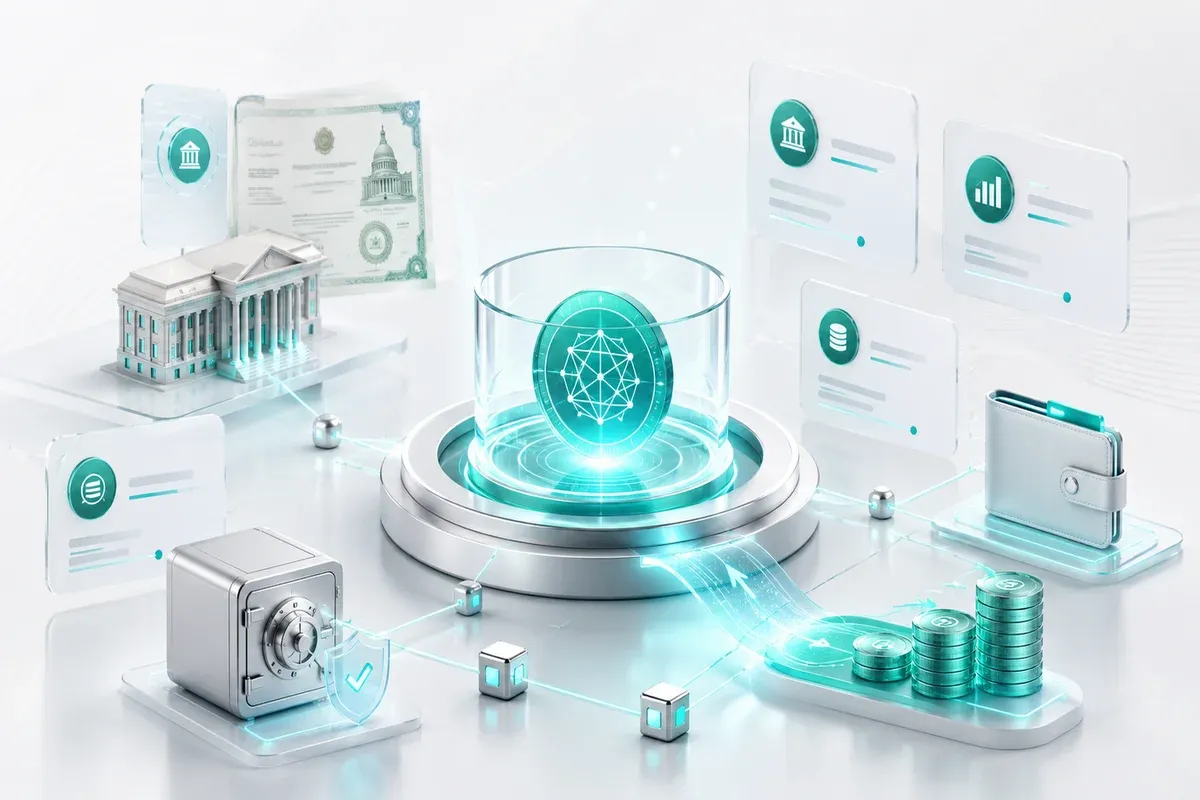
- Six layers sit behind a single token: the asset and its valuation, the legal wrapper, the custodian, the smart contract, price data, and redemption and reporting. A token is only as strong as its weakest layer.
- The rights you hold differ by product: direct ownership, a beneficial interest in a custodied asset, a share in a vehicle, or simply a claim against the issuer.
- Evidence that the asset exists comes from reserve reports, attestations or audits, and on-chain data. An attestation is not the same as a full audit.
- As of 12 October 2026, rwa.xyz records about US$39.16 billion in real-world assets distributed on blockchains, with more than 5.2 million holders. A large market does not remove issuer and custodian risk.
The Underlying Asset Does Not "Move" Onto the Blockchain
Think of a warehouse receipt. The goods stay in the warehouse, while the paper receipt can be sold or used as collateral. Whoever holds a valid receipt is entitled to the goods, as long as the warehouse and the issuer of the receipt can be trusted.
RWA tokens follow the same logic. The blockchain only records who holds which token. The existence of the gold, the authenticity of the bonds, and the legal rights of token holders all sit off-chain, in the hands of the issuer, the custodian, and the governing law. So the key question is not "is the token on a blockchain", but "what stands behind the asset, and who is responsible if something goes wrong".
Six Layers Behind a Single Token
Every RWA product is assembled from the same layers. Differences in quality between products almost always come down to how strongly each layer is built.
| Layer | Who handles it | Question you need to answer |
|---|---|---|
| 1. Asset and valuation | Issuer, independent appraiser | Who confirms the asset exists and is worth that much? |
| 2. Legal wrapper | Issuer and legal counsel, often an SPV | What rights are written down for token holders? |
| 3. Custodian | Vault, bank, or licensed broker | Who holds the asset, and is it separate from the issuer's own money? |
| 4. Smart contract | Issuer and transfer agent | Who can hold and move the token? |
| 5. Price data | Oracle or fund administrator | Where does the reference price come from and how often is it updated? |
| 6. Redemption and reporting | Issuer, custodian, auditor | What can the token be redeemed for, on what terms, and what do the reports look like? |
Layers 1 and 2: The asset and the legal wrapper
The asset is valued and verified, then usually placed inside a legal wrapper such as an SPV (special purpose vehicle), a company created to hold the asset and issue the tokens. This wrapper determines what is written down as the token holder's rights, and ideally it is kept separate from the issuer's own finances. An industry practitioner quoted by Kontan (9 June 2026) argued that validating that the asset really exists is the most important factor for investor trust, and that the process will be complicated.
Layer 3: The custodian
The custodian holds the real asset: a vault for gold, a custodian bank for bonds, a licensed broker for stocks. What to check is whether customer assets are segregated from company funds, and whether the custodian is a regulated institution.
Layer 4: The smart contract, where tokens are minted and burned
DTCC, the US securities settlement institution, describes three basic token operations (DTCC, 2 March 2026):
- Mint: creating tokens that represent a specific asset and sending them to a wallet.
- Burn: removing tokens from a wallet and converting the rights back to their traditional form.
- Cancel: restricting or revoking token or wallet activity for recovery, compliance, or operational control.
The third one is easy to miss: an RWA token is not necessarily free to move like an ordinary crypto coin. A smart contract can restrict who is allowed to hold the token, and a transfer to a non-permitted address can fail or be reversed.
Layer 5: Price data
The token price follows the reference asset's price through an oracle or a net asset value (NAV) calculation. Under market stress, the token's secondary-market price can drift from the reference asset's value. A token that trades 24 hours a day still depends on an underlying market that has opening hours.
Layer 6: Redemption and reporting
Some issuers let holders redeem tokens, after which the token is burned and the rights are returned as physical assets or money. Terms differ widely between products, including minimum amounts and who is eligible. Issuers also usually publish periodic reserve reports.
Real Examples: Stocks and ETFs, Gold, Other Commodities, and Bonds
The structure behind a token differs by asset type. The easiest way to understand it is to look, for each type, at who holds the asset and what you hold.
Stocks and ETFs
Stock and ETF tokens give price exposure to US stocks or ETFs in token form. Different issuers use different structures, but the pattern is similar: real shares are held at a licensed broker or custodian as collateral, and the token you hold is a claim against the issuer, usually through an SPV, not the share itself. DeGate's analysis notes the variations, for example a Jersey SPV with a tracker certificate, or a British Virgin Islands (BVI) SPV with a structured note whose collateral is kept at a minimum of 100.5% of tokens outstanding. At Mobee, stock and ETF token products come from more than one issuer, so the exact structure can differ by product and should be checked on the product page.
Three points apply broadly:
- Shareholder rights do not automatically come with it. Tokens generally do not carry voting rights or shareholder status.
- Dividends are reflected, not paid out separately. The adjustment usually comes through a change in token quantity.
- Your claim is against the issuer or its SPV, not against a company such as Apple.
A deeper look is in the claim chain behind stock tokens, US stock tokens vs regular stocks, and how stock tokens work.
Gold
Paxos describes the PAXG flow in a 23 January 2026 article. Paxos buys bars from LBMA-recognized suppliers, at a minimum purity of 99.5% and about 400 troy ounces per bar, and stores them in LBMA-certified vaults in London. Specific bars are allocated, and each bar's serial number, refiner stamp, and weight are recorded and linked to tokens. The smart contract only mints PAXG when the gold has been allocated, and one token represents one fine troy ounce.
On redemption, Paxos says holders of at least 430 ounces can redeem full bars, while smaller amounts can go through partner gold retailers or be converted to USD or unallocated gold. Redeemed tokens are burned. Paxos also states that independent accounting firms audit the gold reserves monthly.
Tether Gold (XAUT) states that its backing physical gold is held in Switzerland, and its redemption terms should be checked directly on the issuer's site. According to rwa.xyz as of 12 October 2026, XAUT is worth about US$3.0 billion and PAXG about US$1.8 billion. Details on each token are in XAUT and PAX Gold.
Silver, copper, natural gas, and oil
For other commodities, the structure depends on the nature of the goods. Metals such as silver and copper can be stored physically, so a token can represent metal in a warehouse or vault with a custodian and quality checks, or provide price exposure through a fund. Oil and natural gas are hard for a token holder to store, so tokens generally give price exposure through a fund or financial instrument, not rights to physical barrels or gas.
As a result, redemption on fund-based products is usually in money, not goods. An example is the US oil fund token in USOon. Always read what the token actually represents: physical metal, a fund unit, or just price exposure.
Bonds (as a comparison)
BUIDL, BlackRock's tokenized money market fund launched in March 2024, shows another side: access control. The fund holds all of its assets in cash, US Treasury bills, and repurchase agreements, with Securitize as transfer agent and tokenization platform and BNY Mellon as custodian and administrator. The initial minimum investment is US$5 million according to BlackRock's press release.
Only investors who pass KYC and qualification requirements are added to the whitelist, and transfers to addresses outside that list are rejected at the smart contract level. Redemption runs through Securitize: tokens are burned at the next NAV strike, and the proceeds are sent as US dollars. It is worth about US$2.2 billion as of 12 October 2026, per rwa.xyz. This example shows why RWA tokens are not automatically open to everyone. BUIDL is not listed in Mobee's asset list.
Summary of the examples
| Asset type | Example | Who holds it | What you hold | Redemption route |
|---|---|---|---|---|
| Stocks and ETFs | US stock and ETF tokens | Licensed broker or custodian as collateral | A claim against the issuer or its SPV | Set by issuer and platform documents |
| Gold | PAXG, XAUT | Certified vault (PAXG: London, XAUT: Switzerland) | Rights over the tokenized gold, per issuer terms | Full bars, partner retailers, or conversion to money, depending on the product |
| Silver, copper, natural gas, oil | Commodity tokens, for example an oil fund | Warehouse or vault for physical metal, fund custodian for fund-based products | Rights over metal or fund units, depending on the product | Usually money on fund-based products |
| Treasuries | BUIDL | BNY Mellon | A fund unit recorded as a token | Through the transfer agent, registered investors only |
What Do You Actually Hold? Five Types of Rights
The RWA.xyz classification framework separates tokens by the legal relationship between the token and the asset. The way to read it is simple: the further down the table, the further you are from the underlying asset.
| Type | What you hold | Main risk |
|---|---|---|
| Direct ownership | The token is the official record of ownership of the instrument | Quality of the transfer agent and record keeping |
| Interest in a custodied asset | A beneficial interest in a specific asset, while legal title stays with the custodian | Custodian risk and clarity of asset segregation |
| Interest in a vehicle | A share in a fund, SPV, or trust | Manager risk and governance of the vehicle |
| Claim against the issuer | A contractual promise from the issuer, with collateral owned by the issuer | Issuer credit risk and the insolvency process |
| Code-based position | A position defined by a smart contract with no disclosed legal title | Smart contract and oracle risk |
Two tokens with the same price can carry very different rights. That is why you should read the product terms, not just the price.
How Do You Know the Asset Behind It Really Exists?
There is no single proof. Use several layers of checking:
- Periodic reserve reports. Check who publishes them, how often, and what they cover. An attestation confirms figures at a specific date and is not the same as a full audit.
- Asset details. Some issuers publish lists you can check, such as the serial numbers of gold bars linked to tokens.
- On-chain data. Some issuers use proof of reserve or price data from oracles such as Chainlink to monitor reserves and prices on-chain. This helps, but wrong or delayed oracle data can still mislead.
- Official contract address. Make sure you are buying the genuine token from an official source, not a lookalike with a similar name.
One thing to remember: all of these reduce uncertainty but do not eliminate it. Validation of asset existence, which is still done by people and institutions, remains the weakest point.
If the Issuer or Custodian Runs Into Trouble
The token is in your wallet or account, but your claim depends on three things: the issuer's documents, who controls the collateral, and the insolvency process in the issuer's jurisdiction. DeGate's analysis of tokenized stock issuer failure notes that some issuers use SPVs designed to be separate from the issuer, with a security agent who can take control of the collateral if holder rights are not honored.
Key points from that analysis: recovery is more likely to be cash from selling the collateral than delivery of the asset, the process can take weeks to months, and full and fast recovery is not guaranteed. No large tokenized stock issuer has publicly failed yet, so these recovery paths are untested in the real world. That is why you should read the product structure before buying, and treat RWA tokens as risky instruments.
What the Rules Say in Indonesia
Digital financial assets, including crypto assets, have been supervised by OJK since 10 January 2025, with POJK 27/2024 as the implementing regulation. On 6 October 2026, OJK's Chief Executive for IAKD Supervision, Adi Budiarso, said the draft rule on offering tokenized assets is still being prepared. OJK follows the principle of "same activities, same risk, same regulation", meaning activities with the same risk are regulated the same way regardless of the technology.
For now, that means you need to check the status of each product yourself and make sure you transact through a licensed exchange. A full discussion of rules, tax, and a risk checklist is in RWA regulation, tax, and risks in Indonesia. How to verify a platform is in how to check whether a crypto platform is legal.
Six Questions to Ask Before You Buy an RWA Token
- Who is the issuer, and in which jurisdiction is it incorporated?
- Who is the asset custodian, and is the asset segregated from the issuer's own money?
- What is written as my right: ownership, a beneficial interest, or a claim against the issuer?
- How can I see proof of reserves, how often is it updated, and who verifies it?
- What can the token be redeemed for, on what terms and minimum amounts, and am I eligible?
- If the token market goes quiet or the issuer runs into trouble, what is the exit route?
If you cannot answer three or more of these, treat it as a signal to start with a small amount or wait.
At Mobee
Mobee is operated by PT CTXG Indonesia Berkarya, which is licensed and supervised by OJK. Some tokenized products, such as stock and ETF tokens, gold tokens (XAUT and PAXG), and commodity tokens, are listed in the Mobee asset list.
Products can come from more than one issuer and availability can change, so always check in the app. A summary of the coins and tokens in this sector is in RWA coins. Start with assets you understand, in an amount whose risk you can afford.
Conclusion
From real asset to digital token, what changes is how rights over the asset are recorded and transferred, not the physical existence or legal standing of the asset. Behind a single token sit an issuer, a legal wrapper, a custodian, a smart contract, price data, and a redemption mechanism. A token is only as strong as its weakest layer.
Before buying, make sure you know who holds the asset, what rights you hold, and how you can redeem or exit. Treat an RWA token as an instrument that depends on its issuer, not as a real asset that is automatically safe.
Frequently Asked Questions
How can a real asset become a digital token?
The real asset is valued, held by a custodian, and placed in a legal wrapper that defines holders' rights. A smart contract then mints a token representing those rights. The underlying asset does not move onto the blockchain; only who holds the token is recorded there.
Are RWA tokens really backed by real assets?
They should be, but it depends on the issuer and the custodian. Check the reserve reports, who verifies them, and how often they are updated. An attestation is not a full audit, and no single proof removes the risk entirely.
Who holds the asset behind an RWA token?
A custodian appointed by the issuer: a vault for gold, a custodian bank for bonds, or a licensed broker for stocks. For example, PAXG is held in LBMA-certified vaults in London, and BUIDL uses BNY Mellon as custodian.
What do I actually hold when I buy an RWA token?
It depends on the product: direct ownership, a beneficial interest in a custodied asset, a share in a vehicle, or a claim against the issuer. For stock and ETF tokens, for example, the claim is generally against the issuer or its SPV, not the company or the shares directly.
Can an RWA token be exchanged for the physical asset or money?
Sometimes, but terms differ by product. According to Paxos, PAXG holders of at least 430 ounces can redeem full bars, and smaller amounts can be converted to money. For other products, check the issuer's terms on who can redeem and the minimum amount.
What happens if an RWA token issuer goes bankrupt?
Your claim depends on the issuer's documents, who controls the collateral, and the insolvency process in its jurisdiction. Recovery is more likely to be cash from selling the collateral, can take weeks to months, and is not guaranteed in full. This path is untested for large issuers.
Why can only certain investors hold some RWA tokens?
Because a smart contract can be locked to a whitelist that follows investor eligibility rules. BUIDL, for example, is only for investors who pass KYC and qualification requirements, and transfers to addresses outside the list are rejected.
Is asset tokenization regulated in Indonesia?
Digital financial assets, including crypto assets, are supervised by OJK and governed by POJK 27/2024. A specific rule on offering tokenized assets was still being drafted by OJK as of 6 October 2026, so check each product's status and use an OJK-licensed exchange.
Disclaimer
This article is for information and education only and is not investment, legal, or tax advice. Crypto assets and real-world asset tokens are high-risk instruments with large volatility. Do your own research and use only funds whose risk you can afford. Mobee is operated by PT CTXG Indonesia Berkarya, which is licensed and supervised by the Financial Services Authority (OJK).
 Direct market access from the app
 Start exploring digital assets with Mobee
Track the market, learn about digital assets, and start trading more conveniently with the Mobee App.
Mobee is licensed and supervised by the OJK. Not a solicitation to buy or sell any asset.