Mastering Order Types: Limit, Market, and Stop Order

In cryptocurrency trading, selecting the type of order is not just a technical matter but an integral part of the overall strategy. Limit orders, market orders, and stop orders are the three most common types of orders used on trading platforms. Each type has its advantages and disadvantages depending on market conditions and the trader’s approach.
Three Types of Orders in Crypto Trading
When trading, traders are given options on how they want to execute their transactions. The three main types of orders to understand are:
- Market Order, for quick execution.
- Limit Order, for price control.
- Stop Order, for protection or automatic triggers.
These three order types play different roles in trading strategies, whether for short-term execution, risk management, or planning entry and exit prices in the market.
1. Market Order
A market order is used to execute a transaction as quickly as possible at the available market price. This is the simplest type of order and is executed immediately without waiting for a specific price.
Advantages:
- Instant execution, suitable for fast-moving markets.
- Ideal when you want to enter or exit a position immediately.
Disadvantages:
- High potential for slippage, especially on assets with low liquidity.
- Less cost-efficient (usually charged taker fees).
When to use? Market orders are suitable when speed is more important than price, for example, during breakouts, panic selling, or when you need to quickly secure a position.
2. Limit Order
A limit order allows traders to set a specific price at which they want to buy or sell an asset. The order will only be executed if the market price reaches or passes the specified price.
Advantages:
- Full control over the buy or sell price.
- More cost-efficient due to often being charged maker fees.
- Suitable for strategies waiting at support/resistance levels.
Disadvantages:
- No guarantee the order will be executed.
- May miss market momentum if price targets are set too conservatively.
When to use? Limit orders are ideal for traders with specific price targets who are not in a hurry to enter the market. This strategy is also widely used for placing long-term orders.
3. Stop Order
A stop order only becomes active once the price reaches a certain level (stop price). After activation, it can become a market order (stop-market) or a limit order (stop-limit).
Advantages:
- Useful for risk management, especially when applying stop-loss.
- Can be used for automatic entries in breakout strategies.
Disadvantages:
- Risk of slippage on stop-market orders.
- Possible failure to execute stop-limit orders if the price quickly passes the limit.
When to use? Stop orders are suitable for locking profits or limiting losses without continuously monitoring the market. They are also commonly used to take advantage of price movements after key breakout levels.
Which One Is More Suitable for You?
There is no single answer to this question. The most suitable order type depends on:
- Trading style (scalping, swing, long-term).
- Position goals (entry, exit, protection).
- Market conditions (liquid, sideways, volatile).
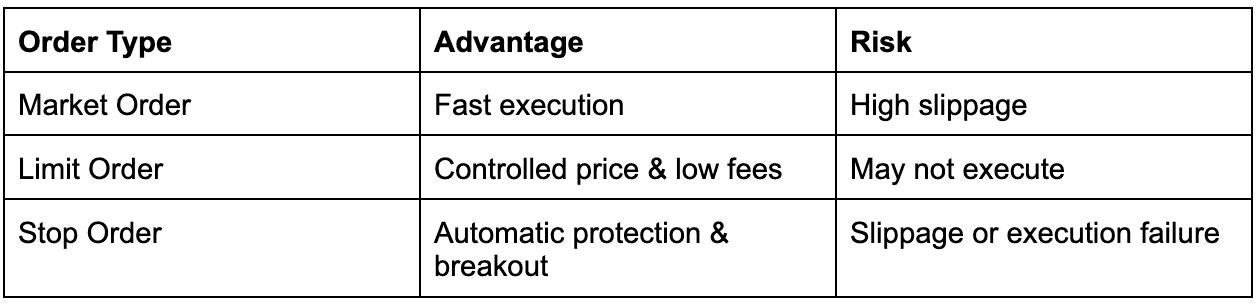
Each order type (market, limit, and stop) has its advantages and risks. Market orders excel in speed but may cause slippage. Limit orders give full price control but may not execute immediately. Meanwhile, stop orders serve as important tools for protection and automatic entry strategies.
Successful traders not only know when to enter or exit the market but also understand which order type suits each condition best. By understanding the characteristics of each order, you can build more precise, efficient, and risk-managed strategies.
Trading becomes easier with the Mobee app. Enjoy comprehensive features that support various investment strategies. Download Mobee now and tailor your trading strategy to fit your needs.
Sources:
Limit Order vs. Stop Order: What’s the Difference? Accessed in 2026. Investopedia.
What Is an Order Book and How Does It Work? Accessed in 2026. Crypto.com.
Disclaimer:
This content is intended to provide additional information to readers. Always conduct your own research before investing. All buying, selling, and investment activities in crypto assets are fully the responsibility of the reader.
 Direct market access from the app
 Start exploring digital assets with Mobee
Track the market, learn about digital assets, and start trading more conveniently with the Mobee App.
Mobee is licensed and supervised by the OJK. Not a solicitation to buy or sell any asset.