Exchange vs Self-Custody: When to Move Your Crypto
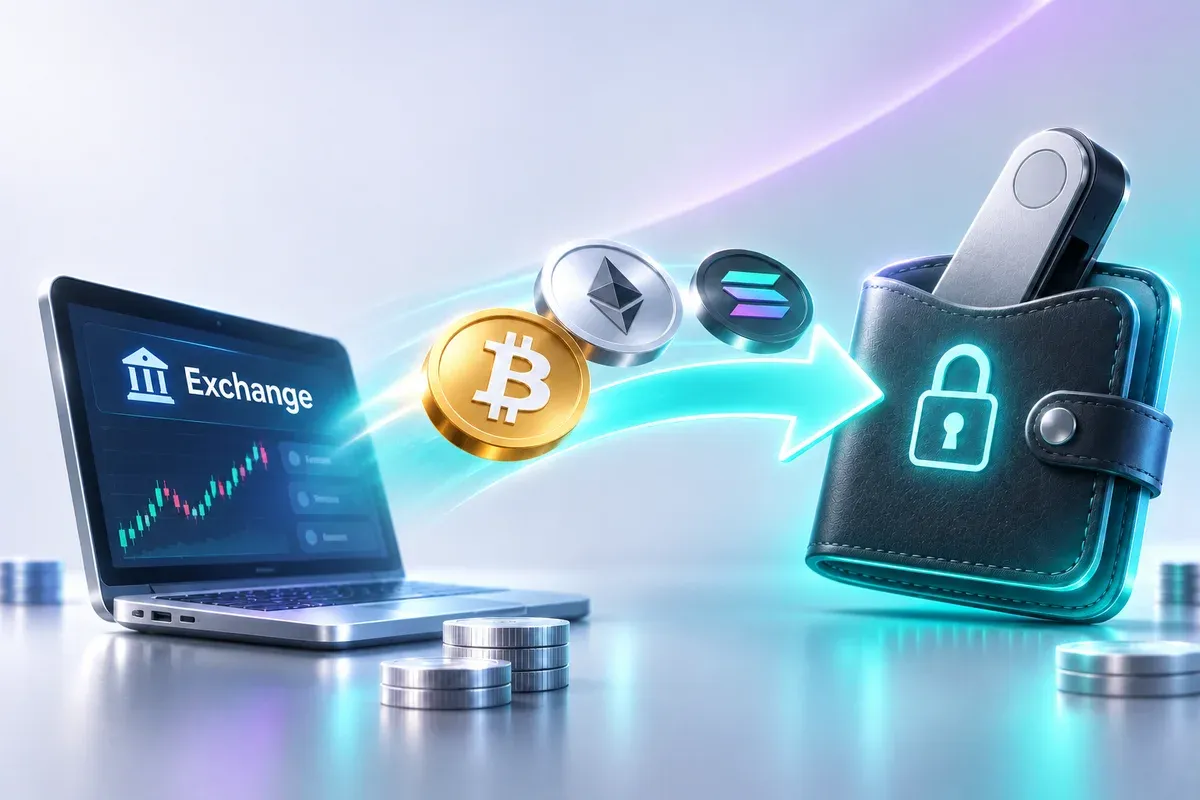
You should move crypto from an exchange to a self-custody wallet when the funds are not needed for active trading, the amount is material, and you can protect a seed phrase without sharing it.
Exchanges are convenient for quick access and frequent transactions, while self-custody gives full control and moves the security burden to you.
This framework weighs access needs, amount, seed phrase capability, and trading frequency instead of prescribing one storage method for everyone.
Key Points
- Access needs: Exchanges suit active trading funds, while self-custody suits assets you rarely move.
- Amount: Larger balances deserve closer scrutiny of counterparty risk, withdrawal terms, and recovery procedures.
- Seed phrase: Self-custody only makes sense if you can store the phrase offline and never share it.
- Trading frequency: Frequent trades add transfer costs, settlement time, and operational friction that must be counted.
- Risk trade-off: Exchanges carry third-party risk, wallets carry loss-of-access risk, and both need mitigation.
Decision Summary: Exchange vs Self-Custody Wallet
This choice is not about exchanges being always bad or wallets being always safer. What changes is who controls the technical keys and how you manage operational mistakes.
• Funds Used for Active Trading
An exchange is more practical when you buy, sell, or rebalance within days. Liquidity and order records sit in one place, so you do not move assets back and forth. Keep only the operating balance there, because idle balances still carry third-party exposure.
• Funds Left Untouched
A self-custody wallet fits assets held for months or years and not needed for daily access. You control the keys, but you also own every recovery step. Move funds only after the backup process has been tested.
• Emergency or Long-term Goals
Money with a clear purpose needs separation from trading capital. Keep untouched funds apart from active balances to reduce panic selling and simplify record keeping. Calculate network fees before moving anything.
Access Needs and Withdrawal Speed
Access determines how often you must interact with a custodian. The faster funds need to move, the greater the practical value of an exchange.
• Daily Access and Fast Execution
Frequent order placement favors an exchange because the workflow is shorter. You do not wait for network confirmations or open a wallet for every trade. The trade-off is that residual balances remain exposed to the provider.
• Independent Access Outside Service Hours
A wallet can be accessed without depending on exchange support hours or withdrawal queues. This helps when you need to move assets at unusual times. You still must verify the network, fee, and destination address.
• Verification and Withdrawal Limits
Exchanges require identity checks and withdrawal approvals before funds leave. That adds compliance and delay during busy markets. Read withdrawal limits and account recovery terms before relying on an exchange for storage.
Amount and the Cost of Mistakes
The amount changes the impact of an error. A wrong address for a small transfer is different from a wrong address for a large holding.
• Small Amounts for Testing
Small transfers are useful for testing deposit, withdrawal, and wallet recovery. Use the correct network and record the actual fee. Once the process works, increase the amount gradually.
• Large Balances and Withdrawal Limits
With larger balances, check withdrawal caps, processing times, and claim procedures. Do not depend on one support channel. Keep transaction records and understand what happens if account access is interrupted.
• Concentration on One Exchange
Keeping all assets on one exchange ties you to one policy, one system, and one queue. Separate operating funds from long-term storage. This does not remove risk, but it makes disruption easier to contain.
• Recovery Costs and Wrong Addresses
Network fees vary by asset and congestion, while wrong addresses or networks are usually irreversible. Verify every address manually and avoid copying from unverified messages. A cheap transfer is not worth a permanent loss.
Seed Phrase and Operational Capability
Self-custody is only as strong as your ability to protect the seed phrase. Without operational discipline, full control can turn into permanent loss.
• Offline Seed Storage
Write the seed phrase on physical material and store it where others cannot easily access it. Do not keep photos or cloud notes. If the device fails, the offline backup becomes the only recovery path.
• Never Sharing the Seed Phrase
No legitimate service needs your full seed phrase by phone, email, or support form. Such requests are a phishing signal. Make this rule clear to anyone who can access your device.
• Testing Wallet Recovery
Before storing a large amount, restore a new wallet with a small balance and confirm the words and order. Check any additional passphrase separately. Testing turns assumptions into evidence.
• Device Hygiene and Physical Backups
Use a clean device, update firmware, and keep backups separate from the main hardware. If you use a hardware wallet, store the phrase away from the device. This limits the impact of one lost or damaged item.
Trading Frequency and Transfer Costs
Trading frequency affects the practical value of an exchange. The more often you move funds, the larger the visible and hidden costs become.
• Daily Trading
Daily traders need fast execution, order history, and liquidity in one place. Moving the entire balance to a wallet every day adds fees and delay. Keep only the amount needed for active strategies on the exchange.
• Weekly or Monthly Trading
If you trade a few times a month, a split model can work better. Use the exchange for execution and a wallet for the remainder. Count transfer fees before moving funds back.
• Buy and Hold
Long-term holders often fit self-custody better after building a position. Daily access is not required, but device updates and backups still are. Exchanges remain useful for initial purchases and conversions.
• Network Fees and Spread
Transfer fees are not the same as trading costs. Spread, withdrawal fees, and confirmation time affect the net result. Review actual costs from several transactions before setting a routine.
Practical Decision Table
This table is not an absolute score. Use it as a comparison aid when weighing two storage options.
| Factor | Leans exchange | Leans self-custody | Check |
|---|---|---|---|
| Access | Fast execution needed | Rare transactions | Service hours and withdrawal limits |
| Amount | Small operating balance | Long-term savings | Transfer fees and claim process |
| Seed phrase | Not ready for offline backup | Ready for offline backup | Recovery test and physical backup |
| Trading frequency | Daily or weekly | Monthly or long term | Spread, fees, and confirmation time |
| Purpose | Liquidity and conversion | Full control of keys | Recovery plan and tax records |
Common Scenarios Without Personal Advice
Scenarios help you read the trade-offs, not replace your own decision. Match them with your operational reality.
• Active Trader with Limited Capital
An active trader may keep an operating balance on an exchange and hold the rest in a wallet. Set the operating limit before trading, not after a position is open. This caps exposure if access is disrupted.
• Long-term Holder
A long-term holder who does not need cash soon may consider self-custody. The focus should be backup, recovery, and device monitoring. The exchange remains a tool for buying or selling when needed.
• New User Who Does Not Understand Seed Phrases
A new user should practice wallet flows with a small amount before moving savings. If the seed phrase cannot be protected with discipline, a regulated exchange is easier to monitor operationally. That does not remove third-party risk.
• User with Multiple Wallets
Separating wallets by purpose, such as trading, storage, and testing, can reduce fund mix-ups. Each wallet still needs its own backup and record. Do not create so many wallets that recovery becomes confusing.
• User Who Needs Records and Claims
Exchanges provide centralised transaction histories that help with bookkeeping or claims. Self-custody provides on-chain proof that you must archive yourself. Choose based on documentation needs, not only fees.
Main Risks to Compare
Exchange risk and self-custody risk take different forms. Both should be judged by impact and your ability to mitigate them.
• Exchange Counterparty Risk
An exchange holds assets through an account managed by the provider, so you depend on its operations and solvency. Withdrawals can be delayed during high demand. Limit idle balances and check official provider information.
• Seed Phrase Loss
Lost seed phrases or passphrases can make a wallet unrecoverable, even by the wallet developer. A damaged backup with no second copy is a common failure. Test recovery and keep separate physical backups.
• Phishing and Social Engineering
Attackers often pose as wallet or exchange support to request secret codes. One fake link can drain a wallet if transaction permissions are approved. Verify domains, use official bookmarks, and never share seed phrases.
• Liquidity and Withdrawal Risk
Exchanges may apply limits or queues during stressed conditions. Users who need cash quickly can face delays. Hold a separate liquidity buffer outside crypto and read withdrawal terms before storing large amounts.
• Regulatory and Tax Risk
Tax treatment and compliance requirements can change, so transaction records must stay organised. Self-custody does not remove reporting duties, and exchanges may not provide the format you need. Keep proof of transactions and verify current rules.
Checklist Before Moving and When to Review
A checklist makes the move more controlled and reduces impulsive decisions.
• Define the Storage Purpose
Write down why you are moving funds, such as long-term storage or separation from trading. A clear purpose guides the amount and wallet type. Without it, the move only adds operational complexity.
• Verify Address and Network
Check the destination address character by character and confirm the network. Do not rely on links from messages or search results. Send a small test before a large transfer.
• Test a Small Transaction
Send a small amount first and confirm that it arrives and can be moved again. Record the actual fee and confirmation time. Stop if anything looks wrong.
• Keep Records and Backups
Record wallet locations, network types, and recovery procedures in a safe place. Store seed backups separately from the device. These records help when the main device fails.
• Review After Material Changes
Review the choice when trading frequency, amount, or operational ability changes. An exchange that once felt practical can become too large a risk. A wallet that once felt difficult can become manageable.
Conclusion
Moving to a self-custody wallet makes sense when the assets are not used for active trading, the amount is significant, and you can protect the seed phrase with discipline. Exchanges remain useful for liquidity and transactions, provided idle balances are limited and third-party risk is understood. The better choice is not the most popular one, but the one that matches your access needs and operational capability.
FAQ
What is the difference between keeping crypto on an exchange and in a self-custody wallet?
On an exchange, assets sit in an account managed by the provider and you access them through login and verification. In a self-custody wallet, the private key or seed phrase is in your hands, so full control comes with security responsibility.
What factors should be weighed before moving to self-custody?
Weigh access needs, amount, seed phrase capability, trading frequency, and recovery quality. If funds must be withdrawn quickly, an exchange may be more practical; if not, a self-custody wallet deserves consideration.
How do amount and trading frequency affect the storage choice?
There is no absolute number, but a larger balance raises the impact of exchange disruption or seed phrase loss. As a working rule, separate operating funds from savings you will not touch for 3 to 6 months.
How important is the ability to safeguard a seed phrase?
It is critical because the seed phrase is the main recovery path. If you cannot store it offline, avoid sharing it, and test recovery, self-custody risks becoming permanent loss.
What are the main risks of exchanges versus self-custody?
Exchanges bring counterparty risk, withdrawal delays, and provider policy risk. Self-custody brings seed phrase loss, phishing, and wrong-address risk; each needs different mitigation.
When should the storage choice be reviewed?
Review it when trading frequency changes, the amount grows, a device fails, or provider rules are updated. Do a review at least every 6 months or before moving a large balance.
Choose Custody by Clear Rules
This financial insight can be a useful starting point before exploring investing at your own pace. When you feel ready, Mobee, operated by PT CTXG Indonesia Berkarya and licensed and supervised by OJK, offers beginner-accessible digital-asset choices with eligible options from IDR 10,000 depending on the product and deposit method.
Disclaimer
This article is for education only, not financial advice. Digital assets carry risk. Do your own research (DYOR) before making investment decisions.
 Akses market langsung dari aplikasi
Mulai eksplorasi aset digital dengan Mobee
Pantau market, pelajari aset digital, dan mulai transaksi dengan lebih praktis melalui Mobee App.
Mobee berizin dan diawasi OJK. Informasi bukan ajakan membeli atau menjual aset.