What Is Palladium? Uses, Producing Countries, and Risks
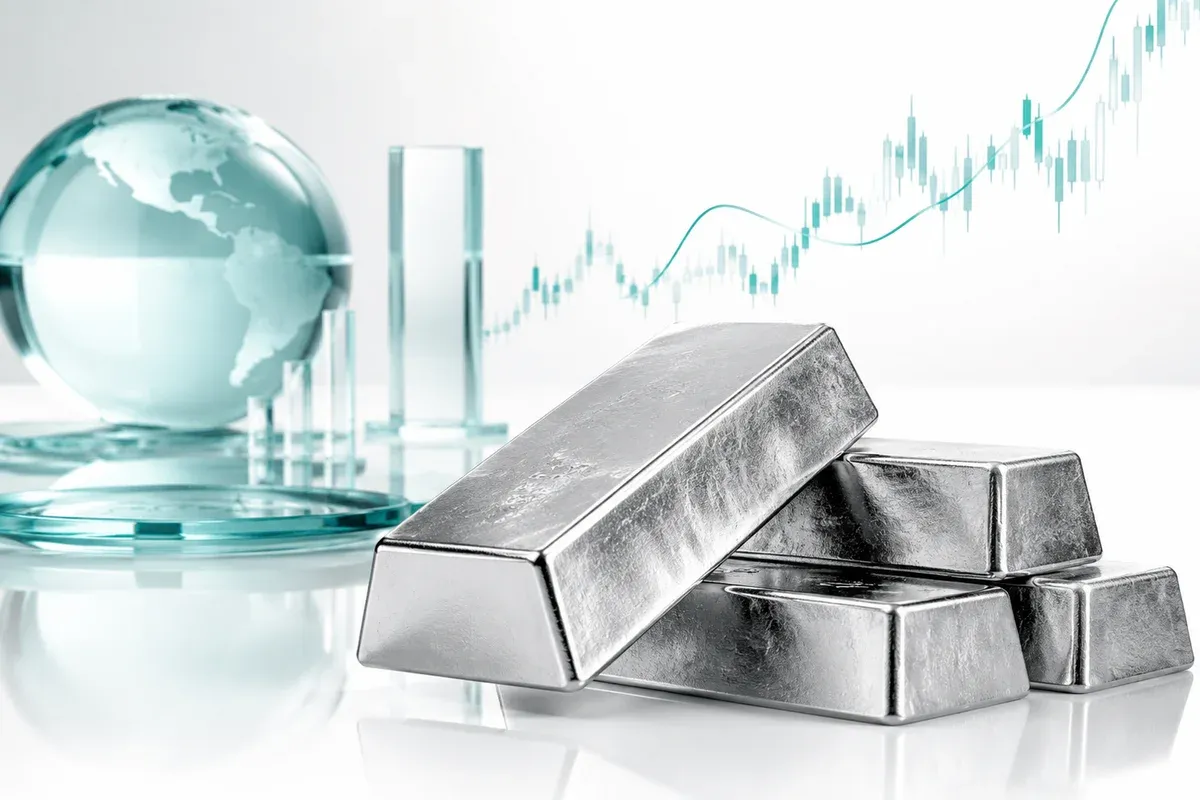
Its main job is as a catalyst in vehicle exhausts, and most of its supply comes from Russia and South Africa. Its price can swing sharply, so learn its uses, producing countries, and risks before you make any decision.
Unlike gold, the palladium market is much smaller, its price is more volatile, and its supply is concentrated in just two countries. Demand is driven largely by the auto industry. So before holding palladium as an asset, you need to understand its nature, what moves its price, and how easily you can sell it again.
Key Takeaways
- Palladium is an industrial precious metal that can also be held as an investment asset.
- About 80% of the world's mined palladium comes from Russia and South Africa (USGS 2026 estimates).
- About 81% of global palladium demand in 2025 went to vehicle catalysts (IPA, May 2026).
- Its price is sensitive to supply deficits or surpluses, car-industry cycles, and the shift to electric vehicles.
- The main risks are high volatility and much lower liquidity than gold.
What Is Palladium Used For?
Palladium's main job is to act as a catalyst. A catalyst is a substance that speeds up a chemical reaction without being used up. That is why palladium is used where reactions need to be fast and heat-resistant.
Catalyst in vehicle exhausts
Its biggest use is in the catalytic converter, a device in the exhaust that turns harmful exhaust gases (carbon monoxide, hydrocarbons, and nitrogen oxides) into safer gases (carbon dioxide, water vapor, and nitrogen). According to the IPA (International Platinum Group Metals Association), the automotive sector absorbed about 81% of global palladium demand in 2025, or 251 tonnes out of 311 tonnes.
Palladium is used mainly in gasoline and hybrid cars, while platinum is used more in diesel cars. Fully electric vehicles have no exhaust, so they do not use this catalyst. That is why the pace of the shift to electric vehicles is often discussed as a long-term risk for palladium demand.
Other uses
Outside the auto industry, palladium is used in the chemical industry as a catalyst in production processes (about 16 tonnes in 2025 according to the IPA, fairly stable) and in a small share of electronic components. Jewelry is a small segment, and some people also hold palladium as an investment asset. These shares are far smaller than automotive, so the health of the car industry largely decides where demand goes.
Palladium Producing Countries (Russia and South Africa)
Palladium is a metal with highly concentrated supply. According to USGS (the US Geological Survey) estimates, Russia and South Africa together produced about 79% of the world's mined palladium in 2024 and about 81% in the 2025 estimate. So if one of these two countries is disrupted, global supply can be shaken.
| Country | 2024 production (tonnes) | 2025 estimate (tonnes) |
|---|---|---|
| Russia | 89.0 | 84.0 |
| South Africa | 82.6 | 70.0 |
| Canada | 17.0 | 16.0 |
| Zimbabwe | 15.2 | 15.0 |
| United States | 10.2 | 6.2 |
| Other countries | 2.9 | 2.9 |
| World total | 217 | 190 |
Source: USGS, Mineral Commodity Summaries 2026 (platinum-group metals). USGS rounds these figures, so the rows may differ slightly from the world total.
Palladium from South Africa
South Africa is the world's second-largest palladium producer, with an estimated 70 tonnes in 2025. That is down about 15% from 82.6 tonnes in 2024. Much of its supply comes from the Bushveld Complex mining region [VERIFIKASI]. South African palladium is generally mined together with platinum and other platinum-group metals, so its volume is also affected by power costs, labor, and mine operations there [VERIFIKASI].
Palladium from Russia
Russia is the largest producer, at about 84 tonnes in the 2025 estimate. Because its share is so large, trade policy and sanctions affecting Russia can influence global palladium supply and prices.
The IPA gives slightly different shares for 2025 (Russia 43%, South Africa 35%), but the picture is the same: these two countries control roughly four-fifths of mined supply.
Palladium vs Platinum vs Gold
All three are precious metals, but their roles and market behavior differ. Palladium and platinum are used mostly by industry, while gold is better known as a store of value. To see where gold sits among the world's biggest assets, see also the list of the world's largest assets [VERIFIKASI SLUG: English version not published yet, link points to the Indonesian page].
| Aspect | Palladium | Platinum | Gold |
|---|---|---|---|
| Main use | Gasoline and hybrid car catalysts | Diesel car catalysts | Monetary reserve and jewelry |
| Main suppliers | Russia and South Africa | South Africa | China, Australia, and Russia |
| Retail liquidity | Low | Medium | Very high |
| Price volatility | Very high | High | Relatively lower |
Liquidity means how easily an asset can be sold without moving its price. In low-liquidity assets like palladium, the gap between the buy and sell price (the spread) tends to be wider.
Why Does the Palladium Price Move So Sharply?
The palladium price swings easily. As of 23 October 2026, it was around US$1,051.50 per troy ounce (1 troy ounce is about 31.1 grams). According to Trading Economics, that was down about 28% from a year earlier, down about 18% from a month earlier, and the lowest since June 2025. This is only a snapshot on that date and can change at any time. Factors analysts cite include outflows of investment money, higher interest rates, platinum taking over part of the catalyst role, projections of a surplus in platinum-group metals, and hybrid demand and recycling that have held up [VERIFIKASI].
Beyond that, several things make palladium sensitive:
Supply and demand balance. According to The Oregon Group, the palladium market ran a deficit of about 0.9 million ounces in 2023 and about 0.5 million ounces in 2024 [VERIFIKASI]. A deficit means annual demand exceeds mine and recycled supply, which tends to push prices up. But this picture can change, and some analysts now project a surplus.
Electric vehicles are not erasing demand as fast as feared. According to the same source, electric-car sales in the United States grew only about 10% in 2024, far below more than 40% in 2023, and sales were flat or down in 13 of the 27 EU countries [VERIFIKASI].
Hybrid cars actually support demand. Hybrid sales are reported to have risen about 83% in 2024, and hybrid engines use roughly 10-20% more palladium than conventional ones because they start and stop often [VERIFIKASI]. So short-term demand is still there, but full electric-vehicle adoption remains a structural threat over the long term.
A thin market. Because the palladium market is far smaller than gold's, even small news can move the price quite far.
Palladium Investment Risks
Palladium can deliver large gains, but also sharp drops. Its futures market (open interest) is far smaller than gold's, so spreads and slippage (the gap between the expected price and the execution price) tend to be larger. The main risks:
1. Auto-industry cycles. If global car sales fall, catalyst demand falls with them. Track industry association data every quarter.
2. The shift to electric vehicles. Over the long term, more fully electric cars means fewer exhaust catalysts.
3. Concentrated supply. About 80% of mined supply comes from two countries. Production disruptions, export policy, or sanctions can make prices swing wildly.
4. Low liquidity. It is hard to sell in large amounts without moving the price, especially when the market is panicking.
5. Excessive speculation. Prices driven by short-term sentiment or passing trends can reverse quickly.
Investment Scenario and Diversification Example
This is a hypothetical example to show the risk, not a price forecast. Suppose the palladium price falls from US$1,000 to US$850 per ounce within a few weeks on news that battery electric car production will speed up. An instrument that tracks palladium would lose about 15% of its value quickly. Conversely, a supply disruption in Russia or South Africa could push the price up sharply within days because the market is thin.
A few practical points to consider:
- Do not buy just because the price fell. Check car sales and catalyst production data before you decide.
- Keep the share small. If you hold palladium, make it a small part of your portfolio.
- Diversify. Spread your assets across stocks, metals, and digital assets. As a comparison before moving into digital assets, you can learn about the types of crypto [VERIFIKASI SLUG: English version not published yet, link points to the Indonesian page].
Conclusion
Palladium has a major industrial role, but it is not right for every investor. Its price responds strongly to the supply-demand balance, car-industry cycles, and Russian export policy. If you are interested, choose liquid instruments, set your risk limits from the start, and monitor car sales and mine supply regularly.
If what you want is precious-metal exposure through Mobee, what is available today is Digital Gold based on the XAUt token (Tether Gold), which is backed by physical gold. This is gold, not palladium. Learn how it works in the Digital Gold article [VERIFIKASI SLUG: English version not published yet, link points to the Indonesian page].
Start exploring digital assets with Mobee
Mobee is operated by PT CTXG Indonesia Berkarya, which is licensed and supervised by OJK. With the Mobee app, you can follow the market, learn about different assets, and transact more conveniently. Open the Mobee App and start by learning [VERIFIKASI: /en/app/ not checked; /app/ verified]. This content is not a recommendation to buy or sell any asset.
Palladium FAQ
What is palladium?
Palladium is a silvery-white precious metal from the platinum group. Its biggest use is as a catalyst in vehicle exhausts to make exhaust gas safer, and it is also traded as an investment asset. Some people spell it "paladium" in Indonesian.
What is palladium used for?
Palladium's main use is as a catalyst in vehicles' catalytic converters, which turn harmful exhaust gases into safer ones. According to the IPA, the auto industry absorbed about 81% of global palladium demand in 2025. The rest goes to the chemical industry, electronics, and jewelry in much smaller shares.
Palladium vs platinum: what is the difference?
Palladium is used mainly in catalysts for gasoline and hybrid cars, while platinum is used more in catalysts for diesel cars. Most palladium supply comes from Russia and South Africa. The palladium price tends to move more sharply than the prices of platinum and gold.
Is palladium suitable for beginner investors?
Palladium is not well suited to beginners who want stability. Its price is volatile, its liquidity is far lower than gold's, and it depends heavily on the auto industry and on supply from two countries. If you are still interested, learn the risks first and keep the amount small.
How can you buy palladium in Indonesia?
Physical palladium is generally bought through licensed precious-metal dealers, or exposure comes through commodity-based products such as ETFs in global markets. Before buying, check the seller's license, storage costs, and the buy-sell spread. Physical palladium is not currently available on Mobee.
What affects the palladium price through the end of 2026?
The palladium price is affected by demand for automotive catalysts, including the pace of the shift to electric vehicles and the role of hybrid cars, supply concentrated in Russia and South Africa, recycling, and the possibility that platinum replaces part of palladium's role. Investment flows and interest rates also matter. The direction of the price cannot be known in advance, so it can rise or fall.
Disclaimer
This article is for education and is not investment advice. The palladium price can rise and fall sharply, and you can lose money. Physical palladium is not currently available on Mobee. Digital Gold based on the XAUt token is gold, not palladium, and its price does not follow the palladium price. The data in this article is valid as of the dates stated. Do your own research before making any decision.
 Direct market access from the app
Start exploring digital assets with Mobee
Track the market, learn about digital assets, and start trading more conveniently with the Mobee App.
Mobee is licensed and supervised by the OJK. Not a solicitation to buy or sell any asset.