How to Avoid FOMO in a Bull Market: 6 Practical Rules

FOMO, or fear of missing out, is the urge to buy because other people are making money, not because you have your own reason to buy.
What makes it dangerous is not the feeling itself, but the timing. FOMO is usually strongest after prices have already risen significantly, which is often when the risk of buying is also higher. That is not a coincidence. Rising prices are what fuel the story.
Key Takeaways
- FOMO is often strongest when risk is already high because the story driving it is created by the price increase itself.
- What you see on social media is usually the successful outcome. People who lose money rarely post screenshots.
- Rules should be created when markets are calm. Decisions made in the middle of euphoria are often worse.
- Investing a fixed amount on a fixed schedule removes the need to guess the perfect entry point.
- One of the clearest signs of FOMO is being unable to explain what you are buying in one sentence.
Why Our Brains React This Way
We Judge Ourselves by Comparison
Losses tend to feel more painful than equivalent gains feel rewarding. But there is something else that can feel even worse: watching someone else make money while you do nothing.
Economically, missing a rally is not a loss. Your balance has not decreased at all.
But the brain can treat it like a loss, and that can be enough to push someone into buying without a clear reason.
You Mostly See the Winners
People who make money post screenshots. People who lose money usually do not.
As a result, what you see is not an accurate picture of the market. It is the brightest slice of it.
If one thousand people buy the same asset and fifty make large profits, those fifty are the ones most likely to appear on your feed. The other nine hundred and fifty stay quiet.
Rising Prices Make Every Story Sound Right
When prices rise, almost every explanation starts to sound convincing.
Narratives are created after the move has already happened and are then used to predict what comes next.
But the order is often reversed: the price increase creates the story, not the other way around.
Signs You Are FOMOing Instead of Analyzing
A few questions can quickly help distinguish the two.
Can you explain what you are buying in one sentence?
If your answer includes "because it's going up" or "everyone is buying it," that is not an investment thesis.
When did you first hear about this asset?
If the answer is less than two days ago and it came from social media, consider that you may be entering near the later stages of the story spreading rather than at the beginning.
At what price would you sell?
If you have not thought about that at all, you do not have a plan yet. You are reacting.
What happens if it falls 50% tomorrow?
If that would change your financial plan, your position is too large regardless of the asset.
Six Practical Rules
1. Write Your Plan While the Market Is Calm
Decide what assets you are willing to buy, how large each position can be, and under what conditions you would increase or reduce it.
Write the rules now, not after the price starts moving.
Rules created in calm conditions are one of your best defenses when the market is no longer calm.
2. Set a Maximum Allocation per Asset
For example, you might decide that no single speculative asset can represent more than five percent of your portfolio.
The exact number is up to you. What matters is having a limit and writing it down.
The limit becomes most useful precisely when you most want to break it.
3. Use a 24-Hour Cooling-Off Period
Whenever you feel an urge to buy something that was not part of your plan, wait one day.
If the reason still holds after 24 hours and you can still explain it clearly in one sentence, then reassess the opportunity.
Many FOMO impulses do not survive that long.
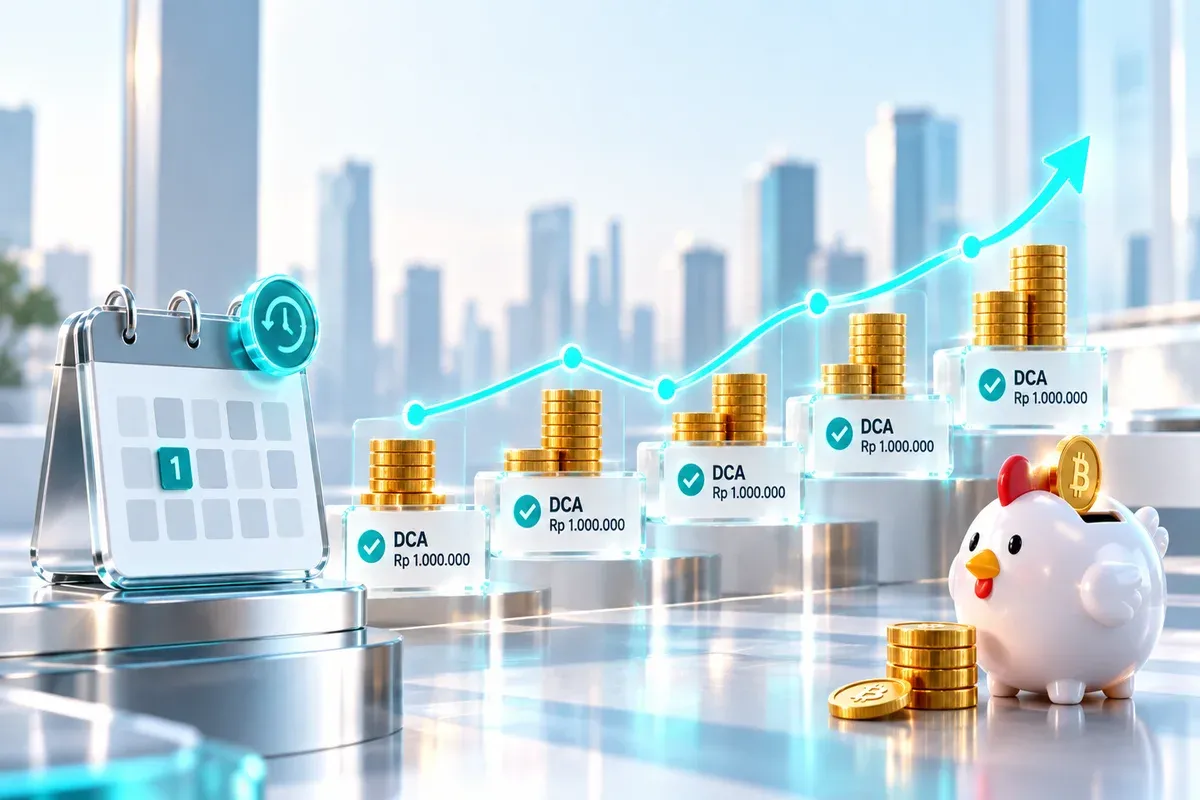
4. Invest a Fixed Amount on a Fixed Schedule
Buying the same amount on the same schedule removes the question of when you should enter.
You no longer need to decide whether today's price is too high.
Learn how the approach works in what is dollar cost averaging.
The important part is keeping the amount consistent, including during periods when the market is attracting a lot of attention.
5. Reduce Your Exposure When the Market Gets Too Loud
This sounds simple, but it can be highly effective.
Stop checking crypto timelines every hour. Leave groups that mostly consist of profit screenshots.
FOMO is partly a response to repeated exposure. Reduce the exposure and the urge often becomes weaker.
6. Record Your Decisions and the Reasons Behind Them
Write one or two sentences every time you buy something: what you bought, how much, and why.
Read those notes again three months later.
They can reveal patterns that are difficult to notice in real time, especially how often the real reason was simply that the price was rising.
What If You Already Bought Because of FOMO?
This is common and rarely discussed.
First, stop adding to the position.
Adding more to lower your average purchase price may make sense for an asset whose underlying value you can assess. But if you bought something only because its price was rising, adding more simply increases the same mistake.
Second, reassess the position as if you did not already own it.
The useful question is not, "How much will I lose if I sell now?"
Ask instead, "If I did not own this asset today, would I buy it at the current price?"
Your original purchase price has no influence on where the market goes next.
Third, if the position is large enough to keep you awake at night, reduce it until it no longer does.
You do not necessarily need to exit completely. The goal is to bring the position back to a size that makes sense for you.
How FOMO Relates to Risk Management
FOMO is usually a symptom rather than the root problem.
The deeper problem is not having a framework that determines position size before the market starts moving.
Someone who has already decided how much of their portfolio can be allocated to high-risk assets does not need to fight FOMO using willpower alone. The limit is already doing part of the work.
Read the full framework in crypto trading risk management, while common mistakes are covered in risk management mistakes beginners often make.
For one of the asset classes most associated with FOMO, read what is a meme coin, including how attention cycles can influence prices.
Frequently Asked Questions
Is FOMO always bad?
The feeling itself is normal and happens to almost everyone. The problem is acting on it without a plan. Sometimes an asset that creates FOMO may still be worth buying, but the reason should come from your own analysis rather than simply from the fact that its price is rising.
How can I tell the difference between FOMO and a real opportunity?
A real opportunity should still make sense without mentioning its recent price movement. If your explanation falls apart as soon as you remove "it's going up," it may be FOMO.
Is waiting for a correction always better?
No. Waiting indefinitely can simply become another form of not having a plan. A fixed purchase schedule can help address both problems.
Why do I always seem to buy near the top?
Because market tops are often when the story is loudest, and that attention is what makes you notice the asset. A predetermined schedule can break the link between market hype and your decision.
Is there a way to measure whether I am experiencing FOMO?
One practical test is to ask whether the decision was already part of a plan you wrote before the market started moving. If it was not, there is a good chance FOMO is influencing you.
This article is provided for educational purposes only and does not constitute investment advice. Crypto assets carry a high level of risk and prices may change at any time. Conduct your own research and consider your financial capacity before making any decision.
 Direct market access from the app
 Start exploring digital assets with Mobee
Track the market, learn about digital assets, and start trading more conveniently with the Mobee App.
Mobee is licensed and supervised by the OJK. Not a solicitation to buy or sell any asset.