Dollar Cost Averaging (DCA): What It Is and How It Works
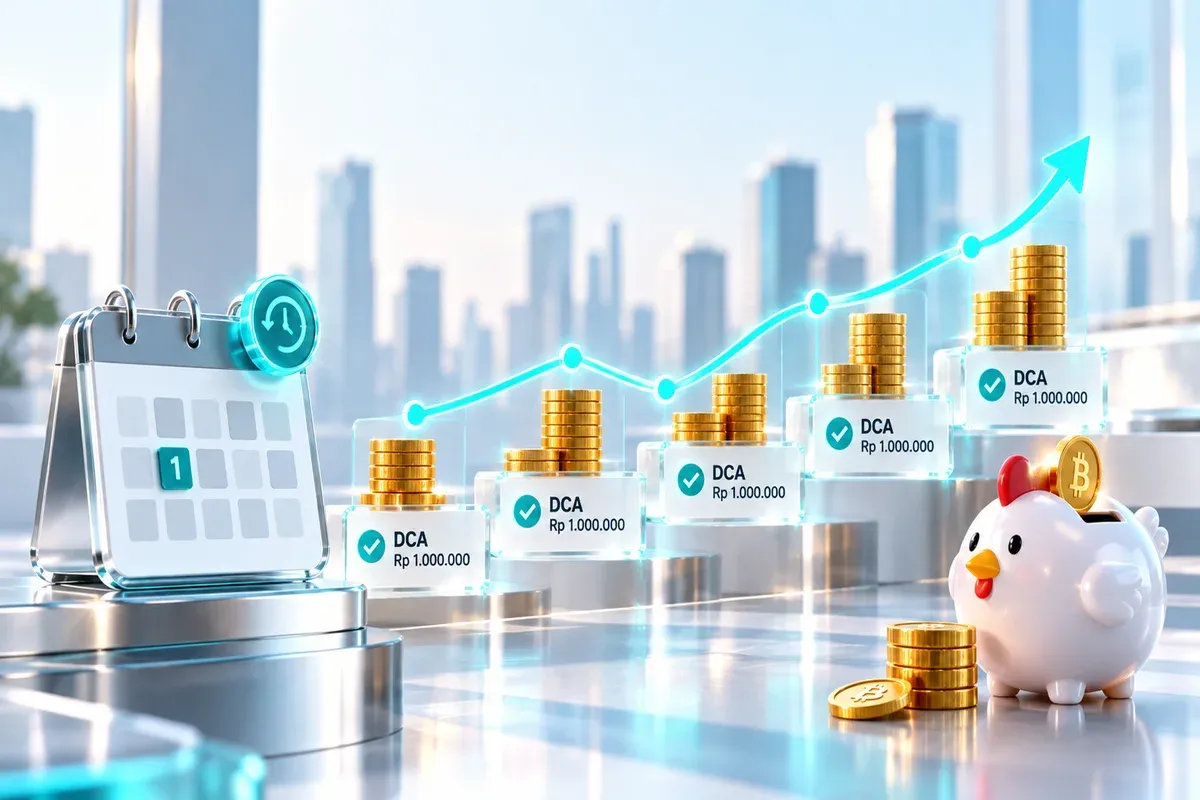
Dollar cost averaging is a strategy of investing a fixed amount on a fixed schedule, regardless of the asset's price at the time.
That single sentence explains the entire mechanism. What makes such a simple strategy worth discussing at length is not how it works, but what it actually solves and what people often assume it solves when it does not.
Key Takeaways
- DCA means investing a fixed amount on a fixed schedule, such as Rp1 million on the first day of every month.
- DCA solves the question of when to buy, not what to buy.
- A fixed investment amount automatically buys more units when prices fall and fewer units when prices rise.
- DCA reduces the risk of entering at the wrong time, but it does not protect you from an asset that permanently loses value.
- In a market that consistently rises, investing a lump sum at the beginning is mathematically more advantageous.
How DCA Works with Numbers
The quickest way to understand DCA is to look at how many units you receive with each purchase.
Suppose you buy Rp1 million worth of Bitcoin every month for four months while the price moves up and down.
| Month | Price per Unit | Investment Amount | Units Purchased |
|---|---|---|---|
| 1 | Rp1,000,000 | Rp1,000,000 | 1.00 |
| 2 | Rp800,000 | Rp1,000,000 | 1.25 |
| 3 | Rp500,000 | Rp1,000,000 | 2.00 |
| 4 | Rp1,000,000 | Rp1,000,000 | 1.00 |
You invest a total of Rp4,000,000 and end up with 5.25 units. Your average purchase price is Rp761,904 per unit.
Notice that this average purchase price is lower than the simple average market price of Rp825,000.
That difference is not luck. It is the mathematical result of investing a fixed amount: when the price falls, the same amount of money buys more units.
What DCA Actually Solves
It Removes the Decision of When to Buy
Trying to identify the market bottom is something even professional fund managers struggle to do consistently.
DCA does not make you better at predicting the bottom. It makes that prediction unnecessary.
For people who work and do not monitor markets all day, this matters. One of the decisions investors often get wrong is removed from the process.
It Reduces Emotional Pressure
Buying when prices are falling sharply can feel wrong, even though that is when your fixed investment amount buys the most units.
Buying when prices are rising can feel too late, even though the number of units you purchase at those higher prices is smaller.
Because the schedule has already been decided in advance, you do not need to debate these situations every month. You simply follow the plan.
It Turns Investing into a Habit, Not an Event
Long-term investing is often built through many small, consistent purchases rather than one perfectly timed large purchase.
DCA turns investing from a repeated decision into a routine.
What DCA Does Not Solve
This part is often overlooked, even though it contains some of the biggest misunderstandings about the strategy.
It Does Not Turn a Bad Asset into a Good One
DCA determines when you buy, not what you buy.
Gradually buying an asset that is permanently losing value only means losing money gradually. It does not protect you from the loss.
Asset selection remains one of the most important decisions, and it should come before deciding on a purchase schedule.
It Is Not Always the Better Strategy
In a market that rises over the long term, investing a lump sum at the beginning can mathematically produce better results because all of your money is invested from day one.
Some stock market studies have found that lump-sum investing outperformed DCA in roughly two-thirds of the periods examined.
What makes DCA useful is not necessarily its average return, but the distribution of outcomes.
DCA reduces the risk of one particularly bad outcome: investing all of your money immediately before a major market decline.
It Does Not Eliminate Market Risk
A DCA portfolio can still lose value when the market falls.
What is reduced is timing risk, not market risk itself.
How to Use DCA
1. Choose the Asset First
Choose one or two assets that you understand and believe have long-term value.
For beginners, assets with deep liquidity and a longer price history may make more sense than newer assets that have not yet gone through a full market cycle.
2. Set an Amount You Can Maintain for Years
This is more important than choosing a large amount.
A DCA plan that stops in the third month because the amount is too high may be less useful than investing half as much consistently for three years.
A simple test is to choose an amount you could still invest even in a month when unexpected expenses appear.
3. Choose a Schedule and Stick to It
Monthly, biweekly, and weekly schedules can all work.
Weekly purchases may create a slightly smoother average purchase price, while monthly purchases are easier to manage and may involve fewer transaction fees.
The frequency matters less than your ability to remain consistent.
4. Use IDR Trading Pairs
If your balance is in Indonesian rupiah, consider buying through an IDR trading pair.
Buying a stablecoin first and then exchanging it for another asset means paying transaction costs twice, every month, potentially for years.
With long-term DCA, small recurring costs can become meaningful over time.
5. Decide When to Stop
DCA without an endpoint is not a strategy. It is simply a habit without a defined objective.
Set the conditions in advance: a specific date, a target portfolio value, or a maximum percentage of your total assets.
Common DCA Mistakes
Stopping DCA when prices fall.
This undermines one of the main reasons for using the strategy. Lower-price periods are exactly when a fixed investment amount buys more units.
Increasing the amount when prices rise.
That is no longer strict DCA. It becomes chasing the market. A fixed amount is a core part of the strategy.
Spreading purchases across too many assets.
DCA into ten assets means paying transaction costs across ten positions every period while potentially holding a portfolio you do not fully understand.
Using money you will need soon.
DCA needs time. Money with a short-term deadline may force you to sell at a time you did not choose.
How DCA Relates to Other Strategies
DCA is often compared with Spot Grid because both can be automated, but they serve different purposes.
DCA invests a fixed amount regardless of price and is generally used for long-term accumulation.
Spot Grid repeatedly buys and sells within a price range you define, making it more suited to markets moving sideways.
If you are just getting started and do not yet have a position, read how to buy crypto for beginners.
To determine how large your crypto allocation should be within your broader finances, our beginner investing guide explains the sequence starting with an emergency fund.
And because one of the biggest temptations while using DCA is increasing your investment amount when markets become exciting, how to avoid FOMO during a bull market is also worth reading early.
Frequently Asked Questions
Does DCA guarantee a profit?
No. DCA determines how you enter a position, not the final outcome. If the asset permanently loses value, you can still lose money.
Is weekly or monthly DCA better?
The difference in results may be small. Choose the schedule you are most likely to follow consistently, and consider transaction fees if you are making frequent purchases with small amounts.
Is DCA suitable for every asset?
It generally makes more sense for assets you believe have long-term value. For highly speculative assets such as meme coins, repeatedly buying may simply increase losses if market interest disappears.
When should I stop DCA?
When your goal has been reached, when the original reason for buying the asset no longer applies, or when the position exceeds the portfolio allocation limit you set in advance.
Can DCA be combined with a lump-sum purchase?
Yes. Some investors invest part of their capital immediately and DCA the remainder. There is no rule against this, as long as the total amount has been planned in advance.
This article is provided for educational purposes only and does not constitute investment advice. Crypto assets carry a high level of risk and prices may change at any time. Conduct your own research and consider your financial capacity before making any decision.
 Direct market access from the app
Start exploring digital assets with Mobee
Track the market, learn about digital assets, and start trading more conveniently with the Mobee App.
Mobee is licensed and supervised by the OJK. Not a solicitation to buy or sell any asset.