RAI Token (RAI): Fundamentals, Tokenomics, and Risks
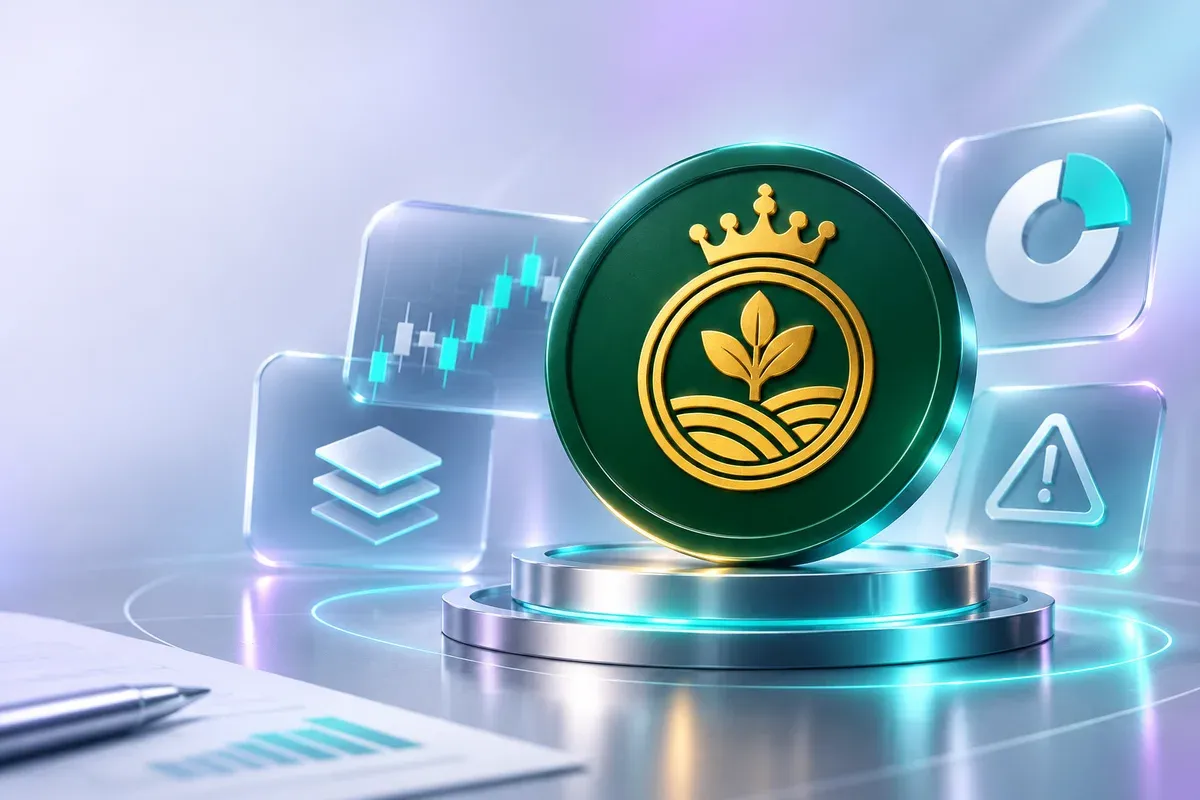
RAI Token is a utility token on Solana linked to PT Royal Agro Industri, with a fixed supply of 50 million. The idea of tracking agribusiness on a blockchain is specific, but most of its functions are still plans, and one number decides how to read the price: only about 0.3% of the supply is reported as circulating.
This article summarizes what is clear, what is still a plan, and what cannot yet be verified from the project's primary sources (the official website, litepaper, and staking page) and market data. There are no price predictions here.
Sources: CoinMarketCap (retrieval time not shown), RAI official website. Ratios and percentages are our calculations.
Key Takeaways
- RAI is a utility token on Solana, not a tokenized stock, and it does not represent ownership, equity, or voting rights in PT Royal Agro Industri
- Maximum and total supply are both 50 million RAI, with no new minting according to the official website
- Only about 151,660 RAI, or 0.30% of supply, is reported as circulating, so the fully diluted valuation (FDV) of about US$5.25 billion is about 330 times the market cap of about US$15.9 million
- The token captures value through staking with rewards of 1.5% to 10%, partly funded by voluntary company contributions rather than protocol revenue
- Only 90% of supply has an itemized allocation, the vesting start date is not published, and another source gives a different split
- The price moved from a record of US$245.29 (19 January 2026) to a low of US$28.13 (20 August 2026), then recovered to about US$105
What Is RAI Token?
RAI is an SPL token on the Solana network. According to the official website, RAI is designed as a utility token for a blockchain-based infrastructure ecosystem in the agribusiness sector. Its web app is called RAI Hub, and there is an innovation fund (RAI Innovation Fund) and a partner program (RAI Partners).
PT Royal Agro Industri is described as a strategic partner, a founding participant of the ecosystem, and the first contributor of operating data. The official website states that RAI is not a share and gives no right to profit or votes in that company. If the company grows, RAI holders do not automatically benefit. The influence is only indirect, through the data it contributes and its reward support.
The contract (mint) address on the official website and CoinMarketCap is FjB1hh9DNnxkjXWwJTSvZbPRYNAbg3Bg5HoFis4akwi6. Match that address before you transact, because many other tokens use the "RAI" ticker (including the RAI stablecoin from Reflexer), and some older articles still describe RAI as an ERC-20 token on Ethereum. CoinMarketCap says RAI has migrated from the old ERC-20 contract to Solana.
On Mobee, RAI is available through the RAI/IDR pair.
Product Status: What Is Live and What Is Still a Plan
This section separates RAI from tokens whose products already run. As of 11 November 2026, the status according to the official website:
A dashed bar means the source gives only a year, with no month. The vertical line marks 11 November 2026.
Sources: raitoken.io (homepage, litepaper V2 May 2026, staking page), read 11 November 2026. Schedules across the documents are not fully consistent.
| Component | Status per the official website | Note |
|---|---|---|
| RAI Hub (web app) | Homepage marks it "coming soon" | The staking page already shows an interface, but a public launch is not confirmed |
| Staking | July 2026 target (litepaper) | That date has passed, and we did not test a wallet connection |
| RAI Innovation Fund | Announcement targeted for Q4 2026 | Not yet visible |
| Logistics tracking and agribusiness reporting pilots | 2026 onward | No results published on the pages we read |
| Global trade verification and regional expansion | 2027 onward | Still a plan |
The schedule is also not fully consistent: the litepaper roadmap says RAI Hub v1 launches in 2026, while another section says partner sign-up opens "after RAI Hub opens to the public in Q4 2026". That means the current status should be checked directly on the official website, not from third-party articles.
How the RAI Token Captures Value
Here RAI differs from tokens whose value is tied to revenue, such as buyback-and-burn mechanisms. On the pages we read, no mechanism links company or user revenue to token demand. The claimed functions are staking, ecosystem rewards, access to RAI Hub, and community governance in the future. Governance itself is described as "designed for the future", so voting rights cannot be relied on today.
Staking is the only mechanism with numbers:
- Reward shown on staking page
- Per-year equivalent (our calculation)
The per-year column assumes the percentage applies per lock period. The staking page does not say whether the figure is per period or per year. Example on the page: 10,000 RAI locked for 12 months becomes 11,000 RAI.
Source: raitoken.io staking page (11 November 2026). Rewards are paid in RAI, partly funded by voluntary company contributions.
| Lock period | Reward on the page | Per-year equivalent (our calculation) |
|---|---|---|
| 3 months | 1.5% | about 6% |
| 6 months | 3.5% | about 7% |
| 12 months | 10% | 10% |
Example on the page: 10,000 RAI locked for 12 months becomes 11,000 RAI when unlocked. The page does not say whether the percentage is per lock period or per year. The last column assumes per period, and that is our calculation, not an official project figure.
Three things to watch. Rewards are paid in RAI, so their rupiah value rises and falls with the price. Their source, according to the official website, is partly voluntary contributions from the company and partners, with the share and mechanism not itemized, so rewards can change. And during the lock period the tokens cannot be sold, while early withdrawal rules are not stated. A general explanation is in our crypto staking guide.
Tokenomics and Valuation
Allocation according to the official website and litepaper:
The thin line above is the entire reported circulating supply, drawn on the same scale as the bar above it.
- Community and ecosystem18,000,000 RAI · 36.0%
- Technology development15,750,000 RAI · 31.5%
- Liquidity (CEX and DEX)9,000,000 RAI · 18.0%
- Not itemized5,000,000 RAI · 10.0%
- Team and founders2,250,000 RAI · 4.5%
Sources: RAI official website and litepaper V2 (allocation), CoinMarketCap (circulating supply, self-reported by the project). The remaining 10% is 50 million minus the 45 million itemized.
| Category | Amount | Share | Cliff | Vesting |
|---|---|---|---|---|
| Team and founders | 2,250,000 RAI | 4.5% | 18 months | 48 months |
| Technology development | 15,750,000 RAI | 31.5% | 12 months | 48 months |
| Community and ecosystem | 18,000,000 RAI | 36% | 3 months | 36 months |
| Liquidity (CEX and DEX) | 9,000,000 RAI | 18% | None | Strategic deployment |
| Total itemized | 45,000,000 RAI | 90% |
The remaining 5 million RAI (10%) has no category in the table. The official website only says the path to 50 million is explained in the official documentation, which we could not find. The vesting start date is also not published.
- Cliff: waiting period
- Vesting: released gradually
Our illustration: the vesting start date is not published, and we assume vesting runs after the cliff ends.
Sources: RAI official website and litepaper V2. End month = cliff + vesting (our calculation, assuming they run back to back).
Compare that schedule with the circulating supply. If release is linear (this is our illustrative calculation, because the start date is unknown), each month the community allocation releases about 500,000 RAI after a 3-month cliff, the technology allocation about 328,125 RAI after a 12-month cliff, and the team allocation about 46,875 RAI after an 18-month cliff. Compare that with the reported circulating supply of about 151,660 RAI: the community allocation's monthly release alone is about 3.3 times today's circulating supply, and the 9 million RAI liquidity allocation (no cliff) is about 59 times it.
Illustrative calculation assuming linear release (amount divided by vesting months). The start date is not published, and circulating supply is a figure reported by the project itself.
Sources: allocation and schedule from the RAI official website, circulating supply from CoinMarketCap. All monthly releases are our calculations.
Those numbers also raise an unanswered question. RAI has had a recorded price since January 2026, but if the 3-month community cliff has passed, circulating supply should be much larger than 151,660, unless vesting has not started or the figure has not been updated. CoinMarketCap also writes two things that contradict each other: a circulating supply of 151,660 (0.30%) in the statistics box, but "1% circulating" in the description text, with a completely different allocation split (60% public allocation, 20% research and development, 18% reserve, 1% each for private sale and pre-sale). We use the official website as the reference, but this gap cannot yet be reconciled.
The market value, according to CoinMarketCap (retrieval time not shown), is as follows:
| Metric | Figure | How to read it |
|---|---|---|
| Price | about US$105 | On Mobee Rp1,900,000, equal to about US$105 |
| Market cap | about US$15.9 million | Price times the circulating supply reported by the project itself |
| FDV | about US$5.25 billion | About 330 times market cap |
| 24-hour volume | US$0 | No recorded trading in this source |
| All-time high | US$245.29 (19 January 2026) | The current price is about 57% below it |
| All-time low | US$28.13 (20 August 2026) | The current price is about 274% above it |
Source: CoinMarketCap (retrieval time not shown). The ratio is our calculation.
A valuation like that of perpetual DEX tokens (FDV compared with revenue) cannot be calculated here, because the project does not publish protocol revenue. An FDV that size is the price multiplied by the entire maximum supply, not a value you can realize, and it cannot be used to conclude that RAI is expensive or cheap. The one safe conclusion: liquidity is very thin (the liquidity-to-market-cap ratio is about 0.02%), so the price reflects a few small orders more than an established market value.
Three 12-Month Scenarios
Because there is no revenue, valuation model, or liquid price history, we give no probabilities or price targets. The scenarios below are a way of thinking, not predictions.
| Scenario | What it looks like | Signs to watch |
|---|---|---|
| Adoption takes hold | RAI Hub and staking are live, tracking pilots produce real data, new partners beyond one company join | Stakers and volume grow, roadmap targets are met, supply details are published |
| Limited utility | The product runs but is small and depends on one partner | Activity stagnates, price is driven by sentiment and liquidity |
| Execution slips | Schedules keep slipping, unlock supply grows without new demand, staking rewards shrink | Announcements are rare, volume dries up, liquidity thins further |
Note the price gap: from US$28.13 to US$245.29 is a range of about 8.7 times in under a year. That range is itself information: uncertainty on this asset is very high and the outcome depends on the project's execution. Volatility is explained in What Is Volatility.
Main Risk: Supply That Is Not Yet Transparent
This is the risk most worth understanding, because it affects how you read every other number. Only about 0.3% of supply is reported as circulating, 10% of the allocation is not itemized, the vesting start date is not published, and two sources give different allocation splits. Until that is clear, you cannot estimate how fast circulating supply could grow.
A long unlock schedule reduces the risk of a sudden flood of supply, but still adds supply over time. How to read cliffs and vesting is explained in our token unlock article. The official website says no new tokens are minted, and the status of the mint and freeze authorities on the blockchain can be checked yourself through a Solana block explorer, which we did not do in this article.
Other Risks to Watch
Liquidity. CoinMarketCap records 24-hour volume of US$0 and showed no market list when we read it. On Mobee, RAI/IDR recorded about Rp350 million in volume (about US$19 thousand, 184 RAI) over 24 hours with a price range of only Rp1,900,000 to Rp1,905,000. In a market this thin, selling a large amount can move the price. The concept of liquidation is explained in What Is Liquidation.
Dependence on one company. Staking rewards and early operating data depend on PT Royal Agro Industri. The long-term question: can the ecosystem stand with other partners?
Supervision claim. The homepage shows an OJK logo under the heading "Regulated and supervised by", but the link goes to a crypto asset list determination document dated 4 December 2025 issued by CFX, which we have not opened. Being on the list of tradable assets is not an assessment of a project's quality or prospects. The rules are discussed in regulation, tax, and risks of tokenized assets in Indonesia.
Audit. The official website links a CertiK Skynet page and CoinMarketCap shows a score of 3.5, but we have not read the smart contract audit report.
Conflicting information. Besides the allocation differences above, CoinMarketCap writes an initial price of "Rp100,000 per RAI" and an old roadmap under the "AgroFi" brand, while the price is now about US$105 and the official website uses the name RAI Hub. Third-party sources also differ on whether there was a pre-sale.
Latest Price Notes
As of 11 November 2026, RAI/IDR on Mobee is at Rp1,900,000, down 0.26% over 24 hours, with a highest bid of Rp1,900,000 and a lowest ask of Rp1,905,000. CoinMarketCap shows about US$105.11, down 0.53% (retrieval time not shown). The gap between the Mobee price and the converted CoinMarketCap price is about 0.3%.
We only know three points from CoinMarketCap. The dashed line connects them and is not daily price data. We do not know the prices in between.
Source: CoinMarketCap (record and price, retrieval time not shown). On Mobee RAI/IDR is Rp1,900,000.
Because volume is thin and the price has moved more than eightfold in a year, this figure goes stale quickly. Check again before making a decision.
Conclusion
RAI is a Solana utility token with a fixed supply of 50 million and a specific idea in the agribusiness sector, with a real operating partner. But most of its functions are still plans, staking rewards depend on voluntary contributions, 10% of the allocation is not itemized, and liquidity is very thin.
Its long-term potential depends on execution: whether RAI Hub and staking actually run, whether partners grow beyond one company, and whether supply and unlock schedules are disclosed clearly. Those are also the indicators worth monitoring: the public launch of RAI Hub, the amount of RAI staked compared with circulating supply, publication of the details of the 5 million RAI and the vesting date, results of the tracking pilots, a verifiable audit report, and trading volume.
Before deciding, make sure you understand how to size a position to your risk profile, as discussed in How to Choose Assets. For comparison, a similar analysis of a token with protocol revenue is in Lighter (LIT). RAI is available on the RAI/IDR page.
Frequently Asked Questions
What is RAI Token (RAI) and who owns it?
RAI is a utility token on the Solana network for a blockchain-based agribusiness ecosystem. The official website names PT Royal Agro Industri as a strategic partner and founding participant of the ecosystem. RAI does not represent ownership or shares in that company.
Which network is RAI Token on?
The official website describes RAI as an SPL token on Solana. Some older articles call it ERC-20 on Ethereum, and CoinMarketCap says RAI has migrated to Solana. Match the contract address before you transact.
What is the RAI staking reward?
The staking page shows a 1.5% reward for a 3-month lock, 3.5% for 6 months, and 10% for 12 months. Rewards are paid in RAI, partly funded by voluntary company contributions, and the page does not say whether the figures are per period or per year.
Is RAI Token a tokenized stock?
No. RAI is a utility token and does not represent ownership, equity, or voting rights in any company. The official website also states that RAI is not a security or an investment instrument.
What is the biggest risk of RAI?
Supply that is not yet transparent (only about 0.3% is reported as circulating and 10% of the allocation is not itemized), very thin liquidity, price volatility, and a product that is mostly still a plan.
Will the RAI price go up in the long term?
No one can say for sure. The long-term price direction depends on project execution, adoption, circulating supply, and liquidity, so we give no price target and suggest you monitor the project's indicators.
Where can I buy RAI in Indonesia?
RAI is available on Mobee through the RAI/IDR pair. Mobee is operated by PT CTXG Indonesia Berkarya, which is licensed and supervised by the Financial Services Authority (OJK).
This article is for reference only and is not financial advice. Always do your own research before making an investment decision. Crypto assets carry high risk and their prices can change at any time. Mobee is operated by PT CTXG Indonesia Berkarya, licensed and supervised by the Financial Services Authority (OJK).
 Direct market access from the app
Start exploring digital assets with Mobee
Track the market, learn about digital assets, and start trading more conveniently with the Mobee App.
Mobee is licensed and supervised by the OJK. Not a solicitation to buy or sell any asset.