Highest Currencies in the World and the Lowest
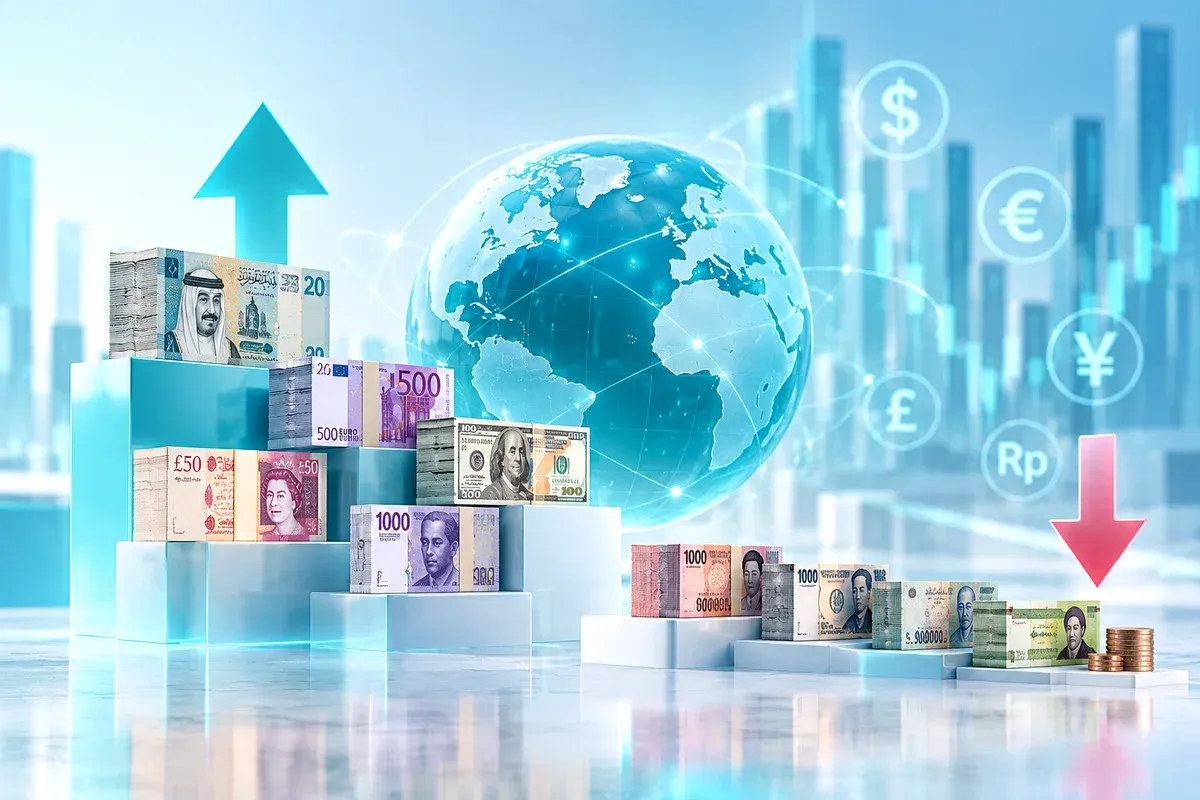
Exchange rates as of 7 October 2026. USD/IDR reference rate: Rp17,902.
The Kuwaiti dinar is the currency with the highest exchange rate in the world. One Kuwaiti dinar is worth about US$3.23 or Rp57,905, more than three times the value of the US dollar.
But there is one thing to understand before reading the lists: a high exchange rate does not mean a strong economy. Kuwait is not the largest economy in the world, and Japan, whose economy is far larger, has a currency with a low face value. The last part of this article explains why.
Key Points
- The Kuwaiti dinar (KWD) is the highest, worth US$3.23 or Rp57,905 per unit.
- The Iranian rial (IRR) is the lowest, at more than 1.72 million rials per US dollar.
- A high exchange rate is not an indicator of economic strength. The top three are all small Gulf states with managed exchange rate policies.
- The rupiah ranks 6th in face value per US dollar out of 166 currencies. That is about denomination, not a weak economy.
- What determines purchasing power is inflation and income, not the number of zeros on a banknote.
The 10 Highest Currencies in the World
Ranked by the value of one unit of currency against the US dollar.
| # | Currency | Country | Value per unit (USD) | Value per unit (IDR) |
|---|---|---|---|---|
| 1 | Kuwaiti Dinar (KWD) | Kuwait | US$3.2346 | Rp57,905 |
| 2 | Bahraini Dinar (BHD) | Bahrain | US$2.6596 | Rp47,612 |
| 3 | Omani Rial (OMR) | Oman | US$2.6008 | Rp46,559 |
| 4 | Jordanian Dinar (JOD) | Jordan | US$1.4104 | Rp25,250 |
| 5 | Gibraltar Pound (GIP) | Gibraltar | US$1.3263 | Rp23,743 |
| 6 | Pound Sterling (GBP) | United Kingdom | US$1.3263 | Rp23,743 |
| 7 | Swiss Franc (CHF) | Switzerland | US$1.2021 | Rp21,521 |
| 8 | Cayman Islands Dollar (KYD) | Cayman Islands | US$1.2000 | Rp21,482 |
| 9 | Euro (EUR) | Eurozone | US$1.1252 | Rp20,143 |
| 10 | US Dollar (USD) | United States | US$1.0000 | Rp17,902 |
Notice something about this table: the top three are all small Gulf states. Kuwait, Bahrain, and Oman. Meanwhile the US dollar, the world's reserve currency and the most widely used in international trade, ranks only tenth.
That is the first sign that this list measures something different from economic strength.
The 10 Lowest Currencies in the World
Ranked by how many units of currency it takes to buy one US dollar. The more units, the lower the face value.
| # | Currency | Country | Units per 1 USD |
|---|---|---|---|
| 1 | Iranian Rial (IRR) | Iran | 1,719,543.10 |
| 2 | Lebanese Pound (LBP) | Lebanon | 89,500.00 |
| 3 | Vietnamese Dong (VND) | Vietnam | 25,935.90 |
| 4 | Sierra Leonean Leone (SLL) | Sierra Leone | 24,654.46 |
| 5 | Lao Kip (LAK) | Laos | 22,253.96 |
| 6 | Rupiah (IDR) | Indonesia | 17,901.96 |
| 7 | Uzbekistani Som (UZS) | Uzbekistan | 11,804.06 |
| 8 | Guinean Franc (GNF) | Guinea | 8,795.38 |
| 9 | Paraguayan Guarani (PYG) | Paraguay | 5,825.06 |
| 10 | South Sudanese Pound (SSP) | South Sudan | 5,651.66 |
Yes, the rupiah is on this list, in sixth place. Out of 166 currencies in the same database, the rupiah is among those with the largest face value per US dollar.
But Indonesia is a G20 member and the largest economy in Southeast Asia. Vietnam, third on this list, is also one of the fastest growing economies in the world. Sierra Leone and Guinea, on the other hand, are in very different situations.
Three countries on the same list, with very different economic conditions. That is the second sign, and now let us look at why.
Why a High Exchange Rate Does Not Mean a Strong Economy
This is the most important part of this article, and the part most often missed.
The nominal exchange rate, meaning the numbers in the tables above, is determined by several factors that are mostly not directly related to how large or healthy an economy is.
1. Denomination, or how many zeros are printed
This is the simplest cause and the most commonly misunderstood.
When a country prints money in large denominations, its face value automatically looks low. The rupiah has banknotes up to Rp100,000. The largest Kuwaiti dinar banknote is 20 dinar.
This is purely a currency design decision. If Indonesia carried out a redenomination and removed three zeros, so that Rp1,000 became Rp1, one US dollar would be worth about Rp17.90, and the rupiah would immediately drop off the list of lowest currencies. Yet people's purchasing power would not change at all.
Some countries have already done it. Turkey removed six zeros from the lira in 2005. The nominal exchange rate changed dramatically, the economy did not.
2. Exchange rate policy, especially pegs
The top three currencies on the list are not the result of a fully free market.
The Kuwaiti dinar is not allowed to float freely, but is managed against a basket of major currencies. The Bahraini dinar and the Omani rial are pegged to the US dollar at a fixed rate.
This means the high value is the result of a policy that is actively maintained, not a reflection of market demand for the currency. These countries can maintain it because they hold large foreign exchange reserves from oil revenue relative to their small populations.
3. Economic size relative to the amount of money in circulation
Kuwait has a population of about four million. Indonesia has more than 280 million. The amount of money needed to serve everyday transactions is on a very different scale.
A large economy with a large population needs far more units of currency, and that affects the value per unit.
So what really shows economic strength?
Not the nominal exchange rate, but:
- Inflation. Whether prices are stable or rising fast. This determines real purchasing power.
- Exchange rate stability. A currency with a low face value that is stable is better than one with a high face value that is volatile.
- Income per capita. How many goods and services the population can buy.
- Foreign exchange reserves and trade balance. A country's ability to meet its foreign payment needs.
The Iranian rial is at the bottom of the list not because of denomination, but because of high inflation and prolonged pressure on its exchange rate. That is a case that genuinely reflects economic problems. The difference from the rupiah and the Vietnamese dong lies in the cause, not in the number.
What Makes Currency Values Change
To understand how they move, these are the main factors:
- Interest rate differences. Countries with higher interest rates tend to attract capital inflows, which strengthens their currencies. This is why currency markets watch central bank decisions very closely.
- Inflation. High inflation erodes purchasing power, and the currency tends to weaken against currencies of countries with low inflation.
- Trade balance. Countries that export more than they import tend to have greater demand for their currency.
- Political stability and confidence. Uncertainty pushes capital out in search of places seen as calmer.
- Central bank policy. Direct market intervention, setting pegs, or changes in foreign exchange reserves.
The basic concept of why paper money has value at all is covered in fiat money, and the deliberate reduction of a currency's value by governments is covered in what devaluation is.
When All Currencies Weaken Together
There is one thing no comparison table shows.
All the numbers above compare one currency against another. The Kuwaiti dinar is high relative to the US dollar. The rupiah is low relative to the US dollar. What they do not answer: what if all of them lose purchasing power against goods at the same time?
That is what happens when global inflation rises. The dollar, euro, yen, and rupiah can all buy fewer goods than five years ago, even though the exchange rates between them have not changed much.
In such conditions, some people compare currencies not with other currencies, but with an asset whose supply cannot be increased at will. Gold has been used for this purpose the longest, because the amount on Earth is limited and new supply grows slowly.
At Mobee, gold exposure is available through Digital Gold based on XAUt, where one token represents one troy ounce of physical gold stored in Switzerland. The full explanation is in digital gold investing with XAUt.
To be clear: this does not mean gold always wins. Gold pays no yield, its price can fall sharply, and it is usually under pressure in periods of high interest rates. The point is not that one asset is better, but that comparing currencies only with other currencies does not answer the question of purchasing power.
Conclusion
The Kuwaiti dinar is the highest currency in the world, worth about US$3.23 or Rp57,905 per unit. The Iranian rial is the lowest, at more than 1.72 million rials per US dollar.
The most important takeaway from both lists: the nominal exchange rate is not a measure of economic strength. The top three are small Gulf states with actively managed exchange rates, while the US dollar ranks only tenth. On the other side, the rupiah and the Vietnamese dong sit on the lowest list alongside countries in very different economic conditions.
What truly determines purchasing power is inflation, stability, and income per capita, not the number of zeros on a banknote.
Frequently Asked Questions
What is the highest-valued currency in the world?
The Kuwaiti dinar (KWD). One Kuwaiti dinar was worth around US$3.23 or Rp57,905 as of October 7, 2026, more than three times the value of one U.S. dollar. It is followed by the Bahraini dinar at around US$2.66 and the Omani rial at around US$2.60.
What is the lowest-valued currency in the world?
The Iranian rial (IRR). It takes more than 1.72 million rials to buy one U.S. dollar. It is followed by the Lebanese pound, Vietnamese dong, Sierra Leonean leone, and Lao kip.
What is the strongest currency in the world?
It depends on how strength is measured. If you mean nominal value per unit, the answer is the Kuwaiti dinar. However, nominal value is not the same as economic strength. The U.S. dollar, for example, ranks much lower by nominal unit value but is the most widely used reserve currency and one of the most important currencies in international trade. Measures such as inflation, exchange-rate stability, and income per capita are often more meaningful.
Why are the Kuwaiti dinar, Bahraini dinar, and Omani rial so valuable?
One major reason is exchange-rate policy. The Kuwaiti dinar is managed against a basket of major currencies, while the Bahraini dinar and Omani rial are pegged to the U.S. dollar at fixed rates. These countries are able to maintain their currency regimes partly because of substantial foreign-exchange reserves supported by oil revenue relative to their relatively small populations.
Is the Indonesian rupiah one of the lowest-valued currencies in the world?
In nominal terms, yes. The rupiah ranks among the currencies with the largest number of units required to buy one U.S. dollar, at around Rp17,901.96 per US$1 in the referenced dataset. However, this is mainly a matter of denomination and does not directly indicate that an economy is weak. Indonesia is a G20 member and the largest economy in Southeast Asia.
Does a high exchange rate mean a country's economy is strong?
No. A currency's nominal exchange rate is influenced by factors such as denomination, exchange-rate policy, and the scale of the money supply, which do not directly measure the size or health of an economy. Kuwait has one of the world's highest-valued currencies, but it is not the world's largest economy. Japan, meanwhile, has a much larger economy even though the yen has a relatively low nominal unit value.
What is redenomination, and does it change purchasing power?
Redenomination is the process of removing zeros from the nominal value of a currency, for example changing Rp1,000 into Rp1. The numbers change, but purchasing power does not. Turkey, for example, removed six zeros from the lira in 2005. If Indonesia removed three zeros, one U.S. dollar would be quoted at around Rp17.90 instead of Rp17,900.
Disclaimer. All information in this article is educational and is not investment advice. Currency exchange rates change every day, and the figures in this article are point-in-time as of the date stated. Always check current rates before you transact or calculate.
 Direct market access from the app
 Start exploring digital assets with Mobee
Track the market, learn about digital assets, and start trading more conveniently with the Mobee App.
Mobee is licensed and supervised by the OJK. Not a solicitation to buy or sell any asset.