Gold Hallmark Codes: What 375, 585, 750, 916, 999 Mean
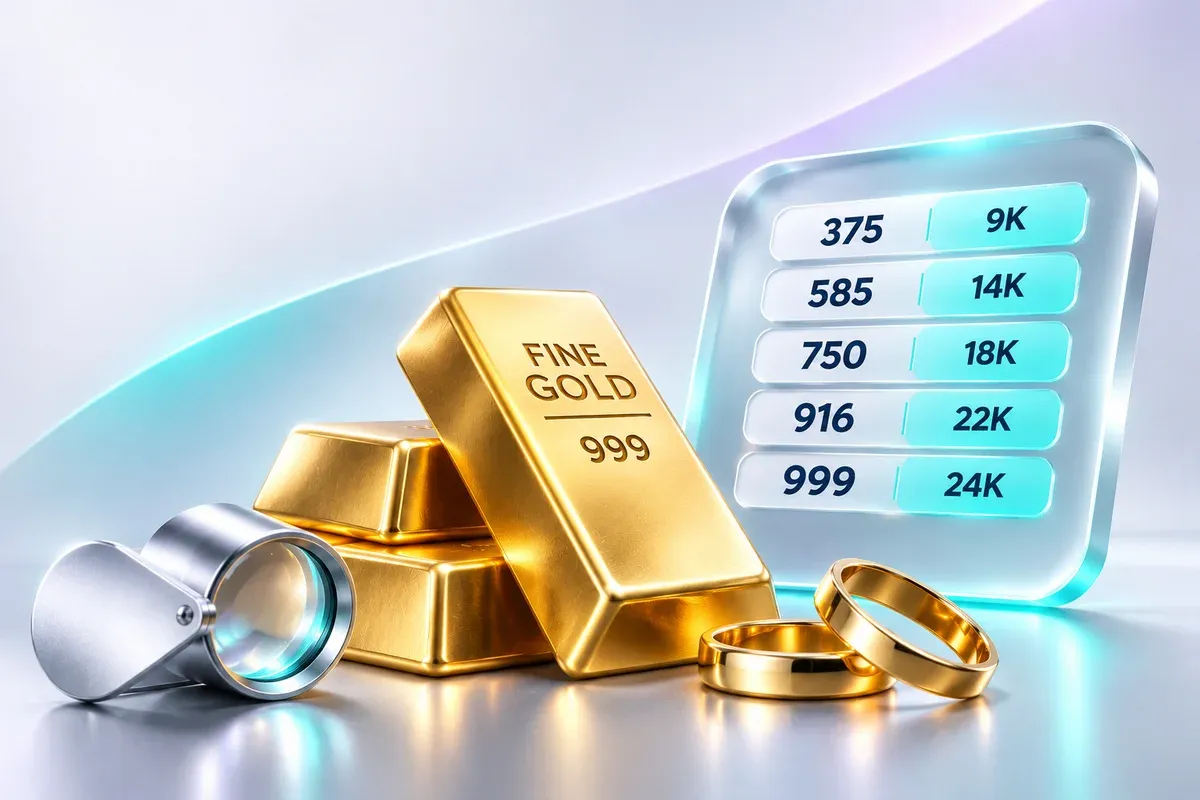
A gold hallmark code is a number that shows how much pure gold is in a piece of metal, counted per thousand parts. A 750 stamp means 750 of every 1,000 parts are pure gold, or 75%, which equals 18 karat. The higher the number, the higher the gold content.
On jewelry, the number is usually stamped next to letter marks. The number tells you the purity, while letters usually point to the maker, the material, or a plating type. This guide covers both in one place, with a conversion chart to karats.
Key Takeaways
- The number is purity per thousand. 375 means 37.5%, 750 means 75%, and 999 means 99.9%.
- Karat comes from purity: purity percent divided by 100, times 24. A 750 stamp is 18 karat.
- Codes below 500 are called young gold, and codes above 500 are called mature gold. The most common in Indonesia are 375, 700, 750 and 916.
- Letter marks are not purity. Letters like UBS, KH or HT usually identify a maker, while GP, GF and GE signal plated gold.
- Stamps can be faked. A code is only an initial claim, so you still need a purity test and purchase documents. The checking steps are in fake gold codes.
Gold Code, Purity, and Karat Chart
| Code | Gold purity | Karat (rounded) | Category | Good to know |
|---|---|---|---|---|
| 333 | 33.3% | 8 | Young gold | Low purity, common in fashion jewelry |
| 375 | 37.5% | 9 | Young gold | Strong and holds its shape, but little actual gold |
| 420 | 42% | 10 | Young gold | Called 10K abroad |
| 585 | 58.5% | 14 | Mature gold | Common in imported jewelry |
| 700 | 70% | 16.8 | Mature gold | Often found in Indonesian shop-made jewelry |
| 750 | 75% | 18 | Mature gold | Common for jewelry, strong because it is alloyed |
| 875 | 87.5% | 21 | Mature gold | Common in Arab countries |
| 916 | 91.6% | 22 | Mature gold | Common in Indonesia, Dubai and Bangkok |
| 958 | 95.8% | 23 | Mature gold | Found in some regions, such as parts of Sumatra and Kalimantan |
| 999 | 99.9% | 24 | Pure gold | Used for gold bars and coins |
This list follows Pegadaian's reference. Other codes also exist, such as 150, 300, 400, 833 and 850, but they are much rarer in everyday jewelry.
One note on the math: 14 karat is 58.3% in theory (14 divided by 24), yet the stamp used in the market is 585. Small gaps like this are normal, so do not be surprised if sources differ slightly.
How to Convert a Gold Code to Karat
The formula is simple:
Karat = (code ÷ 1,000) × 24
- Code 750: 0.75 × 24 = 18 karat
- Code 916: 0.916 × 24 = 21.98 karat, rounded to 22 karat
- Code 700: 0.70 × 24 = 16.8 karat
To go the other way, divide karat by 24 and multiply by 1,000. 18 karat becomes 18 ÷ 24 × 1,000 = 750.
The same ratio helps estimate value. If 24 karat gold is Rp1,000,000 per gram, 18 karat gold is about Rp750,000 per gram in theory, because it holds 75% pure gold. Shop prices for jewelry are usually higher because of making costs, design and gemstones. A full worked example for low-purity codes is in 8K gold price.
Young Gold vs Mature Gold
The split is only about the 50% line.
Young gold means codes below 500, such as 333, 375 and 420. It holds less than half gold, with the rest being alloy metals. The jewelry tends to be hard and shape-stable, but the price per gram is much lower. The full explanation is in young gold.
Mature gold means codes above 500, such as 585, 700, 750, 875 and 916. The higher the code, the more value per gram, but the softer and easier to scratch the piece is.
For the often-asked code 700, including pieces sold without a receipt, see code 700 gold price without papers.
What Letter Marks on Gold Jewelry Mean
Letter marks differ from number codes. According to Pegadaian's reference, letters point to the maker, the material type, or whether the piece is solid, mixed or plated.
Maker or shop marks. UBS, KH (PT King Halim), MT, HT and a few others generally refer to a maker or brand. These letters do not show purity. If you see a mark like SJ or TT, treat it as a producer or shop code and ask the seller about it rather than guessing.
Plated or imitation marks. These letters mean a base metal only coated with gold:
- GP (gold plated) or GE/GEP (electroplated): a thin gold coating
- RGP (rolled gold plate) and GF (gold filled): a thicker layer, but still not solid gold
- HGE (heavy gold electroplate): a thick gold plating
By the same reference, GP, GE, GEP and HGE have no investment value. A number placed in front of a plating mark refers only to the coating, not the whole piece.
White gold marks. PT means platinum, PD palladium, WG white gold, and WP platinum white.
K and P letters. K means karat, while P on some stamps means purity, for example 10KP for 41.7%.
Code 925 Is Not Gold
Code 925 is often mistaken for a gold code. It is usually used for sterling silver, which is 92.5% silver. If a 925 stamp appears on a piece sold as gold, that is a reason to ask the seller more questions.
A Code Is Not Proof of Authenticity
A stamp can be made by anyone, so the result needs checking. A practical routine:
- Read the number and letter marks, then match them to the chart above.
- Weigh the piece and compare the weight with its size and the claimed code.
- Ask for a receipt or certificate, especially for larger purchases.
- For certainty, test purity at an official place, such as a Pegadaian appraisal service or a licensed gold shop.
Full checking guides are in fake gold codes and how to tell real gold from fake. Antam gold bars are checked differently, as covered in how to verify Antam gold.
Conclusion
A gold code is purity per thousand: 375 means 37.5%, 750 means 75%, and 999 means 99.9%. To turn it into karat, multiply the decimal purity by 24, so 750 becomes 18 karat and 916 becomes about 22 karat.
Numbers show purity, while letters usually show the maker or a plating type. Because stamps can be copied, treat a code as an initial claim and confirm it with a purity test and purchase documents.
References: Kode Emas, Pegadaian and Karat Emas Adalah, Pegadaian.
FAQ
What karat is gold code 750?
Code 750 means 75% gold, which equals 18 karat. The math is 0.75 times 24 equals 18. It is common in jewelry because the gold content is high while alloy metals keep it strong.
What karat is gold code 375?
Code 375 means 37.5% gold, or about 9 karat. It counts as young gold: durable and affordable, but with less than half pure gold, so its price per gram is far below mature gold.
How many karats is gold code 916?
Code 916 means 91.6% purity, about 22 karat. The math is 0.916 times 24 equals 21.98, rounded to 22. It is common in Indonesia, Dubai and Bangkok.
What do letter marks on gold jewelry mean?
Letter marks usually point to the maker, material or plating type, not purity. Letters like UBS or KH refer to makers, while GP, GE, GF and HGE signal plated gold. If you do not recognize a mark, ask the seller instead of guessing.
Is a 999 stamp always real gold?
Not always. A 999 stamp means 99.9% pure gold, but stamps can be copied onto other metals. Match it against the weight, a certificate and a purity test at an official place before treating it as genuine.
Disclaimer
This article is for education and is not investment advice. Codes, purity and karat can be used differently across makers and countries, so the figures here are the most common values. Always test purity at an official place before transacting.
 Direct market access from the app
Start exploring digital assets with Mobee
Track the market, learn about digital assets, and start trading more conveniently with the Mobee App.
Mobee is licensed and supervised by the OJK. Not a solicitation to buy or sell any asset.