Indonesia's Financial Institutions: Functions, Risks, and Picks
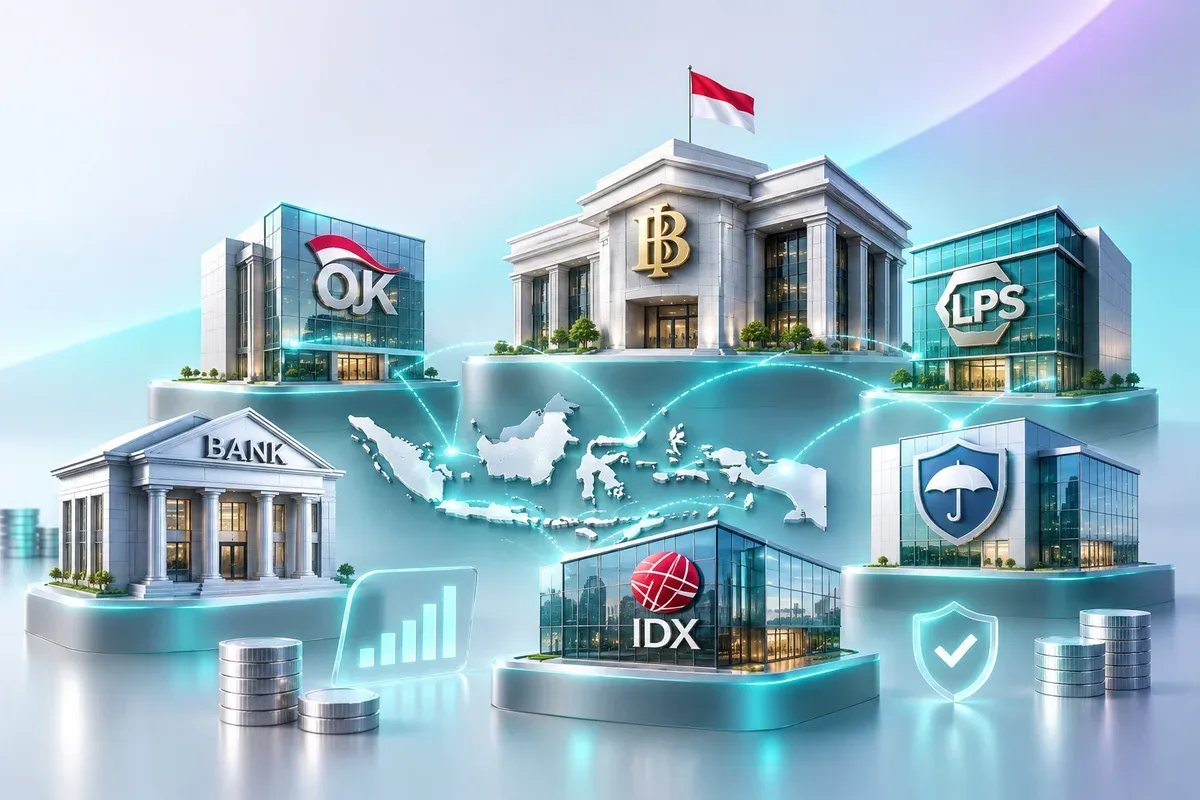
Examples of financial institutions in Indonesia include banks, securities firms, investment managers, custodians, and digital asset providers, each with distinct functions and risks.
Choosing where to store or grow money is less about the highest advertised return and more about matching liquidity, time horizon, and risk.
This map helps you see where money can sit without mixing emergency funds with growth capital.
Key Points
- Institution map: banks, securities firms, investment managers, custodians, and digital asset providers serve different roles.
- Money goals decide the choice: emergency funds should not be treated like long-term growth capital.
- OJK or BI licensing is an early filter, but it does not make a product risk-free.
- Liquidity, fees, and guarantee status must be checked before moving money anywhere.
- Diversifying institutions and products helps reduce operational and concentration risk.
Mapping Financial Institutions and Core Roles
Financial institutions operate at different layers, from holding deposits to administering assets. Knowing their core roles prevents you from expecting a function that is not legally or economically theirs.
• Banks
Banks collect public deposits and channel funds back through credit. Common examples include BCA, Mandiri, and BNI. Their roles cover savings, payments, and financing, so they fit money that needs basic safety and daily transaction access, but deposits are not investment products.
• Securities Firms
Securities firms act as intermediaries for trading securities and may provide research or access to mutual funds and stocks. Examples licensed by OJK include Mandiri Sekuritas and BCA Sekuritas. They facilitate transactions but do not guarantee prices or profits, so market risk stays with the investor.
• Investment Managers
Investment managers run pooled portfolios such as mutual funds under OJK licenses. Examples include Mandiri Investasi and Bahana TCW. They set strategy, select assets, and report performance under the product mandate, but returns are not guaranteed because underlying values can rise or fall.
• Custodians
Custodians safekeep and record securities on behalf of clients, separate from the company's own assets. Examples include bank custodians and KSEI in the market infrastructure. They support asset separation and administration, but they do not choose investments or guarantee returns.
• Digital Asset Providers
Digital asset providers offer trading, storage, and operational access to crypto assets. Examples include crypto trading platforms registered under applicable rules. Prices are highly volatile, so users must check licensing, account security, and withdrawal policies, and this is not a substitute for emergency savings.
Functions, Products, and Risks at a Glance
The table summarizes the main role, example services, key risk, and liquidity profile. Use it as a starting map, then read the product document for fees and withdrawal conditions.
| Institution | Main function | Example services | Key risk | Liquidity |
|---|---|---|---|---|
| Banks | Deposits, payments, credit | Savings, time deposits, transfers | Credit, liquidity, operations | Daily to fixed tenor |
| Securities firms | Trading intermediary for securities | Stocks, bonds, mutual funds | Market, execution, fees | T+2 for securities |
| Investment managers | Manage pooled portfolios | Mutual funds, managed accounts | Market, management, product liquidity | Follows prospectus |
| Custodians | Safekeep and record securities | Custody, asset administration | Operations, records, cyber | Depends on agreement |
| Digital asset providers | Trade and store crypto assets | Spot, wallets, conversion | Volatility, cyber, regulation | 24/7 but may be restricted |
Limits of Each Institution's Role
Many misunderstandings appear because one app can display several products at once. The legal and economic roles remain different even when the interface looks similar.
• A Bank Is Not an Investment Manager
Banks may distribute selected investment products, but deposits and investments carry different protections and risks. Do not treat a savings account as a mutual fund just because both appear in one app. Read the product name, prospectus, and guarantee status.
• A Securities Firm Does Not Guarantee Prices
Securities firms execute orders under market rules; they do not set a stock price to rise. If an order fails or prices move fast, market losses remain with the investor. Understand order types, queues, and auto-rejection limits before trading.
• An Investment Manager Does Not Guarantee Returns
An investment manager works within a mandate, but past performance does not promise future results. Market, liquidity, and policy changes can reduce unit values. Review the prospectus, portfolio composition, and strategy consistency before allocating money.
• A Custodian Does Not Pick Investments
Custodians protect assets and administration, not buy or sell recommendations. Misreading this role can make investors skip due diligence on the investment manager. Ensure asset separation and ownership reporting are clearly written in the agreement.
• A Digital Asset Provider Is Not a Bank
Digital asset platforms facilitate transactions, but balances are not equal to bank deposits covered by LPS. Cyber, withdrawal, and rule-change risks need monitoring. Use layered account security and limit the share of money placed there.
Matching Money Goals to Institution Types
Purpose matters more than a feature list. The same money can look suitable in many places, but only one placement matches its time horizon and the risk you can carry.
• Short-Term Emergency Funds
Emergency funds belong in liquid, lower-risk places such as bank savings or suitable money market products. Keep 3-6 months of expenses and confirm fast withdrawal without heavy penalties. Do not use volatile assets for needs that may arise within a year.
• Goals One to Three Years Away
For medium-term goals, choose institutions and products with transparent fees and a maturity that matches the need. Fixed-income funds or time deposits may be considered, but check withdrawal penalties and interest-rate risk. Avoid locking money beyond your horizon.
• Long-Term Growth
Stocks, equity funds, or other growth instruments require tolerance for fluctuation and a long horizon. Use licensed securities firms or investment managers and understand fees and strategy. Diversification prevents one asset from dominating outcomes.
• Money Needed for Daily Liquidity
Transaction accounts and money market products can park cash temporarily, but do not chase high yield for money you use often. Check transfer limits, admin fees, and settlement time. Liquidity matters more than a small yield difference.
• Digital Asset Allocation
Crypto assets fit only high-risk money that can lose part of its value. Choose a licensed provider, enable account security, and cap the portfolio share. Never use emergency funds or borrowed money for digital assets.
Main Risks by Institution Type
Risk does not disappear just because an institution is licensed. What changes is the form of risk, how to monitor it, and how much it can affect your financial plan.
• Bank Credit and Liquidity Risk
Banks can face loan defaults or liquidity pressure even with supervision and limited deposit insurance. The impact may appear as service restrictions or depositor anxiety. Reduce it by spreading large balances and understanding the applicable guarantee ceiling.
• Securities Market Risk
Stock and bond prices move with interest rates, issuer earnings, and global sentiment. Investors may see temporary or permanent value declines. Use planned orders, diversification, and a horizon that matches risk tolerance, and avoid short-term money.
• Investment Management Risk
Strategies that drift from the mandate or concentrate too heavily can push performance away from expectations. The impact shows in unit values and product liquidity. Monitor monthly reports and key manager changes, and ask how risk is controlled.
• Operational and Cyber Risk
Recording errors, app outages, or stolen credentials can block access to money. The impact includes failed transactions and financial loss. Enable two-factor authentication, save transaction proof, and verify official support channels.
• Regulation and Guarantee Risk
Rule changes can alter product status, fees, or consumer protection. The impact includes service adjustments and the need for re-verification. Check official OJK, BI, or LPS announcements before major decisions, and do not assume every product is guaranteed.
Safety, License, Cost, and Liquidity Checklist
Use this checklist before opening an account or moving a large balance. The aim is not a perfect institution, but a decision you can explain and review later.
• Verify the License
Confirm that the institution holds the right license for the product offered. Banks, securities firms, and investment managers can be checked through official OJK channels, while payment system matters relate to BI. Licensing lowers fraud risk but does not remove market risk.
• Read the Fee Structure
Transaction fees, management fees, withdrawal penalties, and spreads can erode returns. Compare costs across products with similar risk and liquidity. A low-fee product is not automatically suitable if its strategy is hard to understand.
• Test Liquidity
Check how long withdrawal takes and whether penalties apply. For emergency funds, choose access that is fast without damaging value. Good liquidity keeps your plan intact when an unexpected need appears.
• Understand Guarantee Status
Bank deposits have a guarantee mechanism with a ceiling and conditions, while mutual funds or crypto assets are not equivalent. Understand the difference before assuming every product is safe. Verify the latest rules on official sources.
• Keep Access and Records
Store ownership evidence, transaction reports, and official support contacts. A clear trail helps during disputes or account verification. Do not rely only on app screenshots that can change or disappear. Use a registered email and phone number.
Reading the Table and Avoiding Misplacement
The table helps compare functions, but decisions still need personal context. Read the risk and liquidity columns as reminders, not as absolute scores.
• Do Not Mix Goals
Separate emergency funds, medium-term goals, and growth capital. Mixing them tempts you to use volatile assets for near-term needs. One institution may offer many products, but each purpose still needs a clear label.
• Avoid Fomo Decisions
High advertised returns or viral trends are not enough reason to move money. Check risk, fees, and who manages the product. FOMO often leads investors to enter without an exit plan, so set allocation rules first.
• Diversify Institutions
Spreading money across institutions and products reduces operational and concentration risk. Diversification should still follow your goals, not just multiply accounts. Keep a simple record so administration does not become messy.
• Review Periodically
Review performance, fees, and product fit every few months or when goals change. Reviews prevent money from sitting in products that no longer match. Update risk profile data and contact details when needed.
Conclusion
Indonesia's financial institution map shows that banks, securities firms, investment managers, custodians, and digital asset providers serve different purposes. The best choice depends on money goals, time horizon, and risk tolerance. Start with liquid emergency savings, then place growth money in licensed institutions you understand.
FAQ
What Are Examples of Financial Institutions in Indonesia?
Examples include commercial banks such as BCA, Mandiri, and BNI; securities firms such as Mandiri Sekuritas and BCA Sekuritas; investment managers such as Mandiri Investasi and Bahana TCW; bank custodians; and registered digital asset providers. Each has different licenses, products, and risks, so match the institution with your money goal.
What Does a Custodian Do Compared With a Bank?
A custodian safekeeps and records securities for clients, while a bank collects deposits and provides credit. Custodians do not pick stocks or guarantee returns, but they help separate client assets. A bank may offer custody services, yet deposits and investments remain different products.
Which Institution Fits Emergency Savings?
Emergency savings fit banks or liquid money market instruments with low risk. Keep 3-6 months of expenses, confirm fast withdrawal, and avoid volatile assets for needs within one year. If the balance is large, spread it across more than one institution.
Are Mutual Funds Guaranteed by LPS?
No. LPS covers certain bank deposits up to a set ceiling, while mutual funds are investment products with market risk. Unit values can rise or fall, so read the prospectus and do not treat mutual funds as equivalent to savings.
How Should I Assess a Digital Asset Provider?
Check licensing and supervisory status, withdrawal policy, account security, fees, and liquidity of the trading pair. Limit crypto to money that can tolerate high volatility, such as under 5-10 percent of a beginner portfolio. Never use emergency funds.
Does an OJK License Mean a Product Is Risk-Free?
No. An OJK license reduces fraud and legality risk, but it does not remove market, liquidity, or operational risk. Read product documents, check fees, and diversify. For large decisions, verify the latest rules through official channels.
Map the Money, Choose the Institution
After mapping Indonesia's financial institutions, the next step is matching each goal with the right level of risk and liquidity. You can explore eligible investment products, including options starting from IDR 10,000 where the product and funding method qualify, and learn with Mobee, which is licensed and supervised by OJK.
Disclaimer
This article is for education only, not financial advice. Digital assets carry risk. Do your own research (DYOR) before making investment decisions.
 Direct market access from the app
Start exploring digital assets with Mobee
Track the market, learn about digital assets, and start trading more conveniently with the Mobee App.
Mobee is licensed and supervised by the OJK. Not a solicitation to buy or sell any asset.