CEX vs DEX: Key Differences, Fees, and Risks
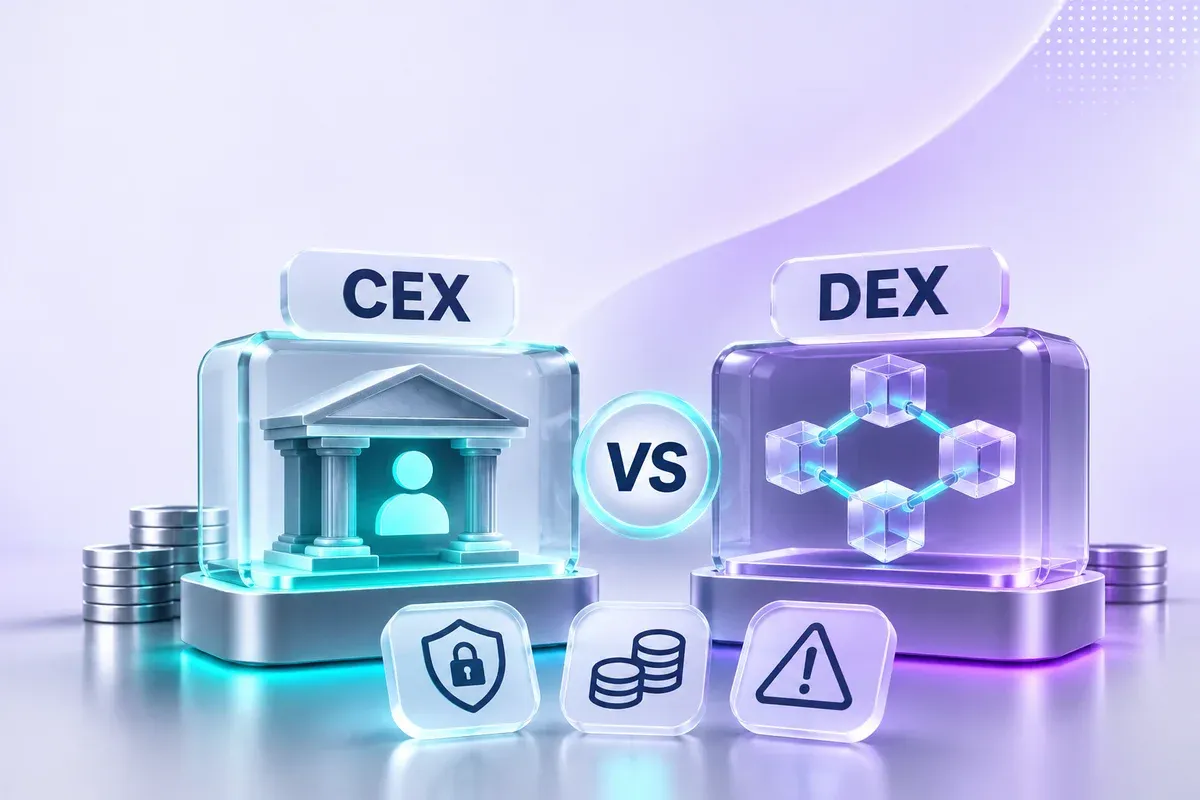
CEX vs DEX is a choice between a centralized venue that holds assets and matches orders through an intermediary and a decentralized venue that settles trades through smart contracts.
That design difference shapes custody, fees, liquidity, ease of use, and the risks you take.
This guide compares both venues in a clear table and turns the trade-offs into profile-based decisions.
Key Points
- Custody: CEX holds assets through a platform account, while DEX puts control in your wallet and smart contracts.
- Fees: CEX charges trading and withdrawal fees, while DEX adds network gas, slippage, and protocol fees.
- Liquidity: CEX often runs deeper for large orders, while DEX can lead in new assets and across protocols.
- Ease: CEX suits beginners with KYC and guided interfaces, while DEX requires wallet and gas knowledge.
- Risk: CEX carries custody and regulatory risk, while DEX carries contract bugs, thin liquidity, and wallet errors.
Cex and Dex at a Glance
Both are trading venues, but the control point differs. A CEX acts as the intermediary and account manager. A DEX relies on your wallet and smart contracts to settle trades.
• Intermediary and Order Book
On a CEX, user orders are collected in the exchange order book. The platform matches buys and sells, then records balances inside your account. The experience feels like a banking app, but you depend on the exchange's operations and controls.
• Smart Contracts as the Matchmaker
Many DEXs use automated market makers instead of a traditional order book. Trades execute against liquidity pools, and smart contracts set the price based on pool ratios. Execution can differ from the quote because the pool changes as you trade.
• Wallet as Identity
On a DEX, your wallet is both identity and vault. You sign transactions yourself, pay gas, and protect the seed phrase. A small mistake with network selection or token approval can make funds difficult to recover.
Custody: Who Holds the Assets
Custody is the core CEX vs DEX difference. Whoever controls the private keys controls access, recovery options, and the type of risk you carry.
• Centralized Custody
On a CEX, the exchange holds assets in its wallets while your account shows a claim on those assets. This makes trading and account recovery easier, but you carry platform, operational, and account freeze risk. Check security policies before funding.
• Self Custody
On a DEX, you hold the private key and bear full responsibility for the wallet. No support team can reverse a signed transaction or restore a lost seed phrase. This freedom suits users who understand operational security and transaction signing.
• Practical Consequences
Use CEX custody for funds you actively trade and keep long term holdings in a separate wallet. Store the seed phrase offline and test recovery before relying on it. Separating operating funds from savings reduces the impact of one mistake.
Fees: the Cost Stack Explained
The visible trading fee is only one part of the cost. CEX and DEX charge through different components, and the cheapest headline number may not be cheapest overall.
• Trading Fees and Spread
A CEX may show maker and taker fees, plus spread on some pairs. Active traders feel these costs quickly because they compound across many trades. Compare fee tiers, spreads, and execution quality, not just the advertised fee.
• Deposit and Withdrawal Costs
Funding and withdrawal methods can carry fees, minimums, or network charges. Fiat rails may have separate limits from crypto networks. Check the full cost before moving funds because small fixed fees hurt small transactions the most.
• Gas, Slippage, and Protocol Fees
A DEX trade can include network gas, protocol fees, and slippage. Slippage appears when the price moves before confirmation. With thin liquidity, slippage can cost more than the trading fee you expected to pay.
Liquidity and Order Execution
Liquidity decides how easily an order fills without moving the price too far. CEX liquidity sits in order books, while DEX liquidity is spread across pools and chains.
• Order Book Depth
A deep order book helps large orders fill in smaller pieces. Depth can change quickly when volatility rises, so a snapshot is not enough. Check several price levels and the estimated average fill, not only 24 hour volume.
• Dex Market Fragmentation
DEX liquidity can fragment across pools, networks, and protocols. A small pool may show an attractive quote, but it can carry higher slippage and impermanent loss. Compare routes before executing, especially for less common tokens.
• Small Versus Large Orders
Small orders often work well on DEXs when a new asset has no CEX listing. Large orders usually benefit from CEX depth and familiar execution tools. Choose by order size and slippage tolerance, not by platform hype.
Ease of Use and Onboarding
For beginners, usability often matters more than advanced features. CEX and DEX start with very different first steps and support expectations.
• Cex Signup Flow
A CEX usually requires account registration, identity verification, and security setup such as two factor authentication. These steps add friction but provide guided recovery and support channels. Most beginners understand this flow faster than wallet setup.
• Dex Wallet Setup
A DEX starts with wallet creation, seed phrase storage, and network awareness. There is no identity verification, but security responsibility sits fully with you. One storage mistake can become permanent and expensive.
• Help When Something Breaks
CEX platforms usually offer support tickets and account recovery procedures. DEXs rarely provide centralized support because transactions live on chain. Read documentation and test small transfers before using a new wallet or protocol.
Main Risks and Mitigation
Neither venue removes risk. The goal is to know which risk you are accepting and how to limit the damage if something goes wrong.
• Custody Risk
With a CEX, you depend on the operator's security and integrity. Account freezes, withdrawal delays, or platform incidents can limit access to your assets. Use reputable services, enable account security, and avoid keeping all funds on one exchange.
• Smart Contract Risk
With a DEX, contract bugs, pool exploits, or excessive token approvals can drain a wallet. Check audits, protocol reputation, and approval limits before trading. Use a separate wallet for experiments so main holdings stay isolated.
• Liquidity and Slippage Risk
Thin liquidity can push execution far from the expected price. This often appears in new tokens or small pools. Set slippage limits deliberately and avoid forcing trades when the market is too quiet.
• Regulatory and Compliance Risk
Centralized venues operate under changing identity and reporting rules. DEXs face different jurisdictional questions and compliance approaches. Monitor official announcements and understand the tax treatment in your location.
Choosing by User Profile
No venue wins for everyone. Start with transaction size, risk tolerance, and technical comfort, then pick the venue that fits that combination.
• Beginners and Active Users
If you are starting out, a CEX offers guided onboarding, account support, and simpler funding. Keep balances limited and learn security basics first. A DEX becomes easier after you understand wallets, gas, and approvals.
• Active Traders and Large Orders
Active traders often need fast execution and deep liquidity. A CEX can be more efficient for large orders and position management. Review market depth, fees, and the exchange's operating history before funding at scale.
• New Assets and DeFi Users
Users chasing new assets or DeFi features may prefer a DEX because access is more open. The trade-off is contract risk and thin liquidity. Start small and verify token contracts through official sources.
Quick Comparison Table
This table summarizes the main differences without declaring one venue the absolute winner. Use it as an early filter before checking details on your chosen platform.
| Factor | CEX | DEX | Reader Implication |
|---|---|---|---|
| Custody | Exchange holds assets in your account | You control the wallet | CEX is easier, DEX gives control |
| Fees | Trading, spread, deposit, withdrawal | Gas, slippage, protocol fees | Compare total cost, not one fee |
| Liquidity | Central order book, often deep | Fragmented across pools | Large orders need depth checks |
| Ease | KYC and guided interface | Wallet, seed phrase, network | Beginners need practice first |
| Risk | Custody, operations, regulation | Contract, wallet, liquidity | Mitigation differs by venue |
| Speed | Fast once funded on exchange | Depends on network confirmation | Not a guarantee of instant fills |
Decision Checklist Before Trading
Before sending funds, run a short checklist. It reduces expensive mistakes, especially when moving between CEX and DEX.
1. Define the Transaction Goal
Write down whether you are trading short term, holding, or testing a new protocol. The goal determines custody needs, liquidity requirements, and transaction frequency. Without a clear goal, you may choose a venue just because it is trending.
2. Check Custody and Account Security
Know who controls the private key and how account recovery works. Enable two factor authentication, store seed phrases offline, and separate experimental wallets. Basic security matters more than chasing the lowest fee.
3. Calculate the Full Cost
Add trading fees, spread, gas, withdrawal costs, and potential slippage. Compare the total for the amount you will actually trade. On small transactions, fixed costs can erase most of the expected gain.
4. Test with a Small Amount
Send a small amount first to verify the address, network, and confirmation process. After success, move a larger amount. This habit is especially useful with a new wallet or protocol.
5. Plan the Exit
Decide how you will withdraw funds, including the network and withdrawal fee. An exit plan prevents panic when the market moves fast. Do not focus only on how to enter.
Conclusion
CEX and DEX serve different needs. A CEX offers convenience, account support, and often deeper liquidity, but you accept custody risk. A DEX gives control and broader access, with wallet responsibility and smart contract risk. Choose by profile, order size, and your ability to manage risk, not by which platform is loudest.
FAQ
What is a CEX in crypto trading?
A CEX is a centralized exchange that holds user assets and matches orders through internal systems. You use a platform account, usually complete KYC, and trade through the exchange interface. Because the exchange controls custody, check its reputation, account security, and withdrawal policies before funding.
What is the main difference between CEX and DEX?
The main difference is custody and execution. A CEX acts as intermediary and asset custodian, while a DEX uses wallets and smart contracts to settle trades. That split affects fees, liquidity, support, and the risks you carry.
Which is safer for beginners, CEX or DEX?
A CEX is usually safer operationally for beginners because it provides guided accounts, identity checks, and support channels. It is not risk free because the exchange holds assets. A DEX is harder because you manage seed phrases, networks, and token approvals yourself.
When should I choose a CEX?
Choose a CEX when you need deep liquidity, large order handling, fiat conversion, or account support. It also suits users who want a simpler trading flow. Keep only a limited balance on the exchange and enable two factor authentication.
When does a DEX make more sense?
A DEX makes sense when you want self custody, access to tokens not listed on a CEX, or DeFi features. Before trading, check contract audits, pool liquidity, and slippage. Start with a small test trade, such as below 5 percent of the funds you are willing to risk.
How do I choose a venue based on my profile?
Map three factors: order size, risk tolerance, and technical comfort. If you trade often and want support, a CEX may be more practical. If you are comfortable with wallets and want full control, a DEX may fit better. Avoid keeping all funds in one venue without a backup plan.
Choose Your Venue by Profile
Understanding the rules and risks is a useful first step before comparing investment options. When you feel ready, Mobee, operated by PT CTXG Indonesia Berkarya and licensed and supervised by OJK, offers beginner-accessible digital-asset choices with eligible options from IDR 10,000 depending on the product and deposit method.
Disclaimer
This article is for education only, not financial advice. Digital assets carry risk. Do your own research (DYOR) before making investment decisions.
 Direct market access from the app
Start exploring digital assets with Mobee
Track the market, learn about digital assets, and start trading more conveniently with the Mobee App.
Mobee is licensed and supervised by the OJK. Not a solicitation to buy or sell any asset.