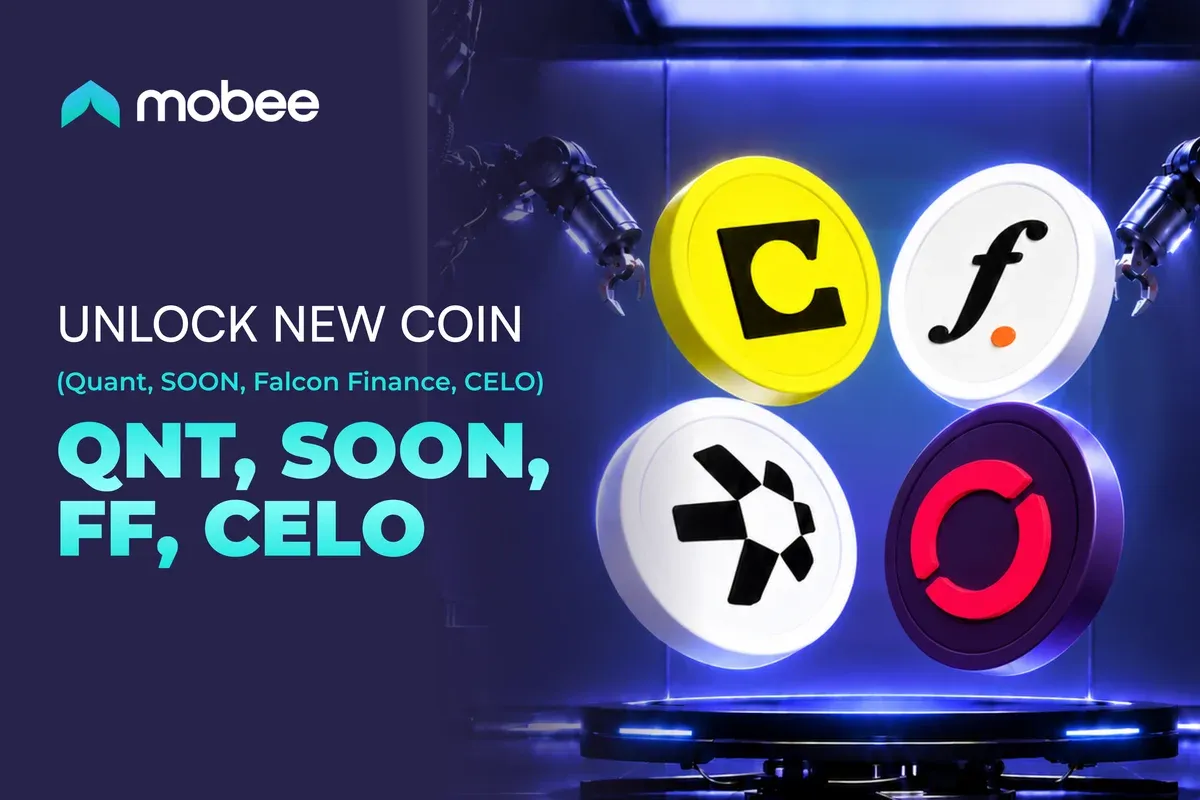
Newest Coin Listings: QNT, SOON, FF, and CELO
Hello, Sobee!
Mobee is adding four new assets representing four different sectors: institutional interoperability infrastructure, an SVM-based layer-2 network, a synthetic dollar protocol, and a mobile-focused payment network.
These four assets are not the same type of project. Understanding their different sectors matters before buying because the factors that influence each token's price are also different.
All data in this announcement is accurate as of October 1, 2026 and may change.
Four New Assets on Mobee
| Token | Network | Sector | Main Token Utility |
|---|---|---|---|
| Quant (QNT) | Ethereum, ERC-20 | Institutional interoperability | Network access fees and enterprise licensing |
| SOON (SOON) | Ethereum ERC-20 and Solana SPL | Layer-2 network | Network fees, governance, staking |
| Falcon Finance (FF) | Ethereum, ERC-20 | DeFi, synthetic dollar | Governance and protocol incentives |
| Celo (CELO) | Celo, Ethereum layer-2 | Payments and stablecoins | Transaction fees, staking, governance |
Getting to Know the Four Assets
1. Quant (QNT)
Quant is an interoperability layer designed to connect different blockchains, primarily for institutional use rather than retail users.
Its core product, Overledger, provides a standardized interface that allows one system to communicate with multiple blockchains without requiring changes to the underlying blockchains.
Its target users include banks, payment networks, and government systems. QNT is used for network access fees, enterprise licensing, and developer usage fees.
Among the four assets in this announcement, QNT has the largest market capitalization at approximately US$3.52 billion and ranks around 30th.
Its maximum supply is 14,881,364 tokens, with approximately 12,072,738 tokens already in circulation, or around 81%.
2. SOON (SOON)
SOON brings Solana's execution environment to other networks.
Its approach separates the Solana Virtual Machine (SVM) from the consensus layer, allowing transactions to be processed quickly while settlement and security rely on Ethereum as the base layer.
Its ecosystem consists of three main components: the mainnet, tools for launching new rollups, and a cross-chain messaging protocol.
SOON is used for network fees, governance, builder incentives, and staking.
Its initial supply is 1 billion tokens, with approximately 186.9 million tokens currently in circulation.
Its price is highly volatile. SOON has risen around 140% over the past seven days, but remains approximately 91% below its all-time high.
3. Falcon Finance (FF)
Falcon Finance is a protocol that issues USDf, an overcollateralized synthetic dollar.
Users deposit assets as collateral to mint USDf. Staked USDf becomes sUSDf, which generates yield from strategies described as market-neutral.
Its collateral includes stablecoins such as USDC and USDT at ratios close to one-to-one, major assets such as BTC and ETH with larger buffers, and certain tokenized real-world assets.
FF is used for governance and incentives rather than as collateral for USDf itself.
Its maximum supply is 10 billion tokens, with approximately 3.14 billion tokens currently in circulation, or around 31%.
This means its fully diluted valuation is roughly three times its current market capitalization. The token unlock schedule is therefore an important factor to review before buying.
4. Celo (CELO)
Celo is an Ethereum layer-2 network designed for mobile payments, with a focus on emerging markets.
Its block finality is around one second, while transaction fees are generally below one U.S. cent.
One feature that sets Celo apart is that users can pay transaction fees using stablecoins instead of having to hold CELO first.
This can reduce a common barrier for new users.
The network also supports multi-currency stablecoins such as cUSD and cEUR.
CELO is used for transaction fees, staking, and governance.
Its maximum supply is 1 billion tokens, with approximately 606.86 million tokens currently in circulation.
Available Trading Pairs
| Asset | Trading Pair | Price as of October 1, 2026 | 24H Change |
|---|---|---|---|
| SOON | SOON/IDR | Rp8,030 | +0.01% |
| Falcon Finance | FF/USDT | 0.12621 | -0.53% |
| Celo | CELO/IDR | Rp1,811 | -1.25% |
| Quant | QNT/IDR | Coming soon | Coming soon |
If your balance is in Indonesian rupiah, an IDR trading pair may offer a simpler route because you do not need to buy a stablecoin first.
Learn more in our guide on how to buy crypto for beginners.
What to Consider Before Buying
The four assets have different risk profiles. QNT has a larger market capitalization and a longer track record. SOON and FF are significantly smaller, which means their prices can move more sharply. Using the same position size for all four assets does not automatically mean you are diversified because their risk profiles are different.
Pay attention to the amount of supply that has not yet entered circulation. Only around 31% of FF's supply is currently circulating. Tokens that have not yet entered the market may be released according to the project's unlock schedule and could create additional selling pressure.
Liquidity in newly listed trading pairs may still be limited. Bid-ask spreads can be wider than those of assets that have been listed for longer, while large orders may have a greater impact on price.
A sharp short-term increase does not guarantee that the trend will continue. SOON has risen around 140% over the past week. Moves like this may attract attention while also increasing the risk of buying after a significant price increase.
Learn more in how to avoid FOMO during a bull market.
Decide your position size before buying. Adjust the amount you invest according to your individual risk profile and strategy.
Read more in our guide to crypto trading risk management.
Start Trading
You can now find these four assets in the Mobee app.
Deposit Indonesian rupiah, choose an available trading pair, and start with an amount that matches your risk profile.
Start trading QNT, SOON, FF, and CELO today and discover more opportunities in the world of digital assets with Mobee.